
OpenAI Hates You
OpenAI hates you. Yes… That OpenAI… One of the tight-swimsuit glamour-girls of artificial intelligence, a company that sells the future in large language models, while enjoying access to Washington and even the White House. Plus, it now bears an odious aura of a Justice Department settlement for shutting American workers out of jobs.
Bottom Line: OpenAI… Hates… Your… Guts.
And in this note, I’ll explain why…
Whoopsie! No Qualified Americans…
According to the U.S. Department of Justice (DOJ), OpenAI and subsidiary Statsig recently agreed to a $3.2 million settlement over allegations that they discriminated against U.S. workers during the Permanent Labor Certification process, or PERM.
Don’t dwell on the lowball number; for Silicon Valley, $3.2 million is pocket change. But as a public marker, the settlement speaks volumes: one of America’s most celebrated AI companies was accused of favoring low-cost, imported visa labor over American applicants.
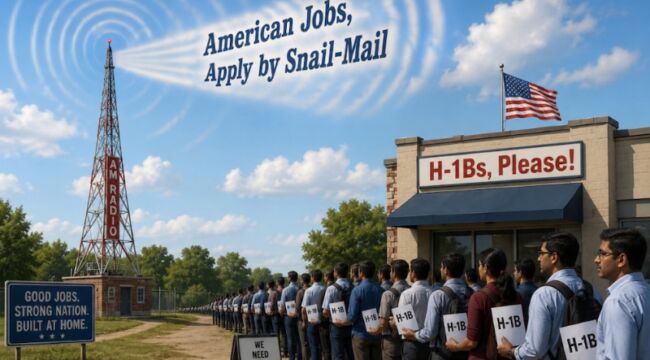
The facts are disgusting, to the point of loathsome. According to DOJ, OpenAI did not advertise a series of PERM jobs on its external careers site. Instead, it sought U.S. workers via late-night, AM-radio ads that required paper applications by snail mail, while ordinary company hiring used modern electronic channels.
And whaddaya know? No Americans showed up. Then the foreign-worker pipeline moved along.
So, are you an American in tech? Did you go to school, “learn to code,” play by the rules and apply online like a normal person? Too. Bad. So. Sad. No. Job. For. You.
OpenAI denied wrongdoing (of course!). Still, it agreed to pay $1.2 million in civil penalties, a pittance, but also a de minimis level set by statute so we can’t exactly blame the DOJ lawyers. Plus, the company will create a $2 million back-pay fund, revise policies, train staff, accept electronic applications and submit to monitoring. More pocket change, really.
Still, though; this gives us a glimpse behind the curtain of widespread visa abuse and rank, pernicious discrimination against U.S. workers in their own country.
Tip of the Visa-Scam Iceberg
The facts of this settlement matter because PERM was never meant to be a paperwork tunnel to move visa workers into permanent U.S. jobs. It was supposed to promote good-faith efforts to recruit ready, willing and able U.S. workers.
But when the process becomes a corrupt Kabuki Theater of late-night notices, paper-only applications and hidden job postings, we’re not looking at a shortage of skills. It is a rigged, wired, anti-American system.
And clearly, OpenAI is not some bootstrap tech wannabe working out of mom’s garage. It rides a mainline track straight into Washington, D.C. It launched OpenAI for Government. It works with U.S. National Labs, the Pentagon, NASA, NIH, the Treasury Department and the General Services Administration; all up to and including highly classified workloads.
And yet… While OpenAI covets the American state, American data, American contract$, American legitimacy and American regulatory accommodation, it overtly discriminates against American workers.
And it’s not me saying it, but the U.S. Department of Justice.
America’s New Moral Equation
Every nation has a labor policy. Rome had slaves. The history book kingdoms of Medieval Europe had serfs and peasants. Imperial Britain had colonies.
Today, America has consultants, contractors, body shop operators, and HR departments whose role, far too often, is to make expensive American workers disappear and replace them with cheap, imported labor.
Never mind that Americans paid for the roads, schools, courts, government grants, power grids and defense budgets that built the platform on which these companies stand. The trick is to privatize the gain and socialize the losses.
Indeed, this recent OpenAI settlement illuminates a key moral point. That happily – and with ill-concealed greed – companies want the benefits of operating in America. They court the government, pitch national-security relevance… yet they treat American workers as one more cog in the wheel, just interchangeable line items in global labor inventory.
The answer ought to be straight out of Politics 101: if the federal government opens lucrative doors, companies must honestly work to recruit U.S. citizens before importing substitutes, if not visa-scabs.
And no, this is not an anti-immigration issue. It’s workforce policy, industrial policy, national security and culture. A nation that will not employ its own engineers, technicians, programmers, machinists and builders is liquidating its future.
The Myth of the “Talent Shortage”
As I’ve discussed before, for over 40 years, Americans were told that companies must import labor because the domestic pool is inadequate. The framing changes; it’s a “skills gap,” or “STEM shortage,” or we need “global talent,” and obviously we all want “the best and brightest.” But the result is the same.
Employers claim scarcity, government loosens the pipeline, and American workers discover that the “shortage” somehow leaves them with stagnant wages, layoffs, age discrimination, and young graduates who can’t get their first job except as a bartender or barista.
In essence, a rotten system incentivizes many firms to game the system and use imported labor as a substitute for hiring and training Americans or retaining experienced employees. But at this stage, when companies say they can’t find talent while refusing to hire young Americans or retain seasoned ones, the public isn’t fooled because – obviously! – the shortage is manufactured; it’s fake.
And this OpenAI outrage is just one example. Consider another company, Cognizant. It’s a major H-1B user and has faced repeated litigation alleging that its workforce practices disadvantage U.S. workers and favor visa-heavy staffing pipelines from India.
In fact, in March 2026, a New York jury awarded former Cognizant executive Jean-Claude Franchitti $8.4 million after finding unlawful retaliation tied to his complaints about discrimination and H-1B hiring practices. While other Cognizant cases have raised similar issues over staffing, promotion and termination patterns. And to be sure, legal details differ by company and case, but the theme is hard to miss: a visa-heavy, Indian-favored labor model has become a mechanism to sideline Americans.
Hollowing Out the Middle
By now, the visa gimmick is clear when you do the pattern recognition. Companies lay off higher-cost Americans and replace them with imported body shop staff based on (often) fake credentials from shady diploma mills. They lean on H-1Bs, outsourcing firms and recruiters. To add insult to injury, they next complain that no qualified Americans are available.
In a saner world, healthy companies depend on a solid middle: experienced employees who know the systems, midcareer people who can train the young, and junior employees who learn by doing. But break that chain and the company looks leaner but has become brittle.
On paper, payrolls fall and margins improve. In reality the business is often just performing an asset strip: it’s burning down the knowledge, judgment, safety habits, customer memory and the informal apprenticeships that keep complex systems alive.
In other words, a business school and management gimmick has become a widespread economic disease. Displaced Americans earn less, spend less and pay less tax. Communities lose good jobs. Families lose ladders upward. National competence weakens because practical knowledge no longer passes cleanly from one generation to the next.
Imported Labor, Bad Business and Local Consequences
The pattern is not limited to OpenAI or Cognizant. Microsoft is another example, with heavy criticism for layoffs while sponsoring thousands of H-1B approvals. Or consider household names like American Express, FedEx, IBM, HomeDepot and other large employers that have appeared in recent reporting over layoffs, outsourcing, visa sponsorship and replacement economics.
Each case has its own facts. But once American workers see layoffs paired with cheaper labor channels, they understand the game.
In communities built around technology, especially, lost jobs change everything: housing, schools, small businesses, tax collections and civic life. In the 1970s, we had the Rust Belt when major industries closed across the heart of the nation. Now, a so-called “tech” company might stick around as a corporate campus, but its economic value is lowered via cheap wages, if not outsourced labor or jobs routed through “temp-worker” channels. One way or another, less of the value-add falls and takes root in jurisdictions where the social costs remain.
And again, don’t view it as hostility toward foreigners. It’s more like pointing out that the obvious duty of a sovereign nation is to protect the economic health and prospects of its own citizens, and certainly its lawful workers. A country that refuses to draw that distinction teaches its people that citizenship has no practical meaning. We’re just one big, wide, free trade zone with no national purpose or meaning. And good luck with that!
Or look at it this way: at some point, Americans must ask what it means for a corporate entity to be an American company. A U.S. headquarters is not enough. Access to American stock and capital markets, courts, infrastructure, consumers, universities, defense contracts and subsidies should come with reciprocal obligations.
An American company should recruit Americans in good faith, train them where skills are scarce and retain them where institutional knowledge matters. It should not manipulate hiring processes to hide jobs from qualified U.S. applicants (like OpenAI and its AM radio ads; seriously?) or take public benefits while treating the U.S. workforce as disposable.
America’s vitality and strength must not be measured by how easily employers can replace citizens with foreign, low-wage workers. It should be measured by whether citizens can build careers and families in the economy their country sustains.
The Policy Response
The OpenAI settlement points toward policy responses. How about just freezing all visas? Don’t laugh it off.
One way or another, penalties must be large enough to change behavior. PERM recruitment should be transparent, digital and auditable. Visa vendors and labor brokers should be audited. Companies claiming shortages should show what they did to recruit, train and retain Americans first.
And definitely, Congress must revisit statutory damages and penalties. If the fine is smaller than the bonus generated by labor savings, the law becomes a dumb, little, nickel & dime toll booth along the economic superhighway. It’s like with U.S. automakers 50 years ago, and their “exploding gas tanks” (look it up); overtly, large firms simply priced gross, criminal misconduct into the business model.
Universities and other schools should face the same truth. It’s dishonest to tell young Americans to take several years and pay big bucks and study engineering, computer science or advanced manufacturing while employers design pathways around them. “Study STEM” becomes a cruel, expensive joke when the first rung of the ladder is removed.
Last Point: Culture Follows Work
Here’s the takeaway: work is not just a paycheck. It teaches discipline, responsibility, teamwork and confidence. It gives young people a place in their own country, if not the world, Plus, older workers have a reason and opportunity to pass along what they know. Remove the foundation of productive, remunerative effort, and the culture weakens.
America is playing with fire, here, with this “EZ-Visa” worker replacement regime. It tells Americans that the country wants their taxes, infrastructure, consumer spending, military protection and political consent… but not them as people.
And not to put too fine a point on things, it tells citizens that the politicians and corporate bubbas disdain them (if not hate them). And no republic can sustain that for long.
The OpenAI settlement is small in dollars but huge in meaning, while Cognizant is another burning road flare on the fuel load of social resentment. Add Microsoft, AmEx, FedEx, IBM, Home Depot and others to the news flow; it reminds us that layoffs followed by cheaper labor channels are not efficiency, only a greedy, chiseling business gimmick with national consequences.
The U.S. cannot bench its own citizens, outsource its memory, import an unacculturated and not-very-middle class, and then expect to remain strong. If America wants American industry, innovation and security, it must demand fair access to jobs:
- Hire Americans.
- Train Americans.
- Retain Americans.
- Promote Americans.
And when companies take the benefits of the American system while blocking Americans from the workplace, the policies, laws and courthouses must make the price high enough that the flinty, greedy, penny-pinching boardroom suits learn a stiff lesson about what citizenship is worth.
That’s all for now. Thank you for subscribing and reading.

Comments: