
Pam’s $2,300 Middle Finger
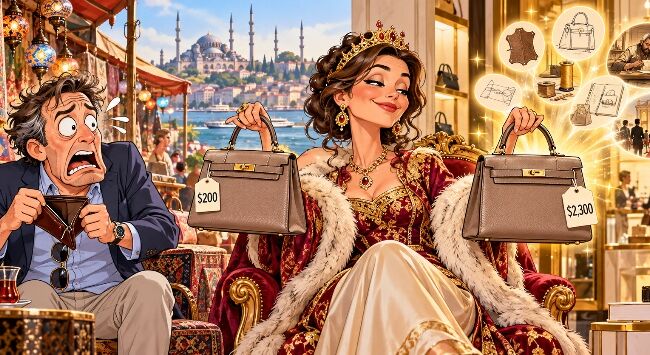
My darling wife Pam owns two Yves Saint Laurent bags (and a damn Gucci bag, but that’s another story). One of the YSL bags cost $200; the other, about $2,300.
The cheap one came from the Spice Market in Istanbul. It was obviously and openly a fake, and Pam loved it on sight. I thought buying it was stupid. But it was only $200, an amount I’m happy to pay for some peace.
She still has that bag. To my shock and wonder, it still looks as new as the day she bought it.
A few years later, we were in Copenhagen, and my Long-Haired General was upset with me, for a reason I don’t remember now and didn’t understand then. So while I was cooling off with a beer at a local bar, she marched into the YSL boutique and dropped $2,300 on the real thing, to my gasping horror.
I was furious, and I wasn’t just mad that she was making a point. I was livid because I don’t think those bags are worth that much.
So which one is better? I’ve stared at both, and for the life of me I couldn’t tell you. And that’s what bugs me. If the $200 bag looks as good as the $2,300 bag, what did the extra $2,100 buy?
Four Things, One Number
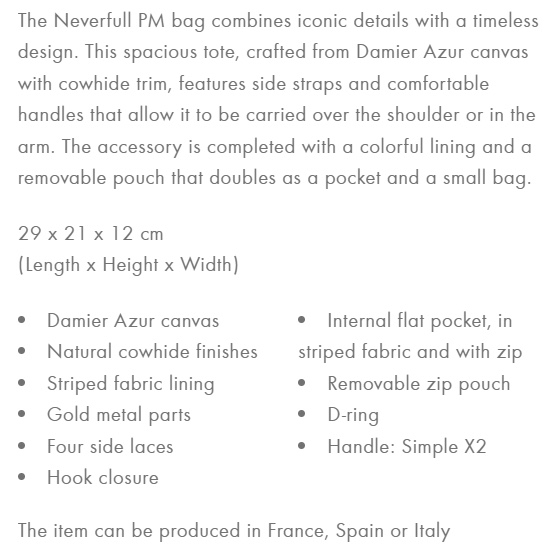
Here’s a fact I should read to Mrs. Ring: Louis Vuitton’s famous Neverfull MM sells for $2,290, and it doesn’t have a leather body. The company says so on its own website. It’s coated canvas with leather trim and a striped cloth lining. But it’s Damier Azur canvas, daaaahhhhling!
Credit: Louis Vuitton
LV isn’t hiding anything. So their buyers must be paying for something other than the stuff.
Well, What Then?
Every luxury price tag bundles four separate things.
First is the stuff: canvas, leather, thread, brass.
Next comes the design. How does it look, carry, and age?
Then, the company’s promise. Are skilled hands really making this product in an old workshop in Europe?
Finally, the name. It’s the thing your neighbor spots from across the parking lot.
This is the Bundle Trick. One big number covers all four, so the buyer lets the price vouch for each of them. If it costs that much, the craft must be real, and the workshop must be honorable. Right?
Another time, a woman in one of my classes in Abu Dhabi once told me Westerners were foolish. We pay far too much for the name on the jewelry, she said. People where she came from pay for the stones. They argue over the cut and clarity of the gem, not the label on the box.
She was describing the Bundle Trick. Perhaps people in a more ancient part of the world refuse to fall for it.
The Workshop Behind the Promise
The third part of the bundle, the promise, is the hardest to check. That’s why it’s worth checking.
In June 2024, a Milan court put Dior’s Italian manufacturing unit under court administration. I live an hour and a half down the road from those workshops. “Made in Italy” still means as much here as “Made in the USA” means in America.
Investigators examined four small Chinese-owned suppliers operating near Milan. Police found workers sleeping on site so the machines could run around the clock. They found safety guards stripped off machines to speed up output. According to court documents, one supplier charged Dior about €53 for a handbag that sold for €2,600.
Dior said those suppliers handled only part of the assembly, so €53 was only part of the cost. That may be true, but that’s not the point. Dior sells the image of master artisans in quiet ateliers. Some of its bags passed through rooms where people slept beside their machines.
Prosecutors pursued the suppliers’ owners, not Dior. But the court lifted the administration in February 2025 after Dior tightened its supply chain. Dior agreed to pay €2 million over 5 years to help victims of labor exploitation, as part of a deal with Italy’s competition authority.
The handbag’s price told the buyer nothing about the workshop. Somebody had to look.
The Swoosh on the Balance Sheet
The Bundle Trick works on shareholders, too.
Nike’s shareholders bought a bundle of their own: the swoosh, the growth, and the fat margins. For years, they let the logo vouch for all three.
On June 28, 2024, Nike shares tanked 20%. New running brands like Hoka were taking heaps of NKE’s disgruntled customers. In 2025, NKE’s top line had fallen by 10% and net income was down 44%.
Last week, NKE tanked again after the market was unimpressed with its latest quarterly report.
The swoosh is still the most famous logo in sports. But customers and investors pay for different things. Customers pay for what the logo means today. Investors pay for the cash it’s supposed to throw off tomorrow.
Wall Street treated the logo as a moat. It turned out to be a reputation, and reputations need defending everywhere and always.
Nike does have a repair plan. It’s called Pace, and it promises $2.5 billion in savings. The size of that number got the headlines. When the savings finally arrive tells you how deep the hole is. (If you haven’t already, read more about Nike’s woes in this morning’s Rude.)
“Shanghai, $200”
Another time I was in Abu Dhabi, a buddy showed me his Rolex Batman, the one with the blue and black bezel. I loved it. I told him how badly I wanted one.
He looked me straight in the eye and said, “Shanghai, $200.”
I almost fell over. I’m not a watch expert, but I couldn’t tell. It looked perfect to me.
That’s where a rumor you may have heard comes from. People say most Rolexes are secretly made in China. Nobody has produced evidence for it. Rolex says it makes, assembles, and tests its watches in Switzerland. What the back alleys of Shanghai make are copies, but very good ones.
(As a side note, another banker buddy of mine once told me that the Chinese knock-off Panerais are better than the originals, but I have no proof of that, either. Still, that people think so must keep Western CEOs up at night.)
Feel free to poke at the brands, but poke at their critics, too. A copy that fools your eye doesn’t prove the original is a copy.
The Case for Prestige
Now let me argue Pam’s side, because it’s a fair one.
Raw materials are never the whole product. A Steinway piano isn’t worth the price of its wood and wire. And a buyer can prize beauty or heritage for its own sake. No one buys a Ferrari for the gas mileage.
Value lives in the mind of the person paying. The first lesson of the Austrian School is that all value is subjective. That’s correct, no matter how ridiculous it may feel to some.
But a preference and a promise aren’t the same thing. “I love how this looks” can’t be wrong. “Craftsmen in Italy made this under fair conditions” can be. One is taste. The other is a claim of fact, and you can check it.
Wrap Up
Before you pay anything, whether it’s for a handbag, a sneaker stock, or a fund with a famous manager, unbundle the price. Check the claims. Would you still want it without the name?
My Empress knew what she was buying in Copenhagen. It was a point, and boy, did she make it!
Buy the design. Buy the craftsmanship. Buy the status, if that’s what you want.
Just know which one you’re paying for.

Comments: