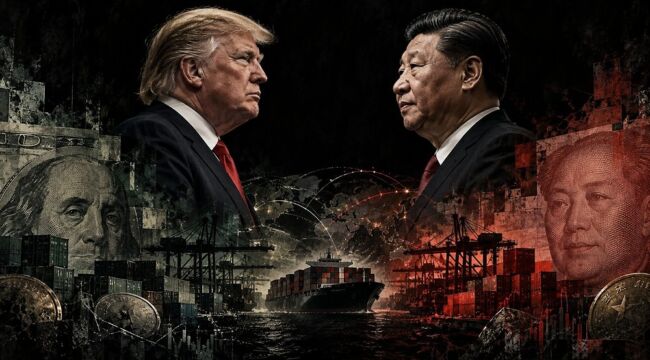

Face-Off: Trump vs. Xi
President Trump hosted Chinese President Xi Jinping for a multi-day state visit beginning Sept. 23. There were a number of interesting aspects to this summit that call for closer examination. And they’re not the features most analysts explored.
Xi is the president of China, but that’s not his most important role. He’s also the General Secretary of the Central Committee of the Chinese Communist Party (CCP) and Chairman of the Central Military Commission.
In China, the state ranks third after the party and the military when it comes to power. Americans tend to gloss over Xi’s CCP role, but in China, nothing is more important. The party is what matters. Government is simply a means to an end, which is the perpetuation of the CCP.
The summit took place in Washington, D.C. That’s not surprising for a visit by Xi to see Trump, except for the fact that the annual U.N. General Assembly (UNGA) meeting was taking place in New York at the same time. Xi did not bother going to the UNGA, even though New York is only about a 60-minute plane trip from Washington.
Xi’s itinerary says something about the rise of a multipolar world and the unilateral power of the U.S. and China, in contrast to the globalized worldview that prevailed from 1994 to 2018. The one-world view promoted at the U.N. is becoming irrelevant, even as the superpowers (China, the U.S. and Russia) go their own way and ignore the U.N. except when some U.N. resolution proves convenient.
When Ceremony Is the Substance
One critique of the summit offered by the legacy media (bearing in mind the media attacks almost everything Trump does) is that it was heavy on ceremony and light on substance.
We’ll look at the substance next, but that critique misses the point and reveals the media’s ignorance about how things work in China. In China, the ceremony is the substance. Putting on a good show offers respect for the visitor, casts the host in a favorable light and allows the guest to gain face. These matters are not trivial.
I’ve spent extensive time in China, Japan and South Korea over the past 40 years. I’ve visited over a dozen cities in China, including cities in the western and northern regions far from Beijing and Shanghai. I understand the importance of face.
We don’t have an exact cultural equivalent in Western culture, but it’s a unique blend of respect and status. By offering face to Xi, Trump was able to solidify the working relationship between the two greatest powers on Earth.
Trump did several things along these lines. He met Xi as he disembarked from his plane at Joint Base Andrews. Typically, a foreign leader is met at the airport by a delegation and is greeted later by the president at the White House. The symbolism behind the airport greeting was huge.
Trump then personally escorted Xi through the West Wing of the White House and gave him a tour. I’ve been in the West Wing on official business a number of times dating back to 1974. It’s a lot smaller than people imagine, definitely smaller than the sets you see on TV.
Trump organized a photo gallery of past presidents. When you get to the place for Biden’s photo, there’s no headshot. Instead, there’s a picture of Joe’s autopen. Xi and Trump had a laugh about that. (Seems likely that Jill Biden was not amused.)
This was all topped off with an elaborate state dinner in the East Room of the White House. (Trump’s new ballroom on the site of the former East Wing is not finished yet, but it’s going up fast.)
Not every leader gets a state dinner. Most leaders get a photo op in the Oval Office, a little face time with the president and that’s about it. Xi got the Full Monty.
There is little doubt that Xi was suitably pleased with his reception and the hospitality extended during his visit to Washington, D.C. There is enormous tension in the U.S.-China strategic relationship at the moment. Taking steps to reduce the tension and improve communications was well advised.
Beyond the ceremony, there was some substance to the summit. Just ahead of the meetings, Treasury Secretary Scott Bessent announced that an existing trade truce between the U.S. and China that was set to expire on Nov. 10 will be extended until Jan. 10, 2027.
By itself, that extension does not resolve open issues, but it does prevent trade relations from getting worse in the meantime.
The U.S. and China also agreed on a framework that could provide more favorable tariff treatment for about $30 billion of imports in each direction. The agreement covered mostly “non-sensitive” goods.
For U.S. imports, those goods include consumer products such as small appliances, toys, holiday decorations and children’s car seats. For U.S. exports, they include agricultural goods, fish and seafood, logs and wood products, cosmetics and medical devices.
Still, these tariff concessions were underwhelming. They did not resolve the most contentious trade issues involving rare earths, high-tech magnets, soybeans, semiconductors and other advanced technologies.
One potentially important development involved NVIDIA’s RTX Pro 5500 chip. China was reported to be considering allowing domestic companies to purchase the chip, although approval had not yet been confirmed. Interestingly, NVIDIA CEO Jensen Huang attended the White House state dinner for Xi.
The most politically sensitive issues, including weapons sales to Taiwan and Iranian oil sales to China, either produced no publicly announced breakthroughs or were not the subject of any public acknowledgment.
So, the accomplishments at the summit were modest, even if the protocol was brilliant. The main accomplishments were the things that didn’t happen. Relations did not get worse and the trade truce did not end. The two sides are still talking, and that’s a positive result in itself.
The Truce Lasted About a Week
That said, the improved vibe didn’t last long.
Just one week after the summit, Chinese refiners suspended exports of gasoline, diesel and jet fuel to destinations outside Hong Kong and Macau as Beijing moved to protect domestic supplies. It was not immediately clear how long the restrictions would remain in place or whether exports would resume after China’s Golden Week holiday ended Oct. 7.
That move was not specifically aimed at the United States. There is a global diesel shortage. Russia has also sharply restricted exports of diesel and other refined fuels as Ukrainian attacks have disrupted Russian refining capacity and Moscow has moved to protect domestic supplies.
Trump had also floated the possibility of restricting U.S. diesel exports as prices surged, although on Oct. 2 he said there would be no U.S. diesel export ban.
Still, there is direct damage to the United States. Diesel trades on a world market, so reduced supply anywhere can translate into increased prices everywhere. The Chinese move could exacerbate inflation in the U.S. and hurt Republican election chances in the midterm elections on Nov. 3.
Meanwhile, U.S.-China tensions remain high around a long list of issues, including Chinese military maneuvers near Taiwan, China building artificial islands by dredging in the South China Sea, U.S. restrictions on high-end chips going to China and Chinese restrictions on rare earths going to the U.S.
There will be more Trump-Xi summits in the months ahead. It’s unclear if the most difficult issues can be resolved. A return to full-scale trade and currency wars is certainly possible.
The best that can be said for the recent summit is that things did not get worse and the two sides are still talking. For now, that’s as good as it gets.

Comments: