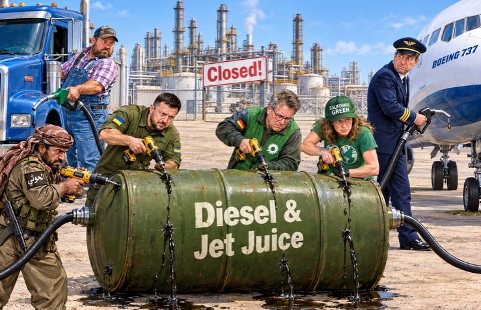

The World Has Oil, but Not Enough Refining
“The world runs on diesel,” goes the saying.
And “Houston, we have a problem,” goes another saying.
So today, we’ll discuss diesel (and its molecular cousin jet fuel). But first we’ll talk about oil. And oh by the way, when was the last time you bought a barrel of crude oil? Probably never.
Let’s dig in…
What’s In Your Tank?
You don’t buy crude oil. You buy gasoline or diesel, right? And lubricants like motor oil. And items made of plastic (almost everything anymore) or other petrochemicals. Or when you fly, a big whack of the ticket price is jet fuel. Plus, much of the food in grocery stores was fertilized in the field or bug-sprayed with goop made from oil or natural gas derivatives. I could go on but you get the idea.
So, you use oil products; but no, you never buy crude oil. Your purchases are far downstream from the pumpjack out in the prairie. Still, people watch the price of crude oil because it’s the headline number. But again, crude is only raw material.
This distinction matters because the world is not “running out of oil,” or some variation on that scary headline. The world is short of refinery capacity; turning crude oil into products that people actually buy.
Another way to say it is that the economic motive force of the Oil Biz is what happens after crude moves through a refinery and comes out as diesel, jet fuel, heating oil, lubricants, naphtha, petrochemical feedstocks, asphalt and hundreds of other necessary materials.
Refining is a business, of course. And refiners watch the price spread between crude and finished fuel because that’s where the money is made or lost. Specifically, people watch what’s called the “crack spread,” which the U.S. Energy Information Administration describes as the difference between the purchase price of crude oil and the selling price of finished products such as gasoline and distillate fuel.
Along these lines, one common refining metric is “3-2-1,” which is a way of explaining how three barrels of crude become two barrels of gasoline and one barrel of distillate. (Although any chemical engineer can tell you long stories about what really happens in those cracking towers.)
The 3-2-1 idea seems simple, but behind it is the uncomfortable fact that the energy-conversion system – aka refineries – has been thinning out for many years. For example, between 2009 and 2024, Europe closed roughly 30 refineries, with more capacity scheduled to disappear this year and next.
The U.S. has also closed refineries, with California in the lead; from over 40 refineries in the Golden State in the 1980s, to seven today (two of which are biodiesel that process French fry grease and similar). Indeed, as I’ve discussed in the past, California is a fuel island, tied to a limited set of local plants and distant replacement cargoes.
Goldman Finds the Choke Point
That brings us to a “choke point” issue that Goldman Sachs flagged in a recent note: the world’s biggest energy problem is not lack of crude in the ground or at wellheads, but refined products coming out of the world’s refineries.
Goldman’s conclusion was that diesel sat “at the epicenter of the supply squeeze.” And this past summer the reality of global energy markets has proved the theory. Consider how Russia has “temporarily” halted diesel exports after repeated refinery strikes and its own domestic fuel shortages; this is on top of previous Russian diesel and gasoil restrictions for export.
Absent Russian energy exports, European diesel prices rose roughly 40% during the past summer price squeeze, and now prices are sky-high just as harvest demand and the winter heating-oil season approach.
Plus, just in the past two weeks Saudi oil and refined fuel exports have been essentially shut off due to conflict with Houthis in neighboring Yemen; I discussed this last week. In fact, Saudi has told buyers in Europe to expect zero oil and fuel for the rest of September and into October; which means a dramatic shortage of refined products by November.
You see the point, yes? The energy problem is no longer as simple as “we just need more crude oil.” It has moved downstream to the refinery level. When refinery output falls in Russia, when Persian Gulf facilities or shipping lanes are disrupted, and when aging Western plants shut for good, the world does not merely lose barrels on paper. It loses diesel for trucks and tractors, jet fuel for aircraft, heating oil for winter, lubricants for engines and factories, and feedstocks for plastics, solvents, resins and chemicals.
This is why the story is bigger than one trade, meaning the price of a barrel of petroleum. It’s a warning about global energy flows tightening at the refined-product level.
Why This Is Bigger Than Diesel
At the beginning, I cited the old saying that the world runs on diesel. And right now, the shortage of diesel and jet fuel is the brightest distress flare in the sky when it comes to energy. Diesel powers freight, farms, construction, mining and backup generation. In much of central and northern Europe, as well as in New England here in the U.S., the same middle portion of the barrel also supplies heating oil.
Meanwhile, jet fuel and kerosene compete for many of the same molecules down at the refinery. Push airline demand higher, and refiners may favor aviation margins while leaving the diesel pool thin.
And don’t forget lubricants, which depend on specialized base-oil units and cannot be replaced by simply pouring extra crude into a tank. Then come asphalt, waxes, sulfur, naphtha and the chemical intermediates behind packaging, synthetic fibers, fertilizer and industrial materials.
That is what insiders call the Diesel Floor. If the truck that hauled your groceries paid a fortune for fuel, the extra cost arrives on the shelf as supermarket sticker shock. If the aircraft carrying high-value freight pays more for jet fuel, the bill moves through logistics. If a mine, steel mill, railroad or machine shop cannot source the proper lubricant, equipment overheats or stops. Scarcity in these products is not cosmetic. It is a tax on motion.
Russia and the Middle East Are the Same Problem
Now, we get to geography and the world’s missing barrels. Think of conflict in Russia and the Middle East as two parts of the same problem. And don’t be confused: much of the media wants to separate these two stories. That is, Middle East troubles are treated as a crude and shipping problem due to Houthis, a subset of U.S.-versus-Iran. And Russia is treated as a sanctions and war problem.
But for diesel and downstream materials, Russia and the Middle East are the same problem; namely, conflicts that result in lower flows of fuel to world markets. Russia’s refinery damage and export restrictions squeeze one major stream of middle distillates. Gulf conflict squeezes another.
All this, while tanker traffic through Hormuz has remained dangerous and disrupted; and attacks on Saudi energy infrastructure have shown that bypasses like the East-West pipeline are not magic solutions. Add to the fact that numerous of Saudi’s giant refineries have been repeatedly attacked.
India and the U.S. can still send barrels to thirsty markets. But first, you need tankers which are, just now, hard to find. Plus, shipping oil or products from a distant refinery raises fuel costs, plus extra for insurance, financing and transit risk. And the crude oil or refined product may also be the wrong specification for a particular local market. That is how a regional outage becomes a global price: the marginal buyer must reach farther, wait longer and pay more.
Germany Shows What Tight Energy Flows Do
Germany shows what tight energy flows look like; in essence, scarcity can choke a major industrial economy. Across Deutschland, thousands of small, medium and large businesses are scaling back or closing due to energy costs and availability. Volkswagen, for example, is laying off over 100,000 workers.
Plus, Europe now enters winter months when its industries need gas and power, while its freight system, farms and many heating systems need middle distillates. If diesel is already expensive before furnaces come on, winter demand adds stress to the system; indeed, it reveals how little slack there was all along.
That pressure shows up everywhere: at the pump, in power prices, in chemical plants, in plastics, in fertilizer, in logistics and in the auto supply chain. And to be fair, energy is not the only source of German industrial stress (i.e., Chinese imports are causing problems); but energy is the cost floor under the entire system.
Now connect that back to Russia and the Middle East. If Middle East trouble lifts oil and refined prices, or LNG prices, or simply threatens tanker routes, Germany pays. If Russian refinery outages and export restrictions remove diesel from the global market, Germany pays. If global crude-derived feedstocks tighten, Germany’s manufacturers pay before the average consumer even notices. This is how the shortage moves: from pipeline to tanker, from refinery to truck, from fuel invoice to factory gate.
Why the Fed Cannot Print Diesel
And this is not to beat-up on Germany; but that nation’s industrial policies and so-called “green” politics has a dire message for everyone else: when fuel, gas, feedstocks and freight all rise together, inflation stops being a monetary abstraction and becomes a physical bottleneck.
Central banks can print money, but they can’t print diesel fuel. Brussels can coordinate stock releases, subsidize bills and ask consumers to conserve. European Commission President Ursula von der Leyen put the fallback plainly in April: “The least expensive energy is of course the energy we do not use. We should reduce demand.”
Well, okay; but try telling a farmer to harvest without fuel, an airline to fly without jet fuel, or a machine shop or factory to run without lubricant for the rotating equipment. And yes, food is cheaper when you don’t eat it. And didn’t Marie Antoinette say something about, “If the peasants have no bread, then let them eat cake”? (Hint: didn’t work out too well for her.)
So, here’s the takeaway: we like oil companies that operate away from the Middle East, as well as refiners; and toss in service companies and offshore drillers. I mentioned some last week:
ExxonMobil (XOM). Chevron (CVX). Petrobras (PBR). Schlumberger (SLB). Halliburton (HAL). Cenovus Energy (CVE). Syncrude/Suncor (SU). Transocean (RIG). Oceaneering International (OII). Valero Refining (VLO).
The trade may be crowded, and some stocks may pull back if demand weakens. But the larger argument does not depend on one quarterly earnings cycle. The point is that global energy flows have tightened in products people actually use, which leads us all to an era of higher energy prices and higher downstream costs.
Wrap Up
The headline price of crude still matters. But in this market, the deeper question is whether the world can turn crude into products required where and when they are needed. That’s a refinery question, a shipping question and increasingly a national-security question.
So, watch crack spreads, refinery outages and middle-distillate inventories alongside crude. Watch jet-fuel margins, base-oil availability and heating-oil stocks. Those gauges tell you whether the world has enough useful petroleum, not merely enough raw crude.
The investable lesson is that a barrel underground is potential; but a functioning refinery turns it into mobility, heat, food, freight and industrial output.
After decades of refinery closures, underinvestment and now these recent physical attacks, the oil-to-product conversion step has become the scarcest asset. And yes, the world may even have sufficient oil, but what it lacks is cracking towers down at the refinery.
That’s all for now. Thank you for subscribing and reading.

Comments: