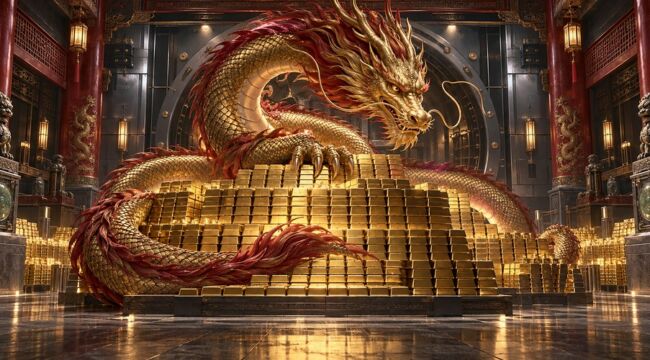

Beijing Preps for Currency Wars
The fact that China has a large quantity of gold in its official reserve position is not news. China’s gold reserves have been rising substantially since 2009.
At that time, China’s official gold reserves were 1,054 metric tonnes (mt). Today, those reserves stand at approximately 2,366 mt, an increase of about 124%. But that does not tell the whole story.
The official reserves are reported by the People’s Bank of China (PBOC), the Chinese central bank. But China may also hold gold through other state entities, including the State Administration of Foreign Exchange (SAFE). China is non-transparent about the full extent of its gold holdings. The exact amount of any unreported gold is unknown. Estimates can be formed based on imports from Switzerland via Hong Kong, but those are inexact.
One estimate is that the amount of “hidden gold” held by Chinese state entities is approximately the same as the amount reported publicly by the PBOC. If that estimate is correct, total Chinese gold reserves would be about 4,700 mt, or roughly 58% of U.S. gold reserves of 8,133 mt.
That would make China the second-largest sovereign gold holder in the world after the U.S. and put China ahead of gold powers such as Germany, Italy and France. Still, caution is warranted. Actual official gold holdings in China could be higher or lower than that estimate.
Both the publicly reported gold reserves of PBOC and any hidden state gold reserves are in addition to the amount of privately held gold in China. That figure is even more difficult to estimate. It is widely reported that Indian citizens privately own substantial quantities of gold, with estimates often running into the tens of thousands of tonnes.
China has a population about the same size as India and an equally strong cultural affinity for gold bullion. An estimate of perhaps 10,000 metric tonnes of gold held privately by Chinese citizens seems reasonable, although it cannot be verified precisely.
By any measure, China is a gold powerhouse, even if its reported official holdings still fall short of those of the U.S. But what is China doing with its gold? What is the point of massive gold accumulation by the Chinese government and its people?
The Gold-Backed Yuan Is a Chimera
One thing that is not happening is the creation of a gold-backed Chinese yuan. China may have an enormous amount of gold, but China has an even larger money supply than the U.S. and an enormous debt burden once provincial debt issuance is taken into account.
Traditionally, gold holdings must be between 20% and 40% of the money supply to engender trust in a gold-backed currency system. China’s reported gold holdings are in the low single digits as a percentage of money supply. In my view, there will be no gold-backed yuan for the foreseeable future.
The idea that the Chinese yuan, whether gold-backed or not, can replace the U.S. dollar as the global reserve currency is also nonsense. Official foreign exchange reserves are not simply piles of currency. They are held largely as securities and deposits denominated in a currency. These securities are typically government bonds but can include other assets, depending on the country.
In short, you cannot be considered a major reserve currency unless you have financial markets large enough to absorb global official savings.
A bond market requires underwriters, called “primary dealers” in the U.S., a range of maturities, regular auctions, hedging instruments such as futures, options and when-issued trading, a large pool of institutional buyers and, above all, a strong rule of law.
China has a large bond market, but it lacks the depth, openness, convertibility and legal protections needed to rival the U.S. Treasury market as the foundation of the global reserve system. It will take years to build a system that does. China is simply not in the same league when it comes to reserve-currency status, with or without gold.
The latest IMF data show that the U.S. dollar accounts for about 57% of global foreign exchange reserves. The euro accounts for about 20%.
That leaves all other currencies to share the remaining 23%, with significant portions taken up by Japanese and U.K. securities, along with Australian and Canadian dollars and Swiss francs. The Chinese share is about 2%.
If a gold-backed yuan is a chimera and the yuan as a dominant reserve currency is a nonstarter due to the limitations of its financial markets, why is China buying so much gold? What is the real plan?
Follow the Gold, Not the Yuan
To understand China’s gold acquisitions, we need to look at what else China is doing in the gold market.
Major Chinese banks have recently moved to suspend or restrict individual trading in precious metals linked to the Shanghai Gold Exchange. This was presented as a risk-reducing measure. The restrictions do not prohibit physical gold purchases or ownership through gold funds by everyday Chinese citizens.
In effect, China is curbing certain forms of retail “paper gold” trading while allowing accumulation of physical gold. That’s an amplification of trends already in place.
Hong Kong also launched a new central clearing and settlement system for gold in July 2026. Hong Kong has a better rule of law than mainland China, although it is firmly under the control of the Chinese Communist Party.
This arrangement gives China greater flexibility to develop gold trading and settlement outside the traditional dollar-dominated system. That result is not the same as a gold-backed yuan, but it does lessen China’s dependence on dollar-denominated payment systems with regard to gold.
China also changed its insurance regulations to allow ten major insurance companies to invest in gold, with exposure capped at 1% of total assets. Given the size of the Chinese insurance market, even 1% represents a potentially major increase in demand for gold.
Hong Kong is also expanding its physical storage capacity, with a target of over 2,000 metric tonnes within three years. That would make it one of the world’s major gold storage centers, although the target has not yet been reached.
China’s Golden Escape Hatch
Taken together, these measures show that China — already the largest gold producer in the world based on its mining operations — is building more than a massive gold reserve.
It is positioning itself as a global gold trading center, with infrastructure for investment, retail accumulation, hedging, imports, settlement, clearing and storage.
China is not troubled by the decline in the dollar price of gold between January 2026 and today. The reason is that China is in acquisition mode.
In my view, Chinese policymakers expect the price of gold to soar sooner rather than later. Any buyer accumulating gold favors a lower price for the time being because it means getting more gold for every dollar spent.
The payoff comes later if the dollar price of gold spikes higher. Whoever has the most gold then is the biggest winner.
All of this dollar price action really says more about dollar volatility than it does about gold. That’s one more reason to get out of dollars and into physical gold.
China is looking ahead to the day when a confrontation with the United States could force it to separate from the dollar payments system entirely in order to avoid asset freezes and financial sanctions.
Chinese policymakers are watching the financial sanctions that the U.S. is imposing on Russia and Iran and drawing the appropriate lessons.
China’s solution to geopolitical chaos and financial warfare is to buy physical gold. Investors in the U.S. are well advised to take the same approach.

Comments: