
Earth-Shakers: Trading Big Ideas
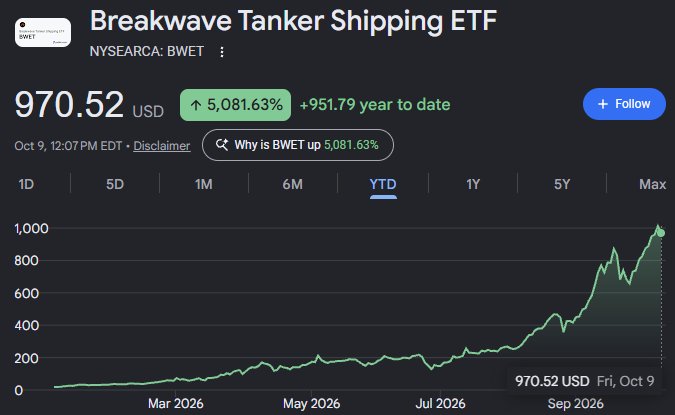
A tiny ETF is up 5,081% (51x) since the beginning of the year.
It’s a niche fund that owns oil tanker freight futures. So when the cost of shipping crude oil rises, so does this ETF.
And since the war with Iran, the cost to rent a tanker has gone vertical.
In 2025, the average rate to book a VLCC oil tanker was about $65,000 per day. Today it has risen to $1.6 million.
A Simple Trade
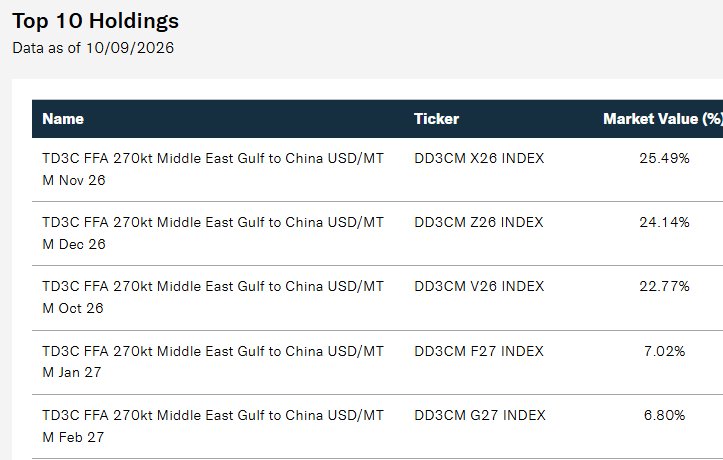
The ETF is the Breakwave Tanker Shipping ETF (BWET). As I mentioned, it owns futures contracts which track the cost to ship oil around the world. Here’s a look at their top 5 holdings.
Source: Breakwave
And please, don’t go out and buy BWET now. It’s already up 51x this year, and whenever the Iran and Ukraine situations get resolved, the fund is practically guaranteed to crash. It may go higher first, but eventually gravity will return. I mean, just look at the chart.
In hindsight, however, BWET was an obvious trade. We knew early on that Iran had significant anti-ship missile capabilities, and wrote about it frequently. Their strategy depends on preventing tankers from freely crossing the Strait of Hormuz. We knew this early on.
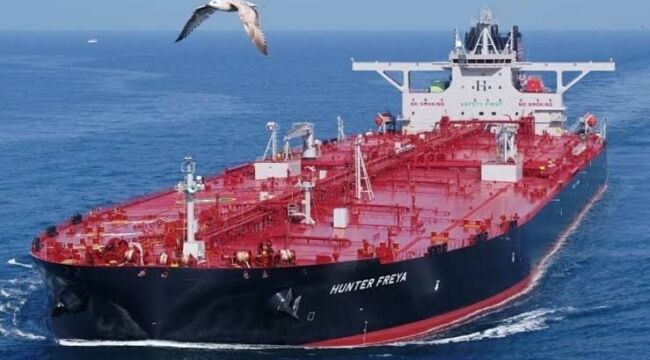
Oil tanker rates were bound to rise along with the danger of transiting the Strait of Hormuz. As soon as they started blowing up full VLCC tankers, that should have been the cue to look for ways to play the shift.
BWET was the ideal play. All it would have taken to find it was a simple AI query. “Hey ChatGPT, how can I bet on rising oil tanker rates?”
AI can be an extremely valuable research tool. Just don’t ask it what to buy, or when. AI is NOT good at generating unique ideas, and even today’s top AI models are horrible traders. You need to provide the spark. But for brainstorming and research, it can be a very useful tool. I view AI as a valuable research assistant, but never a stock picker.
Anyway, missing the tanker trade has inspired me to perform better and deeper research when these earth-shaking events like the Iran war happen.
They always bring opportunity. And sometimes, it’s downright massive.
What’s Next?
The world is in a crazy place today. War, inflation, AI disruption, debt, trade and currency wars. We’re essentially living in the scenario Jim Rickards laid out in his books and other work over the past 15 years.
But amongst the chaos, there exist rare opportunities for investors.
Here are 4 earth-shaking events I’m watching closely.
- Ukraine will lose the war against Russia, probably next year.
- The global debt situation has reached a tipping point. Yields are soaring.
- AI will disrupt white collar work in unprecedented ways.
- America’s higher education system will die and be reborn over the next 15 years.
The implications for each of these are huge.
Let’s think about the Ukraine vs. Russia war quickly. When Ukraine loses, the world will change. NATO put its full support behind Ukraine. Tanks, planes, bombs, missiles, drones, refugee support, directly funding the government, covert on-the-ground assets, and most importantly – intelligence, satellite and recon (ISR) assistance. Without our eyes in the sky, Ukraine would have lost in the first year.
Between NATO and Europe, about $650 billion has been spent to support Ukraine during the war. When Ukraine loses, and the scale of it all becomes apparent, I believe it will speed the breakup of NATO, and possibly the EU as well.
More than a million lives will have been wasted. And Russia will end up with Ukraine’s most valuable territories.
Confidence will be lost in European and NATO leadership, as it should. Fortunately President Trump has distanced us from Ukraine somewhat, and tried to take a more even-keeled approach to ending the conflict. But the Ukraine war truly began in 2014, when Obama’s intelligence services executed the Maidan Revolution (coup). NATO is deep in this war.
I’m still searching for how to trade the end of the Ukraine war. It’s a sad situation all around. But as investors we have to distance ourselves from emotion.
Some of these other earth-shakers are easier. The debt crisis trade is pretty simple, and we’ve been discussing it for years now. Hard assets, foreign stocks, precious metals. That’s more of a decade-long investment than a “trade”, for me at least.
The bigger point is this – I’m going to look even harder for big idea opportunities. When the world is changing this fast, there are inevitably some incredible opportunities for those who are paying attention.
Of course, I’ll share the best ideas with you all as I find them.

Comments: