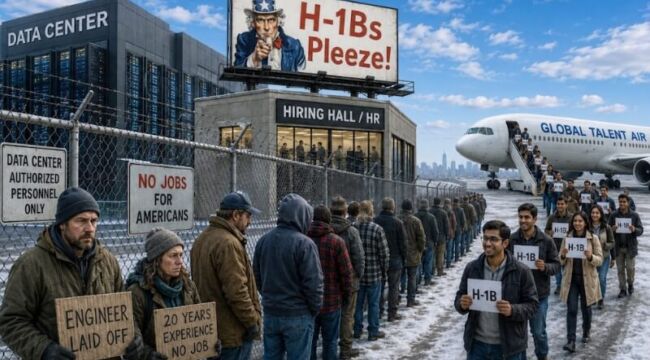

The Siren’s Song of Cheap Labor
Long ago, during my days at Gulf Oil, twice a month (usually on Friday) my then-boss would take the geology team to lunch at K-Bob’s Steakhouse in Monahans, Texas, deep in the heart of the Permian Basin.
There, we would eat ribeye, talk shop and learn what good geologists ought to know. (Historical Note: this quaint custom is how senior people used to teach important things to junior people.)
“You know why I hired you, Byron?” asked the main man.
“I guess you figured I might know some geology,” I replied.
“No,” he said. “I can hire all the geologists I want with a phone call. But I liked how your resume said you know how to weld. So, if something breaks out on a rig, you can help fix it.”
It’s funny how life works. I had a geology degree from Harvard and studied petroleum engineering at Purdue. But I owed my oil company job to an old ironworker in Pittsburgh who taught me how to weld one summer when I worked in a heavy machine shop.
I mention this because, right now, America is reindustrializing, yet I keep seeing stories about how difficult it is for employers to find skilled labor: welders, electricians, pipefitters, electronic technicians and much else. Let’s dig into this…
A Fake “Skills Shortage” Became Business Gospel
America didn’t lose its industrial edge because Americans forgot how to work. Americans are good at work, and they get stuff done. Grand Coulee Dam kind of speaks for itself, right? Still, the country has a workforce problem, and it came from a within; from a long campaign by business, academic and political elites to replace national skills and workers with short-term labor arbitrage.
The pitch was simple. Americans cost too much. And American schools don’t produce enough talent. Plus, American workers are picky and rooted. So, goes the brief, the country must import labor, offshore jobs, use global vendors, and pursue the chimera of endless “flexibility,” all sold as “efficiency.” In practice, this line of argument has transformed into a buzz saw that has cut many current Americans out of the career ladders their parents and grandparents built.
The Siren’s Song began to play in the 1980s, when inflation was high, U.S. wage rates were rising, and businesses felt sticker shock. So, corporate America had two choices: hire and train more U.S. citizens and pay them; or persuade Washington that a “skills shortage” required low-cost imported workers. By 1990, Congress had created the modern H-1B visa program, grafted onto a broad visa structure that gave companies a formal pipeline for “specialty occupation” labor.
Then came the 1990s dot-com boom, and the volume went up: “More visas! More imported labor!” And perhaps, in narrow cases, the shortage claims were even slightly true. Sheep-shearing comes to mind. The U.S. simply does not produce enough sheep-shearers.
But much of the call for foreign labor was just a disguised excuse to cut wage levels across broad swaths of industry. That is, the alleged “skills shortage” often meant that Americans weren’t willing to work at the lowball salary levels employers wanted to pay.
When you think about it, the “lack of skilled workers” argument was absurd. After all, the U.S. “won World War II,” as the saying goes; and “put men on the moon,” as the other saying goes. Yet suddenly, in a nation of something like 300 million, business leaders insisted that they couldn’t find people ready, willing and able to work. So, went the argument, America had to open its doors to foreign labor via work visas.
The Myth of “Global” Talent
Let’s back up even further. Because American history is filled with stories of skilled immigrants who arrived, built, invented and contributed. For example, in the late 1700s, E.I duPont came to the U.S. from France, set up a factory and made gunpowder for the Army. Or consider how Albert Einstein helped the U.S. develop the science that led to the atom bomb. These kinds of success stories are legion.
And indeed, any nation that expects to do well in science and engineering should work to attract rare talent. But “rare talent” is not the goal for much of the current visa system. Too often, H-1B and related programs are just legalistic paperwork for body shops, staffing firms and HR departments that seek cheap, pliable, low-risk labor.
In the olden days, America’s hiring systems tended to offer employment via a certain level of sociological scrutiny. In many fields, students pursued rigorous academic programs, internships, co-ops, technical interviews, peer review and probationary periods. Generally, hiring managers knew that candidates had been tested by professors, supervisors, colleagues and even customers.
But today, in way too many corners of tech and other sectors, that formerly trustworthy chain of verification has been replaced by shoddy or fake paperwork, sleazy vendor relationships and ethnic-oriented offshore recruiting networks. All while credentialing has become a crap-shoot because of counterfeit degrees and fabricated claims of experience.
The current U.S. visa system is biased toward low costs and high volume, and thus the process has evolved to select for… low cost and high volume.
Imported labor also gave the U.S. education establishment its own bucket of whitewash. If primary and secondary schools graduated weak students, employers could say, “We can’t find what we need, so we must import talent.” And if universities admitted unprepared high school grads and diluted standards to keep enrollment flowing, they could say, “We must recruit internationally.” Failure at home became tolerable because the system could paper over the deficit with people trained elsewhere.
Fake Vetting and a Crisis of Competence
This is not an argument against every visa worker or foreign student. But it helps highlight how the U.S. now has a structural labor and demographic problem. That is, if employers (and university faculties) can bypass the hard work of cultivating home-grown American talent, relieve their wage pressures and route hiring through intermediaries, the incentive is obvious: go cheap.
And the social and cultural damage doesn’t stop with one displaced worker. For example, in entire fields of science and engineering, bad incentives compound other problems. Product quality suffers. Medical systems become harder to trust. Cybersecurity risk rises. Intellectual property gets pirated. Safety margins shrink. Institutional knowledge thins. The public experiences buggy software, shoddy products, endless service loops and compromised systems.
Then there’s outsourcing, which has done to supply chains what visa abuse did to domestic labor markets. It turned national capability into a hollow shell, a Potemkin Global Village. That is, factories closed here at home, and toolmakers and machine builders vanished. Apprenticeship ladders broke. Entire towns and even regions were told to retrain: “Learn to code!”
In the 1990s NAFTA (North American Free Trade Agreement) literally and figuratively paved entire highways to Mexican factory sites. Then in 2001 China entered the WTO (World Trade Organization), again another event that opened America’s doors wide to an outflow of industry and talent.
Over time, corporate America discovered that back-office functions, software teams, call centers, assembly lines and compliance could be chopped up, priced by the hour, and set up at some 24/7 boiler shop on the other side of the planet.
All along, the “global” culture-freaks and corporate media sold this labor bloodletting as some sort of beneficial modernization. But really, it was the old Rust Belt deindustrialization model in a newer paint job. From boots and blue jeans to motorcycles and trucks, and even to the working man’s most iconic hand tools, America kept its brand names but lost industrial muscle.
Sure, many corporate headquarters remained domestic because C-Suite people tend to enjoy their U.S. social circles and the kids’ private schools. But for all the U.S. glass tower jobs that remained in, say, legal and investor relations, much of American business exported its production know-how.
Then to mask reality, many corporations highlighted slogans about their clever business model, like Apple with its odious, disgusting line, “Designed in California, Made in China.” Yeah, right; while over the past three decades, Apple or its subsidiaries trained over 25 million Chinese workers on how to do electronic assembly. (It’s true; look it up!)
Meanwhile, U.S. shop floors hollowed out. Labs and engineering benches disappeared. Critical capabilities migrated to foreign jurisdictions, where others now do the innovation and eventual maturation. It’s a sad, tragic tale because no country can outsource the hard parts and still expect to command the future.
The National Security Bill Comes Due
Now, between support for Ukraine and the ongoing war with Iran, comes the national-security bill for outsourcing labor and capabilities. It’s blindingly apparent at the near-empty bunkers of more than a few Naval Weapon Stations and Army Storage Depots. And while the Pentagon scrambles to restock depleted inventories of munitions – let alone to build new ships and airplanes – the contractor base replies that many (literal) elements of the supply chains are somewhere down the path of thin to non-existent.
Oh, you want new missiles? Radars? Ammunition? Spares and repairs for ships, submarines, aircraft? Whoops… Sorry; we don’t have enough antimony, bismuth, cobalt, gallium, germanium, graphite, rare earths, tellurium, titanium, tungsten, zircon. And the issue is no longer theoretical because China controls the product pipelines and they just closed the valves.
The U.S. has painted itself into a corner of opaque and iffy foreign supply chains, where strategic dependence is neither true capability nor resilience. And that same logic applies to software and technical labor. When critical code, architecture, cybersecurity and maintenance are dispersed through offshore contractors and weakly vetted labor channels, America loses control over its own nervous system.
And no, you need not assume that every outsider is hostile. You only need to understand that dispersed control, weak vetting and dependency on foreign labor create exploitable openings.
The SpaceX Exception: High Standards Still Work
On the positive side, SpaceX demonstrates how flimsy the cheap-labor story has always been. Because here’s a highly successful technology company that simply cannot hire “foreign” due to national security regulations.
That is, rockets are a national security thing. Launchers, propulsion systems, flight software and guidance hardware, and of course satellites all live inside tight export controls like ITAR (International Traffic in Arms Regulations) and other restrictions. And this is before we get to classified military programs, facility clearances and FBI-level personnel vetting.
No aerospace or defense firm can simply outsource sensitive work across cheap global labor pools. Defense work operates under a different rubric. There’s nothing casual or borderless about access to controlled data, classified information and sensitive facilities. Indeed, for defense systems, labor is not just a cost center. Labor is a security perimeter. And yet, somehow without all those allegedly critical visa-workers, SpaceX is world class.
As with SpaceX, so are many defense primes, shipyards, missile shops, semiconductor fabs, nuclear labs and specialized machinery firms that must – by law – hire U.S. citizens. They don’t win by finding the lowest hourly rate on the planet. They win by building American teams that can handle difficult work, protect secrets, iterate fast and keep responsibility inside a controlled chain of command.
Or in other words, excellence does not require cheap labor and visa loopholes. Sometimes, excellence just involves bringing the work inside and closing the g0dd@m doors.
Disposable Workers, Discarded Citizens
There’s a certain moral architecture to every labor system. And yes… perhaps America’s old labor bargain was imperfect, although in its own way it was understandable: work hard, build skills, earn enough to support a family, buy a house, join the community and pass something on.
Now, though, the new model of cheap foreign labor breaks that bargain. Native-born Americans are told they are too expensive, too demanding, too rooted, too unwilling to relocate, too likely to ask questions and too likely to push back when management cuts corners.
Meanwhile, the new visa-work model harms nearly everyone, excepting people who collect rent on the spread. As for American citizens? Clearly, young people have lost the entry-level rungs of the ladder. Mid-career workers have lost bargaining power, and then their jobs. Communities have lost stable taxpayers, and by extension volunteers and future civic leaders.
Ironically, even visa workers are often trapped inside a squirrel cage of dependency, afraid to seek change or speak plainly because their legal status is tied to a particular employer. And the winner is the firm that converts that insecurity into higher margins.
The Public Has Awakened
Now the public is catching on. Visa games, layoffs, wage cuts, outsourcing, political donations and procurement failures are no longer hidden in the shadows; they’re visible in real time.
Young workers see the pattern. A company lays off Americans, then petitions for more imported labor. STEM graduates can’t find work, while trillion-dollar firms with massive overseas operations complain about labor shortages. And the alleged American “talent gap” becomes a glaringly ethnic wage gap in workplaces where English is the second language.
The immediate fixes are straightforward. Restrict foreign talent to skillsets that truly are rare. Verify all credentials. Ban replacement schemes. Audit wage gaps and stop allowing outsourcing firms to drink everyone else’s milkshake. Restore apprenticeships, entry-level pipelines and support serious technical education. Revise tax and regulatory codes to favor a rebuild of critical manufacturing. Map defense supply chains down to the mine and mineral. Punish fraud until fraud quits paying. Defend national sovereignty in the workplace.
Across its 250-year history, America’s edge was never just that the country had money. No, the leg up, so to speak was a culture that valued skill, trust, discipline, and the ability to turn ideas into real things that add value: metals, tools, machines, ships, chips, oil wells, autos, aircraft, rockets and code. Now, though, cheap imported labor has corroded all of that, while outsourcing has hollowed it out.
The takeaway here is that long-term visa abuse has inflicted immense damage on the country, and the bill is now coming due. Looking ahead, America cannot afford another generation of rigged national decline. Because there’s nothing “cheap” about cheap labor.
That’s all for now. Thank you for subscribing and reading.

Comments: