
Pure, Refined Profit
I’m an oil and gas guy. In graduate school, I studied sedimentary geology… the kind of rocks that hold oil fields. ExxonMobil (XOM) financed part of my original PhD thesis.
Years ago, I was one of the first analysts to suss out the shale plays. I spent a lot of time around Beeville, Texas, following the discovery of the Eagle Ford Shale.
Here’s the thing… in all my time, I’ve never seen anything like what’s going on in the oil markets today. The issue is less about the price of oil and more about refining.
Refining is a historically bad business. Over the past several decades, refiners’ profit margins averaged about 1% to 3%. That’s terrible. You typically think about oil companies as rolling in cash. Refiners aren’t those kinds of oil companies.
However, there’s a reason giant “integrated” oil companies like Chevron, Shell, and ExxonMobil all own refiners. Because sometimes, refiners print big money. And that’s what’s happening today.
Before we discuss how to play this trend, let’s do a little background so we can understand what oil is and what refiners do.
Refining 101
Think of oil as a soup made up of different kinds of molecule chains. Some chains are long and some are short. If they are very short, they form gases at regular temperatures. The shortest chain, methane (natural gas), is just four hydrogen atoms and a carbon atom.
The longest chains, asphaltenes, can hold up to 100 carbon atoms. These are so thick they won’t flow without heating. These are common in the Canadian heavy oil sands.
Refiners use different techniques to chop up the chains into their products:
- Gasoline has four to 12 carbon atoms.
- Jet fuel has between eight and 16 carbon atoms.
- Diesel fuel has between nine and 25 carbon atoms.
Shorter chains vaporize easier. Longer chains have more energy. Each link between a carbon atom and hydrogen atoms holds energy. The more links, the more energy dense the molecule.
Like the price of oil, gasoline, diesel, jet fuel, etc. move together around the world. That’s because gasoline is gasoline is gasoline. You know it has four to twelve carbon atoms, so there is uniformity to the product. If you make gasoline in Kyoto, Japan, and gasoline in Philadelphia, the two batches are going to be nearly identical. However, the oil they come from is not.
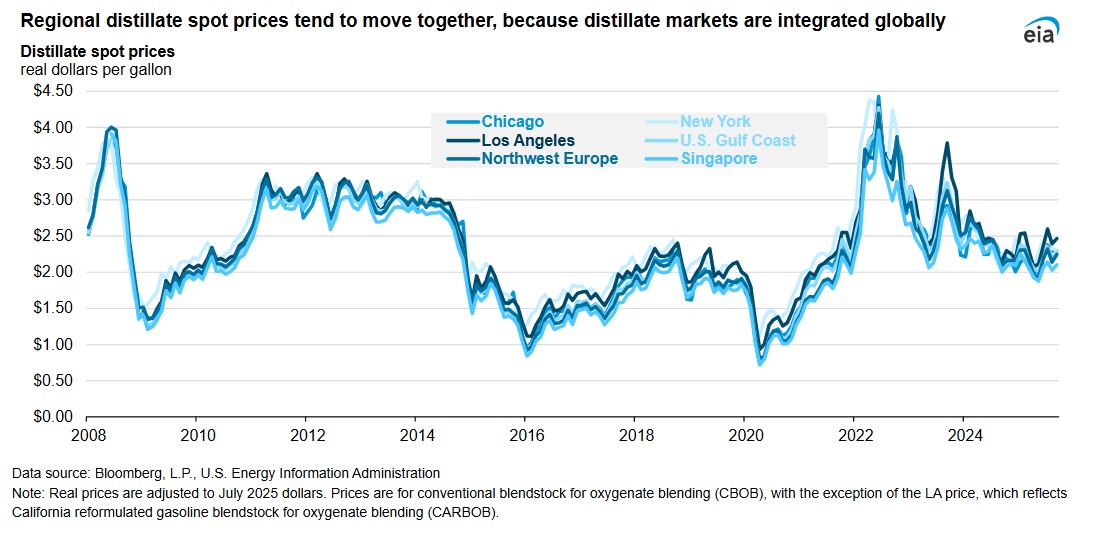
The most important thing to know is that as long as you can move distilled products, then the market isn’t set in one area. Instead, the price is set globally. That’s why the price of gasoline here in the U.S. is high, even when we produce plenty of our own oil. You can ship it to the market that’s willing to pay the best price. That regulates the market.
Refiners use chemistry to “crack” oil molecule chains into those fuel ranges. But it’s an imperfect process. You can’t turn a barrel of oil into a whole barrel of gasoline.
What comes out during refining is about 43% gasoline, 28% diesel, 14% heavier products (like roof tar), 9% jet fuel, and 6% natural gas liquids (like butane). However, that’s an “ideal” barrel of oil.
In light, sweet crude oil like West Texas Intermediate (WTI), you get up to 45% gasoline, 30% diesel,15% jet fuel, and 10% heavy residue. In Canadian oil sands (WCS), the breakdown is much different. About 60% of the barrel is heavy residue, 25% diesel, 15% gasoline, and 15% jet fuel.
That’s why there are huge price differences in oil between source regions. For example, the difference between WTI and WCS is on the order of $15 to $25 per barrel. That’s because refiners can make much more useful fuel from a barrel of WTI.
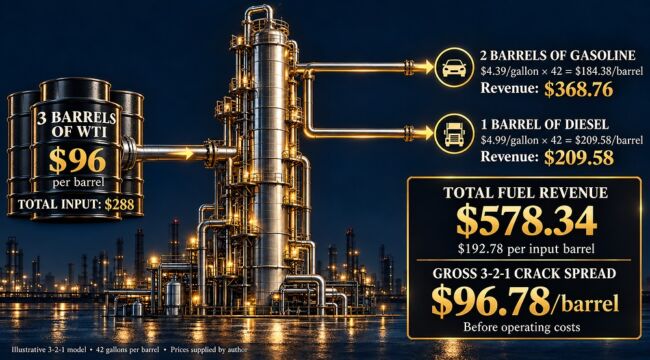
We measure the profit from refining a barrel of oil using the 3-2-1 Crack Spread. It uses an average price for three barrels of oil yielding two barrels of gasoline and one barrel of diesel. This how we get a general idea of the profit margins for refiners.
Today, a barrel of WTI costs around $96, a gallon of reformulated (RBOB) gasoline is around $4.39 per gallon, and ultra-low sulfur diesel is $4.99 per gallon. If we put that into our 3-2-1 Crack Spread model, we see that refiners make about $96.78 per barrel in profit today.
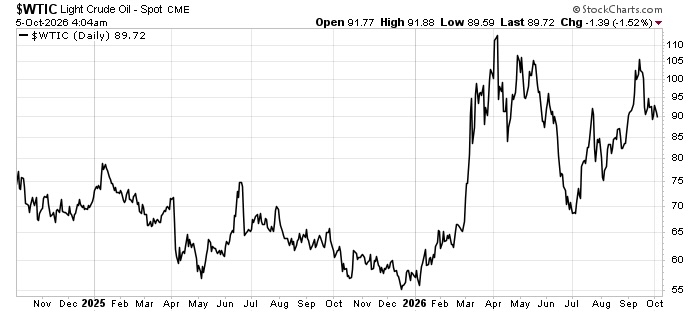
To put that into perspective, a year ago, refiners made about $32 per barrel…
That’s an extraordinary jump in price. It’s literally a 200% increase in one year. And it doesn’t look like it will change anytime soon. So, refiners are generating enormous profits today. And that they may make EVEN MORE if the Strait of Hormuz opens.
That’s because the prices of refined products are disconnecting from the price of oil. This is the part of the story that is new territory. And it’s due to the wars in Ukraine and Iran.
Destruction From Above
Oil refineries are vulnerable. They are big, delicate chemistry sets. You can’t move them, hide them, or even harden them. That makes them big, fat, juicy targets for drones and missiles. So, they are being hit… every day.
This is from Sunday, October 4th:
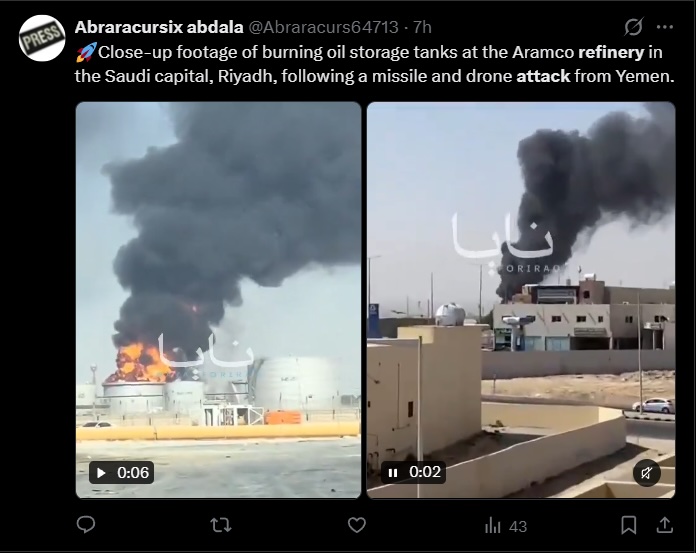
Yemeni Houthis are now fully involved in the Iran war. They targeted oil infrastructure like Saudi Arabia’s East/West pipeline and refining assets.
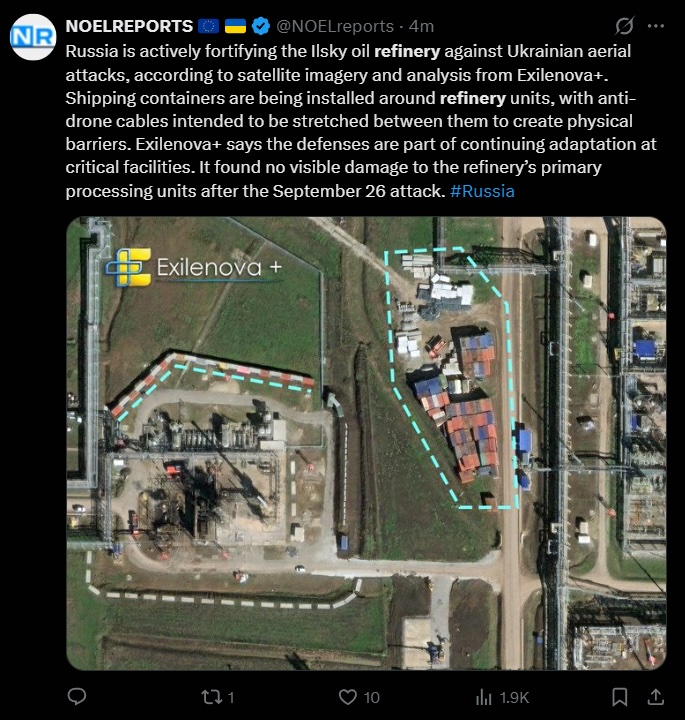
The story is similar in Russia where Ukraine recently hit 24 of Russia’s 34 refineries. That’s about 5.1 million barrels per day, or 81% of Russia’s refining capacity.
It’s so bad that Russia is trying to fortify its Ilsky refinery with shipping containers:
Ukraine’s attacks disrupted roughly 4% of global seaborne diesel and gasoline trade. And that’s just Russia.
Together, the two wars cut about 1.6 million barrels per day of global diesel and gasoline supply between February and August. In February 2026, those regions accounted for 45% of global gasoline and diesel exports.
While this situation will slightly improve when the wars end, that doesn’t look likely anytime soon. And even if the Iran war ends or the Strait of Hormuz is fixed, that will only bring down the cost of oil. It won’t rebuild refineries.
In fact, it may create a glut of oil. There is a scenario where the Strait of Hormuz opens and there simply isn’t enough global refining capacity to take all the oil right away. That could send oil prices much lower but leave the price of gasoline and diesel high.
And that is the absolute best-case scenario for refiners. If the cost of their feedstock falls while their products stay expensive, it would increase their profits.
The risk to this trade is if the U.S. government goes ahead with an export ban on fuels. If we can’t ship diesel and gasoline, there would be a dramatic fall in prices. And a massive backlash.
That’s why I consider this a risky trade. The safest way to play this is to simply buy the VanEck Oil Refiners ETF (NYSE: CRAK):
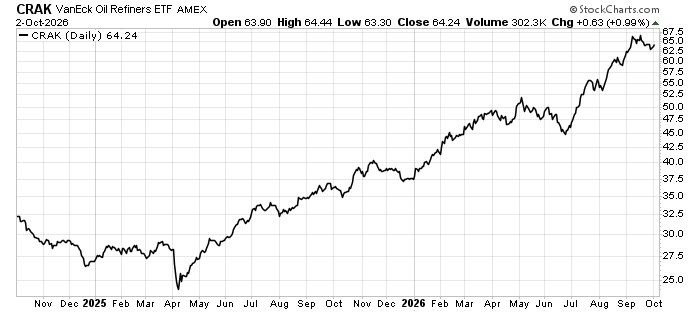
CRAK holds a basket of the world’s refiners and gives you exposure to international refiners that we can’t buy easily. And it’s cheap. The price-to-earnings ratio (PE) of the S&P 500 is about 25 times. CRAK, on the other hand, trades for about 9.4 times.
So, these refiners, even when they are having their best performance ever, are still 2.5 times cheaper than the S&P 500. It makes no sense.
You could go out and buy CRAK and do well. But there is another, riskier kind of opportunity in refining today.
The difference, for investors, between CRAK and small U.S. refiners is scale. In CRAK you get refiners that are global. That means they are the ones paying the risk premiums on oil. The investment success hinges on their ability to make money in this environment. It’s a more limited upside, but it also reduces risk.
However, for those willing to take on company risk, there is a huge upside in individual refiners in the U.S. They get excellent access to crude oil, without the risk premium. In addition, they aren’t well known in the broader market. We see that in the low price to earnings (about 9 times earnings).
That means, as these companies outperform the market and expectations, they will attract more investors. To put this in perspective, the S&P 500 trades at 25 times earnings. So, these companies are cheap, relative to the greater market.
And I think the U.S. refiners have a massive edge over their peers. That’s because our domestic oil industry is outstanding. There simply isn’t a better place in the world to produce oil. There may be better places to find the oil… but if you want to get it from the well to the refiner, the U.S. is the place to be.
But if the U.S. government bans diesel exports, these companies will be hurt. And there will be massive profit taking. So, if you see that in the news, don’t wait for us to give you the alert – just sell your position.
That said, if the Strait of Hormuz suddenly opens and oil prices fall, that could be even better for these companies. If we find ourselves in a place where oil prices fall 20% but distillates only fall 10%, these companies will make even more money than they do now.
Let that sink in… there’s a scenario where oil and fuel prices go down but the refiners’ profits go up!
We are in the absolute sweet spot for refiners. The stuff they sell is more than double but the stuff they buy to make their product isn’t. That’s the recipe for higher profits and it should continue.

Comments: