All Roads Lead to Inflation

Over the past 4 years, the world has slowly woken up.
Investors have finally recognized just how unsustainable the debt situation is.
Governments have piled up IOUs steadily since the 1980s. But for a long time, it didn’t seem to matter.
Mainstream economists told us it wasn’t a big deal.
Nobel Prize-winning economist Paul Krugman is a prime offender here. The New York Times columnist has argued the following:
- “No, debt does not mean that we’re stealing from future generations.” Feb 2015
- “Large-scale deficit spending isn’t just OK, it’s the only responsible thing to do.” Oct 2020
- “That is, to act responsibly, we must stop worrying and learn to love debt.” Dec 2020
- “We weren’t and aren’t anywhere close to that kind of crisis and probably never will be.” Dec 2020
Over the years he has ranted and raved about how debt is just money we owe to ourselves. It’s no big deal!
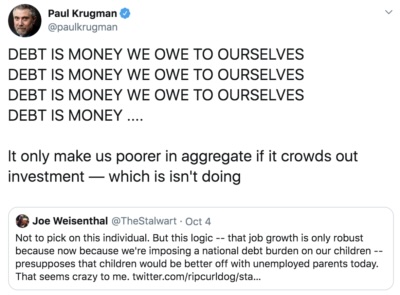
This is the wisdom of the most influential economist in America.
Krugman seems to have assumed we’d have low interest rates forever. Now that rates are soaring, he’s changing his tune a bit.
But still, he assures us there’s no chance of a serious debt crisis, because we can always just print money to pay it off. That’s reassuring…
“The truth is that even fiscally irresponsible nations very rarely have acute debt crises unless they borrow large amounts in foreign currency, because countries that borrow in their own currency can’t literally run out of money — they can print more as needed.”
If a nation’s debt causes it to print gobs of money, which results in problematic inflation, I’d call that a debt crisis.
In fact, I would argue that no matter what we do, a sustained period of high inflation is unavoidable.
The High Rate Path
The U.S. basically has two paths in front of it. One where interest rates stay high.
Peter Schiff recently summed up the first option nicely:
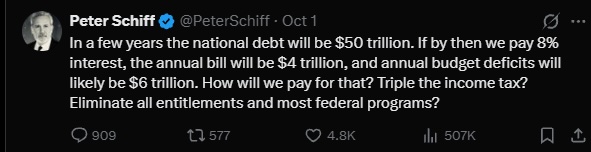
If rates stay high, the debt will rapidly snowball to $50 then $100 trillion. Peter’s post got me curious, so I had an AI agent run the numbers. Here’s what we have, assuming the fed funds rate rises to 8% and stays there:
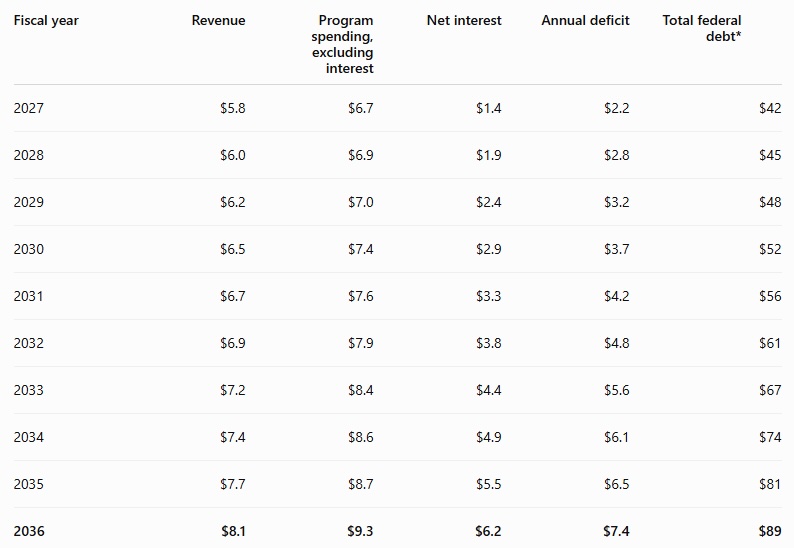
So by 2036, total federal debt would rise to $89 trillion, from $40 trillion today.
Paying the interest on that debt would cost $6.2 trillion. That’s more than the federal government’s total revenue (taxes etc) in 2026, which will be around $5.8 trillion.
All that money would have to be printed.
If you extend the high-rate simulation to 2046, debt would reach a shocking $240 trillion.
And by the way, this projection uses government spending and revenue estimates (CBO). Those numbers are always too optimistic.
The Low Rate Path
The other path is where the Fed and Treasury work together to get rates back down to near zero.
We had this for almost 10 of the past 20 years. After the housing crash of 2008, and during Covid. And I believe we will return to it.
I ran the same projection using AI, but it assumes the Fed drops interest rates to 1%, and they stay there for 10 years.
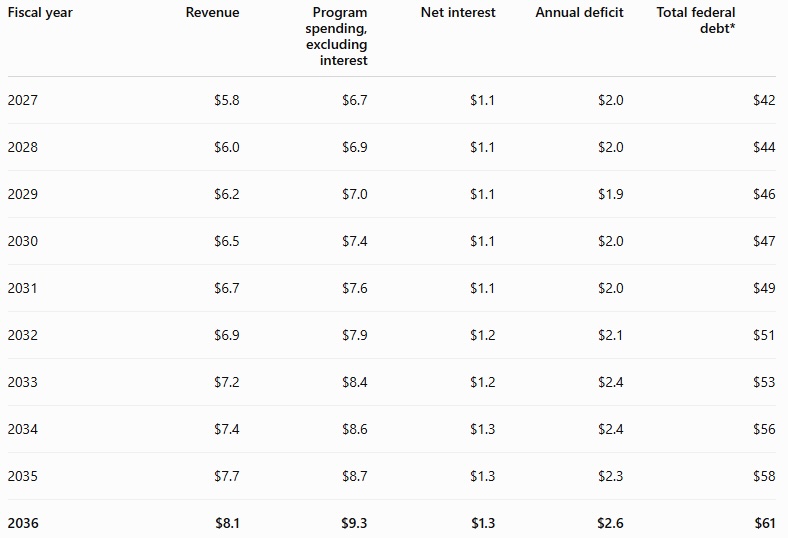
In the low-rate scenario, debt “only” rises to $61 trillion, rather than $89 trillion. Interest costs would be a more affordable $1.3 trillion, rather than $6.2 trillion in the higher-rate world.
The difference between the high and low-rate scenarios would grow exponentially over time.
This is the choice facing our central bank and politicians. Technically, the Fed isn’t supposed to concern itself with debt. Its mandate is to maximize employment, and minimize inflation.
But in the real world, they absolutely have to take debt into account. The tables above show why. The Fed certainly did during the financial repression of the 1940s. That was yield curve control, and I believe we’ll see it again.
Real World
These projections are simplified. They don’t account for inflation and a whole lot of other stuff.
But the exercise is worthwhile because it shows just how bad our debt will become if interest rates stay high. In fact, over the long run, inflation may be worse on the high-rate path. The debt snowballs.
We need lower rates. The country can’t even afford these “normal” interest rates. Corporations, people, or governments. We all have too much debt.
Of course, we technically could stay on the high rate path. But we’d have to cut government spending by 40%, raise taxes, and stamp out all the corruption. There’d be a wave of corporate and personal bankruptcies within a few years, as refinancing at higher rates breaks the math.
It’s not realistic. At least not yet.
Of course, artificially low rates have downsides too. Asset price bubbles, savers get robbed, and higher inflation. There’s a reason they call it financial repression.
But it’s more palatable than the alternative.
So I continue to believe that they’ll force interest rates back down towards zero within the next year or two. Even as inflation remains too high. It’s the path of least resistance.
It’s an extreme step, yield curve control. So it might take a painful catalyst to get us there. But I have no doubt it is the destination.
This is why we spend so much time talking about hard assets, inflation hedges, and monetary policy.
Owning them is going to be key to thriving during the next decade.