

Drones Invade Moscow
Every fifty years or so, a tech breakthrough revolutionizes warfare.
The English longbow devastated heavy cavalry at the Battle of Agincourt, and beyond.
Mongol composite bows and horse archery conquered Eurasia.
Crossbows made anyone into a ranged threat.
Gunpowder ended the age of heavy armor, knights, and castles.
Now drones are doing it again.
Moscow Refinery Hit
This is what the skyline looked like on the outskirts of Moscow last week.

Source: X
On Friday June 19th, Ukraine launched a massive drone attack. It reportedly involved more than 700 long-range drones. Russia shot most down, or used electronic warfare to crash them, but some got through.
The drones mostly hit “soft targets” like oil refineries and storage tanks. A few apartment buildings were also hit, but it’s unclear whether these were a mistake, or possibly targeted at military housing.
The picture above shows Moscow’s largest oil refinery. According to Reuters, the refinery that Moscow residents rely on for their fuel will be down for the rest of the year.
Normally this site produces 6 million tons of gasoline and diesel per year. Ukraine’s wave of attacks on Russian energy sites has severely hampered production. The country may soon be forced to stop exporting diesel, leaving customers in the lurch.
The most disturbing thing here is that Moscow probably has the best air defense network on the planet. A massive ring of electronic warfare zones. Short, medium, and long range anti-air missile systems. There were even huge nets over the refinery, but some of the heavier drones still got through.
Russia’s capital is only 280 miles from the Ukrainian border, so it is under constant threat. Defenses have been built over years, but they still weren’t enough.
The rain was black again, and this time in Russia’s capital.
Cheap and Dangerous
The drone pictured below is Ukraine’s AN-196 Liutyi. It has a range up to 2,000 km and a warhead that weighs about 75 kg (165 lbs).
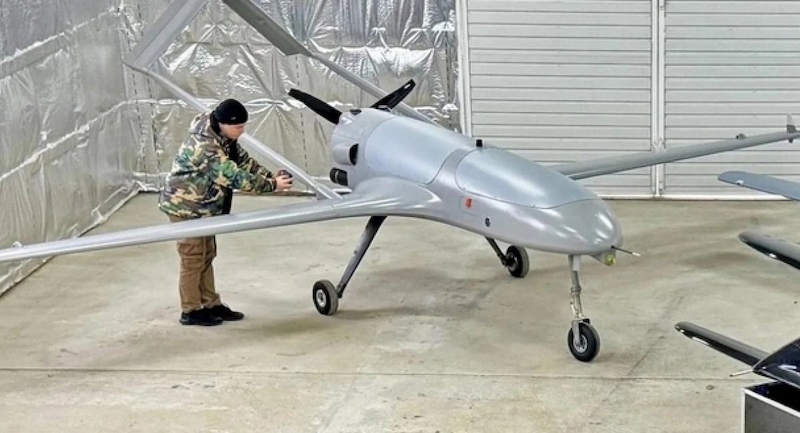
Ukraine’s AN-196 Liutyi long-range drone | Source: U.S. Army
This is one of Ukraine’s top tier drones. It costs an estimated $200,000. The expensive parts are the optical suite, navigation, processing, and electronic hardening. As production scales up, costs should fall sharply. And even at $200k, that’s far cheaper than any cruise missile.
Companies around the world are working to mass-produce attack drones. Efficiency improvements over the coming years will make long-range drones even cheaper.
It’s estimated that Russia’s Geran-2, with 1,500km range and a ~200lb warhead, costs $20-50k depending on the version. Small drones used on the frontlines cost well under $1,000 each, and can take out a $5 million tank.
New drones are being equipped to operate using on-board AI.
Drone Stocks
A technology so disruptive inevitably brings opportunity.
The U.S. military is beginning to acknowledge this shift. The Pentagon will ask for $55-75 billion in funding for unmanned systems for the next fiscal year.
However, that’d only be 5-7% of the total defense budget.
In Ukraine, drones account for around 90% of Russian casualties. That’s according to former CIA Director David Petraeus. For Ukraine, it has become a drone war.
Russia is using more glide bombs, missiles, and artillery. But I’d guess that still 60% of the casualties they inflict are from drones. And 80% of the long distance strikes are carried out by UAS (unmanned aircraft systems).
So in the largest war in recent history, and the largest modern frontline combat in history, drones are the undisputed king.
Shouldn’t we be spending 30% or more on unmanned systems? Soon enough…
Aerovironment (AVAV) – Worth a Look
There are a few “pure play” drone stocks out there. Aerovironment (AVAV) is among the largest and most well-established.
I dug deep into this stock over the past few weeks. AVAV has had a rough year. It’s down 42% over that period, and down 65% from its all-time high of around $417.
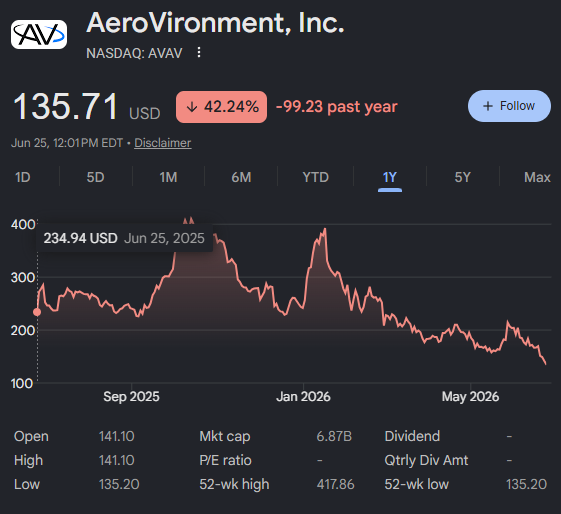
Expectations for Aerovironment were sky-high. They had acquired BlueHalo, a leading drone defense and space communications company, for $4.1B.
Then one of BlueHalo’s key contracts with Space Force was cancelled. And AVAV had to restate earnings due to an accounting error, which is never popular with investors.
Additionally, the company’s Switchblade drones performed somewhat poorly in Ukraine. Russia jammed them, the warheads were too small, and they were very expensive compared to off-the-shelf Chinese drones + RPG warheads.
The Switchblade 600 did score kills against expensive Russian missile systems, IFVs, and other targets. Overall though, the cost was too great compared to alternatives. But lessons were learned, and new products are launching.
At some point Aerovironment will become attractive. Maybe soon. They still have major contracts for both offensive and defensive drone systems. Their products have been through the ultimate test – operating in Ukraine. The experience and data gathered is valuable, even if their products weren’t a huge battlefield success.
Aerovironment’s BlueHalo division has a number of counter-drone defense systems which are promising. Their Titan counter-UAS unit has sold more than 1,000 units worldwide, making it a leading U.S. drone defense company in terms of systems deployed. This unit can detect, track, and defeat (jam) drones.
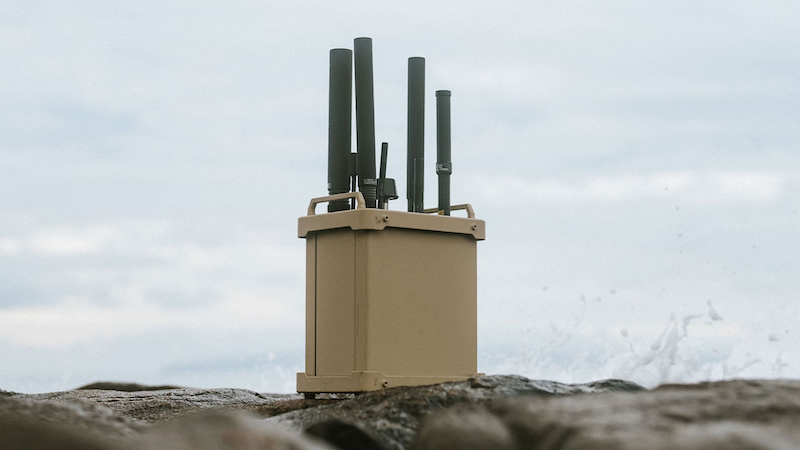
AVAV’s Titan 4 RF counter-UAS system
The company has anti-drone missiles, laser weapons, microwave systems for swarms, and interceptors.
Drone defense is one area I’m particularly bullish on. It’s even possible that more money will need to be spent on defense than offense. When a $500 drone can destroy a $200 million bomber, or shut an oil refinery down for 6 months, the problem is hugely asymmetric.
AVAV looks like one of the more promising names in the counter-drone space.
I haven’t bought Aerovironment yet. Still doing research, but it’s on my watchlist. The stock looks like it may go lower before finding a bottom.
Drones are one of the most disruptive breakthroughs in military history. This tech is rapidly spreading around the world, and there’s no putting the toothpaste back in the tube.
A few U.S. companies will likely end up as the dominant drone players. And there’s a good chance it won’t be any of today’s defense giants.
My research continues, and I’ll share anything interesting I find. We’ll review more drone stocks soon.
Further reading:

Comments: