
Defense Dinosaurs Fall Behind
While the war with Iran might be nearing a resolution, the war in Ukraine is heating up.
Whether this is the next stage in escalation, or the grand finale remains unclear. But lessons continue to emerge from this conflict, and world powers are beginning to act on them at scale.
Ukrainian long-range drones continue to hammer Russian energy and military sites. Targets up to 1,700 kilometers inside Russia are being hit.
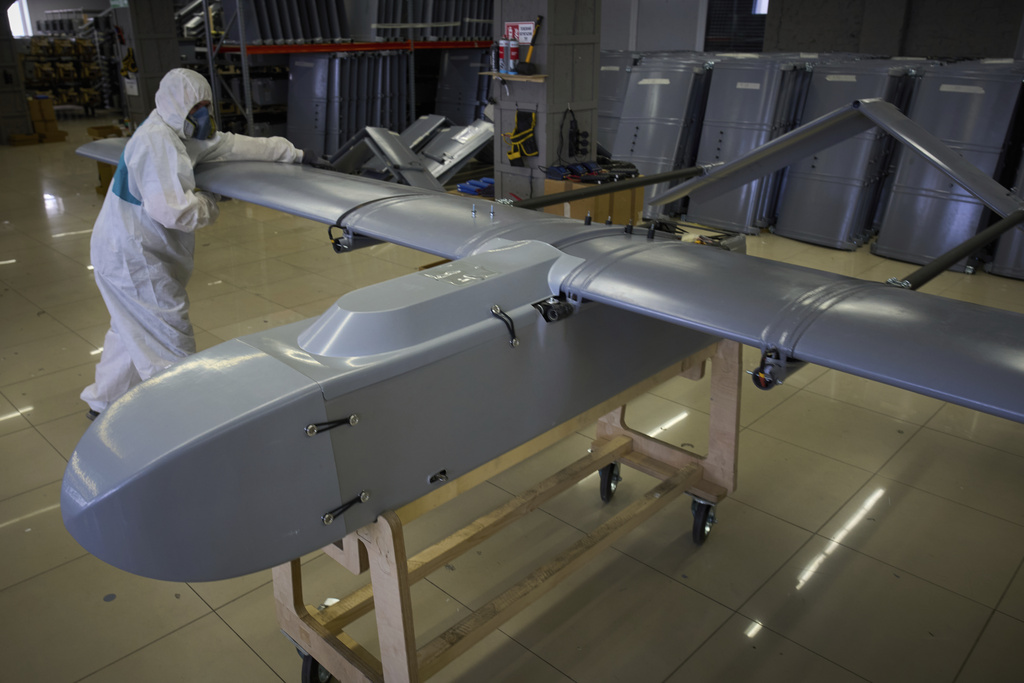
A Ukrainian long-range drone. Source: AP
These strikes are causing serious economic damage to Russia, not to mention the environmental harm. Here’s a screenshot of recent fires at Russia’s Rosneft facility on the Black Sea after recent drone attacks.

Source: X
On the front lines, short-range drones are now Ukraine’s primary weapon holding back Russian advances. Most of these are small drones with anti-tank RPG warheads attached.
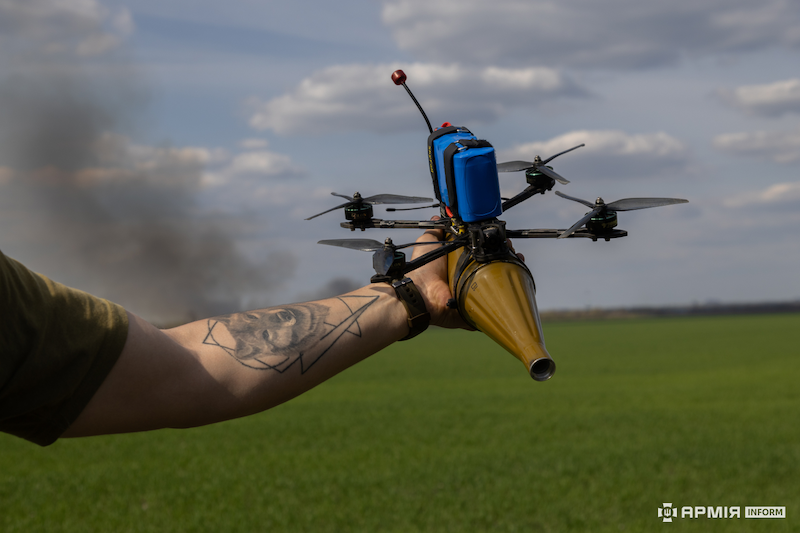
Crude, but highly effective. There are also bomber drones which drop grenades, mortars, and improvised munitions. Interceptor drones roam the skies, looking to foil enemy attacks.
Both sides are using flamethrower drones, which drip molten thermite to melt anti-drone netting and ignite enemy structures.
Meanwhile Russian long-range drones and missiles are increasingly hitting military sites in the capital, Kiev (Kyiv). And across the rest of the country. Glide bombs are devastating the front lines. And Russia is using at least as many short-range drones as Ukraine is.
It is estimated that up to 15,000 drones are being used in Ukraine per day. And that up to 90% of casualties are caused by these terrible little machines.
Traditional maneuver warfare is extremely difficult in these conditions. Advances crawl forward at a snail’s pace.
Tanks and IFVs are increasingly irrelevant on the battlefield. Even artillery, the “God of War”, has become an afterthought.
In just a few short years, this new class of drones have changed warfare forever. The question is: are American defense contractors ready for this new world?
Petraeus’ Warning
Former Army General and CIA Director David Petraeus is out with a new warning about drone warfare. I’m not a fan of the man, but what he says here is true.
“We have not remotely learned all the lessons we should have from the war in Ukraine.
That is the future of war right now. Ukraine is using 10,000 drones a day.
Ninety percent of the casualties on the Russian side are caused by drones. Tanks can’t manoeuvre anymore. They can’t survive. Armored vehicles can’t survive.
And by the way, there’s more coming. Within a year or two, we’re going to see unmanned systems that are not remotely piloted.
In the future, we’re going to see autonomous systems — truly autonomous — that do not require a pilot to remotely operate them.
Then you face drone swarms. And that is something for which we really don’t have a solution.”
Weapons Giants Fall Behind
America’s largest defense contractors, Lockheed Martin (LMT) and Northrop Grumman (NOC), have traditionally focused on gigantic programs. The F-35, naval ships, helicopters, cruise missiles, and big drones costing $30-90 million a piece.
These contractors have been forced to build their supply chains and manufacturing around getting support from specific political districts.
Elon Musk has been especially critical of U.S. defense firms, singling out manned fighter jets like the F-35 as “obsolete in the age of drones.”
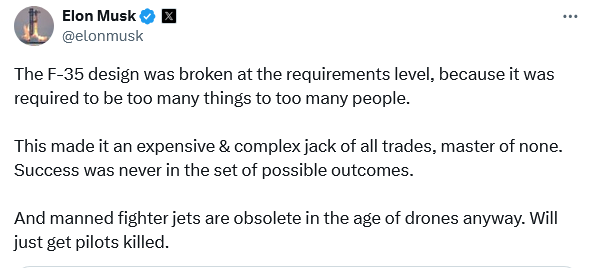
Source: X
I’m not sure fighter jets are obsolete just yet. But tanks and other traditional weapons systems do seem to be moving in that direction.
The point is that making cheap disposable “kamikaze” drones at scale is outside the wheelhouse of big defense firms.
Now that the U.S. military wants low-cost attack drones, they are doing something unusual: going to smaller firms in search of innovation.
The Drone Dominance Program
It’s been over 4 years since the war in Ukraine began, and the disruptive potential of drone warfare became clear.
The Department of War is now beginning to ramp up drone programs. In Iran we saw the debut of the LUCAS attack drone, based on Iran’s Shahed-136.
Now the American military is looking to build 300,000 attack drones by 2028. That may sound like a lot, but it’s 15 days of supply for Russia and Ukraine.
And the requirements call for doing it without Chinese parts. That in itself is a huge challenge, because today China makes about 85% of the world’s commercial and personal drones. China’s supply chains are already incredibly developed, and it will take time to build out our own. The vast majority of Ukrainian and Russian drones used are either Chinese, or built with Chinese motors, batteries, servos, and other parts.
The Drone Dominance Program (DDP) is a fascinating development. The Department of War is tearing up the old playbook of 10-30 year development cycles and trying something fresh.
Dozens of companies were invited to participate in a series of trials. Various drones are tested for accuracy, speed, resistance to electronic warfare, and other objectives.
And the Department of War has an online leaderboard showing the top performers:
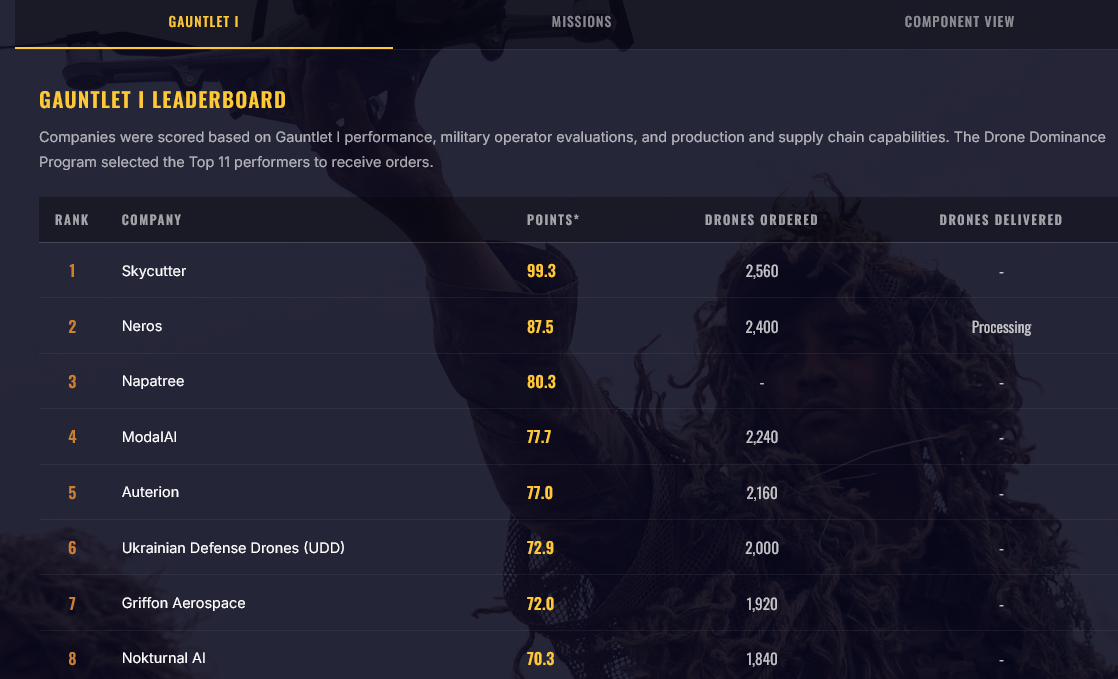
Source: Drone Dominance official site
Note the complete absence of any big defense contractors. The leading performer, Skycutter, is a small private U.K. company with plenty of frontline experience in Ukraine.
We are early in this new age of drone warfare. But it is set to shake up America’s stale defense contracting business. New players are emerging.
The legacy defense giants have been slow to adapt to this reality. They remain focused on cash cow programs.
And for a while, that playbook will work. But the future of warfare looks like it will be dominated by unmanned systems. And the big, slow, expensive drones they make today are clearly not cut out for this new world.
American defense giants have coasted for decades on gold-plated billion-dollar contracts. They have failed to produce effective hypersonic missiles and affordable attack drones. Their reign won’t last forever.
I’ll be watching to see which companies emerge as leaders in this new tech. Most of them are private startups at this point, so aren’t investable (yet).
But disruption is finally coming to the defense industry. It’s about time.

Comments: