

Gold Surges as the Debt Reckoning Begins
It was a good day for gold bugs.
As of midday gold was +4% to $4,266/oz. Silver popped +4.3% to $63/oz.
The GDX gold miner ETF rose +6.99%. The SILJ junior silver miner ETF was +6.2%.
Let’s take a quick peek at the GDX chart over the last year.
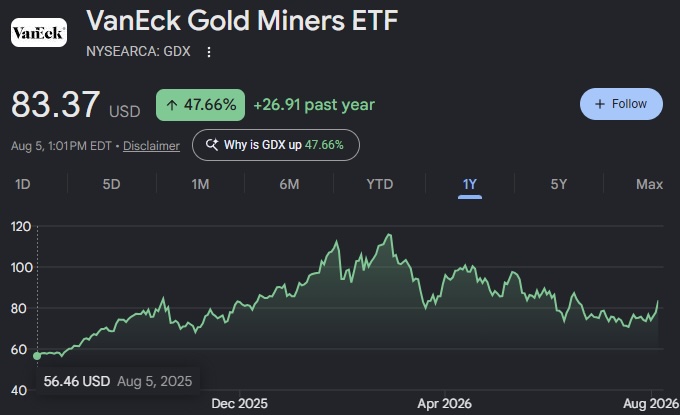
Still up 47% over the past year. Nice. But near the beginning of the year, gold miners were up more than 100%.
I believe we’ll set new all-time highs within the next few years. Heck, it could even be this year.
The market is slowly remembering that behind the Iran war and AI excitement, there’s still a looming global debt crisis.
And endless bailouts are on the horizon.
Catalysts
If you read mainstream financial outlets, they’ll tell you precious metals are jumping due to the prospect of peace with Iran, which should keep interest rates lower.
Pffffft.
This move is more about debt, the dollar, Japan, and fallout from the Iran war.
Let’s start with what’s happening in Japan, which we covered yesterday. Essentially Japan needs cash to support its own currency, which is falling off a cliff.
They would like to sell U.S. treasuries, of which they own over $1.1 trillion worth. But that would make Uncle Sam angry. Because if Japan dumps a bunch of treasuries, it would force the price of treasuries down, and yields up.
So we’re essentially loaning them freshly printed dollars. AND we’re using our own funds to help support the yen as well.
The Financial Times’ Barry Eichengreen laid the implications out in a viral article yesterday titled The real message in the yen intervention. Here’s an excerpt:
Both moves are an indication that the dollar’s status as a reserve currency is not what it used to be. Central banks are accustomed to holding foreign reserves in dollars because markets in US Treasury securities are liquid. Central banks hold US Treasuries because they can be freely bought and sold and used in interventions. But not now, at least not in unlimited quantities. Instead, we see the US Treasury stepping in with euro sales as part of its contribution to the intervention, thus limiting the volume of dollar sales needed by the Japanese authorities.
…The bottom line is that Washington, fearing the consequences for US financial markets, is reluctant to see foreign central banks use their dollar reserves. This is telling us that the dollar is not the attractive reserve currency it once was. When this message sinks in, other countries will redouble their search for more attractive, readily usable alternatives. Reserve diversification is apt to gather steam.
Some of you are scratching your head right now, and that’s understandable. This is complex and boring stuff. But unfortunately it’s important.
The essence is that around the world, countries are reconsidering how much of their reserves should be in dollar assets.
South Korea Goes for Gold
In the FT article I quoted above, Mr. Eichengreen writes, “When this message sinks in, other countries will redouble their search for more attractive, readily usable alternatives.”
Indeed, they already are. South Korea’s central bank just announced it was buying gold for the first time in 13 years.
Jeong Hee-sup, head of the Bank of Korea’s Reserve Management Group, was unusually blunt about why gold is attractive.
“With geopolitical risks becoming a persistent feature of the global environment, interest in gold as a safe-haven asset has grown significantly among central banks.
Given gold’s role as an inflation hedge and its potential as an alternative to the U.S. dollar, it’s evident that gold should be considered one of the viable assets from a medium- to long-term perspective.”
Hmm, what do we have here? A central banker from a close ally admitting that gold is an “alternative to the U.S. dollar” and “should be considered one of the viable assets”.
Central bankers around the world are remembering why gold was the ultimate monetary asset for thousands of years. It’s apolitical. No counter parties. No confiscation risk. No permission is required to sell it.
Gold simply sits in a vault, gains value over time, and is invaluable during a crisis. And there will be no shortage of crises over the next decade.
A Harsh Reminder
What’s happening in Japan served as an unwelcome reminder to the world. We still face a debt crisis of unprecedented scale.
One that isn’t going away even if the Iran war is resolved tomorrow (and it won’t be).
Over the coming years, incredible amounts of dollars will be printed to attempt to prevent major financial crises. It will only delay the day of reckoning. But the money will still be printed anyway.
Jim Rickards calls gold “the everything hedge”. That’s a great way to describe it. For me, gold, silver, and miners are a hedge against financial chaos. And there’s going to be no shortage of that.
So I’m holding onto my ~18% allocation to gold, silver, and miners. If you don’t own any yet, this is a fine time to buy. As long-time readers know, I’m especially fond of silver. Higher risk, but higher potential reward than gold.
Precious metals remain a critical part of a modern investment portfolio. But most people are still dramatically underweight the asset class.
That will change once the first real financial crisis hits.

Comments: