
The Conquest Clause
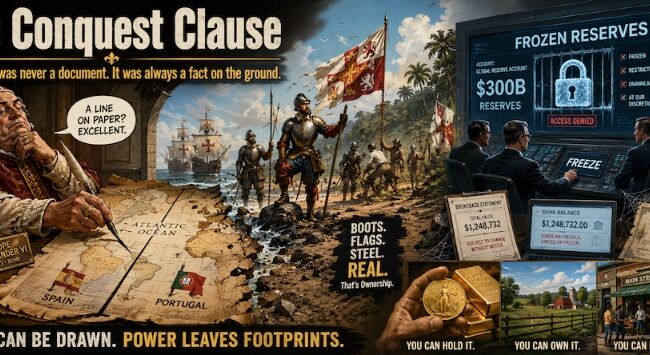
In 1493, Pope Alexander VI picked up a pen and drew a line down the middle of the Atlantic Ocean.
Everything west of that line belonged to Spain. Everything east belonged to Portugal. Two kingdoms split an entire hemisphere neither of them had ever seen, based on one man’s signature in Rome.
It was the greatest real estate deal in history. No inspection. No survey. No buyer’s remorse allowed.
There was just one problem. A line on a map doesn’t hold ground. Ships and soldiers do.
The Friar Who Called the Bluff
In 1539, a Dominican friar named Francisco de Vitoria stood up in a lecture hall in Salamanca, Spain, and said something dangerous.
He said the Pope’s line was worthless.
Vitoria argued that a pope in Rome had no power to hand out land in the Americas like party favors. He said sovereignty doesn’t come from signatures, but something real.
His lectures, known as De Indis, are considered the founding document of international law. Buried inside them is an idea Vitoria’s successors spent the next 400 years working out in practice, even if they never said it out loud.
Simply put, a piece of paper means nothing without the power to hold what you claim.
What the Right of Conquest Meant
For most of recorded history, nations operated on a simple, unwritten rule. If you conquered a territory and could hold it, the world would eventually recognize it as legitimately yours.
“I respect your conquest, and you respect mine.” And however ugly the process, the map eventually caught up with reality on the ground.
This is how most of the borders you grew up with actually got drawn. While force drew them, time and recognition secured them.
The Rule Still Applies
After World War II, the United Nations Charter banned the use of force to acquire territory. Officially, conquest was over. Allegedly, borders were now untouchable by force.
It sounded wonderful, but wasn’t quite true.
The unwritten rule didn’t disappear. It just stopped being polite company. Nations still take territory by force. They just no longer call it that, while everyone else pretends not to notice… right up until the day they’re forced to deal with it.
For instance, regarding Ukraine, a settlement with the West that leaves Russia holding land it seized by force is a quiet admission the old rule still applies. No bueno.
The Relevance
The Conquest Clause governs nations. And you.
In 2022, the United States and its vassals froze roughly $300 billion in Russian central bank reserves. Keystrokes froze the money, because you don’t need tanks or soldiers to steal anymore.
Moscow held the paper, but the West held the actual power. When push came to shove, the paper lost.
That’s conquest dressed up in a suit. Legal title is a courtesy extended by whoever currently runs the system you’re relying on. It holds up… until it doesn’t. Just ask Venezuela.
Remember, your bank balance is a promise from an institution. Your brokerage account is an entry in someone else’s database. Even your dollars are a claim on a system the Federal Reserve can (and will) dilute whenever it wants. None of these things are wrong to own. But none of them are yours the way a friar in 1539 would have understood the word.
Holding your gold in your hand needs no one’s permission or system. Land you own is yours in the oldest sense there is. A business with real customers and real cash flow answers to you and no one else.
Don’t rush to sell your paper assets. Stocks, bonds, and bank accounts still do the heavy lifting in a portfolio. But know the difference between what you hold and what you’re merely promised. Make sure some of what you own doesn’t require anyone’s permission to stay yours.
Wrap Up
Holding your gold feels different from seeing a number on a screen, even when the number represents more wealth. Vitoria’s lesson is in our DNA. Paper is a courtesy, not a fact.
Nations have always known this, even if they pretend otherwise. The lawyers may write treaties, but the world waits to see who can hold the ground.
When it comes to your wealth, ask what you hold, not just what you’re owed. The gap between the two has a way of revealing itself at the most inopportune time.

Comments: