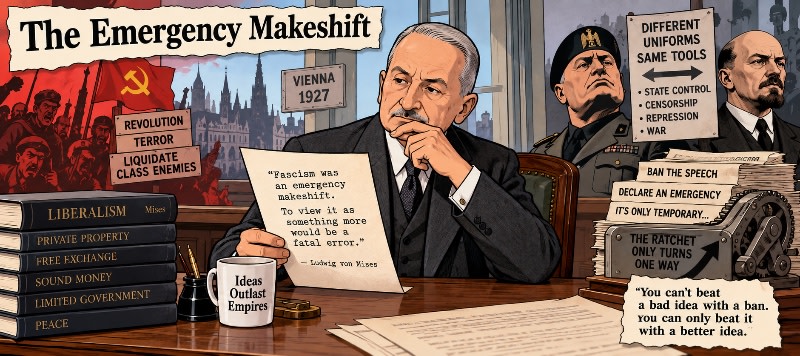
The Emergency Makeshift

It’s Vienna in 1927.
Ludwig von Mises is sitting in his office at the Austrian Chamber of Commerce and has just written the most dangerous paragraph of his career.
Of course, he doesn’t know that. But that paragraph will be clipped, stripped of context, and thrown in his face for the next century. His ideological enemies will use it to smear him. What’s even worse is that some of his supposed friends will use it to claim him.
The book is called Liberalism. Chapter 1, Section 10 of the tome is titled “The Argument of Fascism.”
In it, Mises admitted something most classical liberals wouldn't say out loud. He wrote that the fascist movements sweeping Europe were full of the best intentions, and that their intervention had, for the moment, saved European civilization.
If you stop reading there, you have the perfect scandal. “Mises praised fascism!”
But if you finish the paragraph, you have context, and hence, the truth.
He ended that section by writing, “Fascism was an emergency makeshift. To view it as something more would be a fatal error.”
Those who don’t argue in good faith never mention that all-important conclusion. Of course, if they did, there would be no argument. Mises was no fascist at all.
What Europe Looked Like From Vienna
To understand what Mises meant, you have to see what he saw.
The Bolsheviks had taken Russia in 1917. The civil war that followed killed millions. The Comintern wasn't shy about its plans for the rest of Europe: revolution, terror, and liquidating its class enemies. Communist risings had already broken out in Germany and Hungary. Then, Mussolini took Italy in 1922.
From a Vienna office in 1927, none of this was theory. It was the continental neighborhood.
So Mises made a narrow, lawyerly point. When armed men come to overthrow your society by force, you may defend yourself by force. No liberal has to pretend otherwise. The fascist militias had met revolutionary violence with counterviolence, and, in the short run, it had worked.
That’s the entire concession. Self-defense works in the moment.
Then he spent the rest of the section explaining why Fascism would only ever win “the moment.”
The Demolition
Here’s what the quote-clippers on both sides leave out.
Mises argued that fascism couldn’t defeat socialism, because it refused to fight socialism where socialism actually lived: in men’s minds.
Communism is an idea. It’s a horrendous idea, but it’s an idea, nevertheless. You can’t shoot it or jail it. You can ban the pamphlets, shut down the presses, and exile the professors, but the idea bides its time, waiting for the pressure to abate.
Persecution only feeds it. Every jailed agitator becomes a martyr. Every banned book becomes forbidden fruit. Repression converts the curious into true believers.
And what did fascism offer in place of the socialist idea? Nothing. Mises noted that its economic program was interventionist to the bone: price controls, cartels, state direction of industry. Fascism fought socialism with socialism’s own tools while borrowing its methods of force. They were two peas in a pod.
Only a better idea can beat an idea, and Mises had great one: private property, free exchange, sound money, limited government, and peace. It was the decidedly ordinary machinery of liberalism. It didn’t march or wear uniforms. It just worked, which is why there’s no such thing as a rally for capitalism. Everyone who believes it works is, well, at work.
Mises predicted another thing. A movement built on the worship of force at home would worship force abroad. He warned that the fascist powers would drag Europe into wars that would wreck the civilization they claimed to save.
He wrote that 12 years before the Wehrmacht crossed into Poland.
The Makeshift Never Stays Temporary
Now, why does a 99-year-old book section matter to your Thursday morning?
Because the emergency makeshift isn’t a fascist invention, but a permanent temptation that every generation reaches for.
The pattern is always the same. First, a genuine threat appears. Then, fear takes hold. Next, someone offers the shortcut: skip the argument, just suppress the threat.
Or ban the speech at the university, lest we offend the students. Or declare an emergency, grab the state’s power, and swear to the Holy Father above that the new rule is temporary. You know, like they did with the Patriot Act.
But we know the Ratchet only turns one way. Emergency powers outlive every emergency. The censorship built for your enemies spreads domestically. Yes, we scan!
And the bad idea you banned? It’s still there, getting stronger, in fact, because now it can claim it was silenced instead of answered.
Mises lived the endpoint. He fled Vienna in 1934. His books were purged. His seminar scattered across the globe… all the way to NYU.
Then the strangest thing happened. The regimes that banned him died. The empire that embodied everything he fought collapsed in 1991, for the very reasons he’d laid out in print decades earlier. His ideas outlived every man who tried to bury them.
Force lost. The idea won. It only took 50 years, which is roughly 49 years longer than any politician's patience.
Wrap Up
When you’re told some idea is too dangerous to be heard, or that this crisis requires suspending the normal rules, or that the makeshift will be temporary this time, you’re watching the oldest play in the book. It failed in 1927, and it hasn’t improved with age.
You can’t beat a bad idea with a ban. You can only beat it with a better idea, argued in the open, by people with the patience to keep arguing.
That’s the way for civilization to keep moving forward.
Have a great day ahead.