

Nothing Stops This Train
By now, everybody knows the U.S. government has a debt problem.
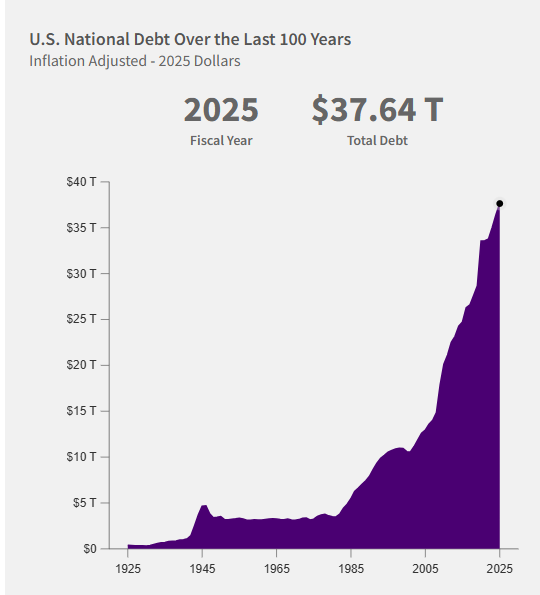
But the chart below offers a new angle, because it is inflation-adjusted.
Source: U.S. Treasury Dept
This chart is about 6 months old, so it’s already outdated. The current federal debt total is up to $39 trillion. And growing at $2 trillion a year, which could rise to $2.5 trillion soon. And much larger when we get a recession.
The point is that even once we adjust for inflation, debt is a big problem. It’s not a good sign when debt charts go parabolic.
Besides the obvious, there are a few interesting things to note in the image. First, look at the bump in 1945 from World War II. It looks so tiny once you adjust for inflation.
Second, look at what happened after WW2. The debt load came down, and was steady for around 40 years.
Then in the 1980s, government spending jumped. Around 2008, the debt goes almost vertical.
That’s what most people think of when they think of our country’s financial problems. And it’s a real, big thing. Oh yeah, and let’s add in another $7 trillion for state and local debt.
But there’s another black swan lurking out there. One many people aren’t aware of.
Unfunded Liabilities
Social Security and Medicare. The two horsemen of the unfunded fiscapocalypse.
The American government has promised huge benefits for these programs going forward.
And for a while, when baby boomers were at their earnings peak, we had huge surpluses. All that money should have been saved for the future, when baby boomers were set to retire.
But those surpluses were spent by stupid politicians. So now we have massive unfunded liabilities.
Here’s the broad overview:
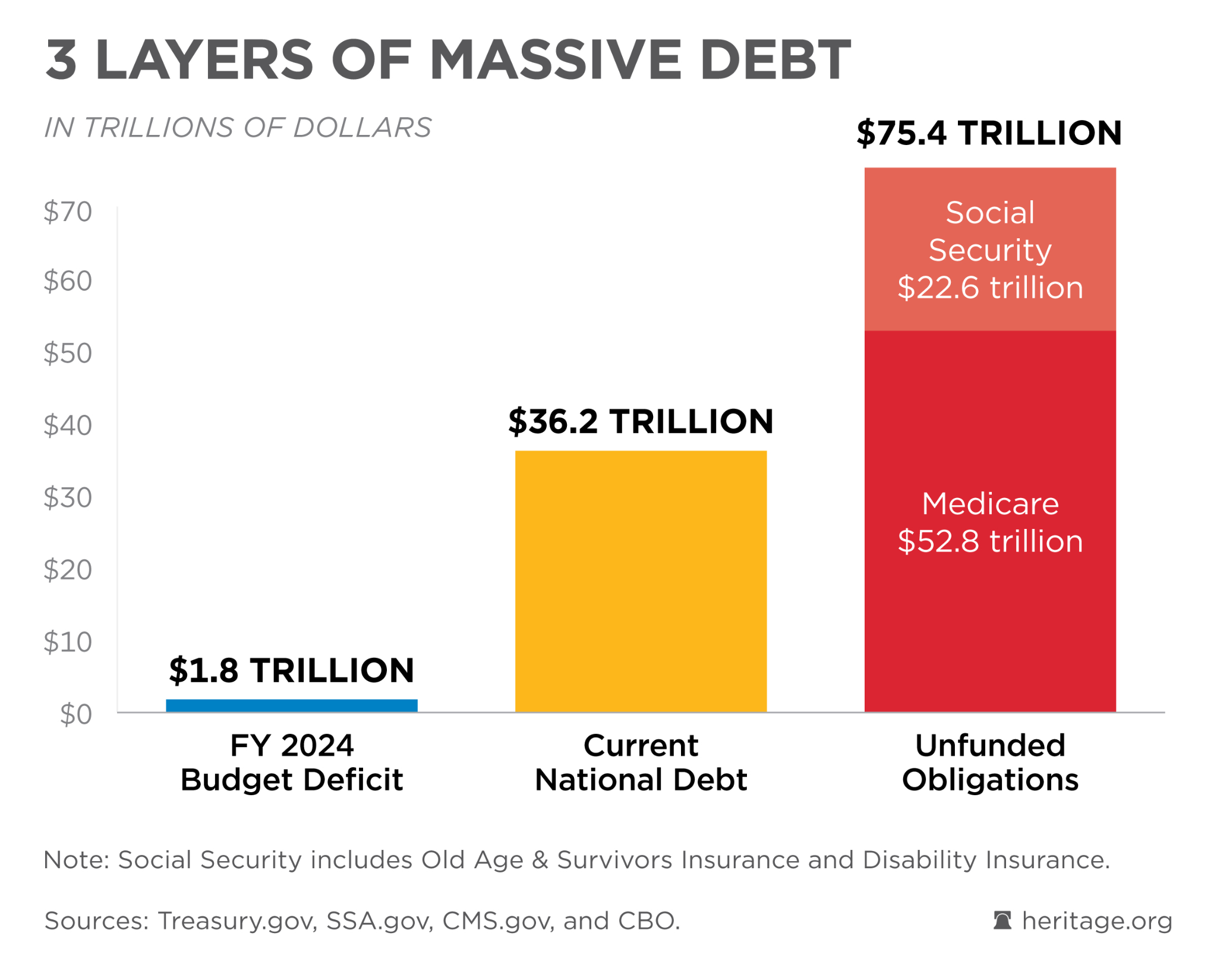
Medicare is the biggest unfunded liability. Healthcare costs (and fraud) are absolutely surging.
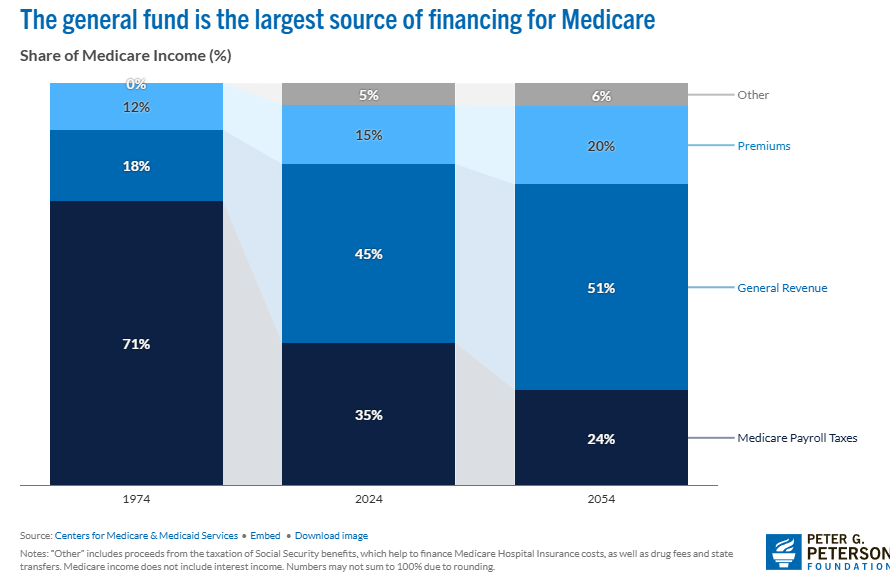
Take a look at the chart below. It shows the percentage of Medicare spending which is funded by payroll taxes.
Source: Peterson Foundation
In 1974, payroll taxes paid for 71% of Medicare expenses. Only 18% came from the government’s “general revenue” fund. Not bad, almost sustainable.
But today payroll taxes cover less than 35% of Medicare expenses. The rest is paid with general taxes and deficit spending. So despite having massive payroll tax revenue, Medicare is still underwater.
According to the Medicare Trustees Report, the program’s Hospital Insurance Trust Fund will be depleted by 2033.
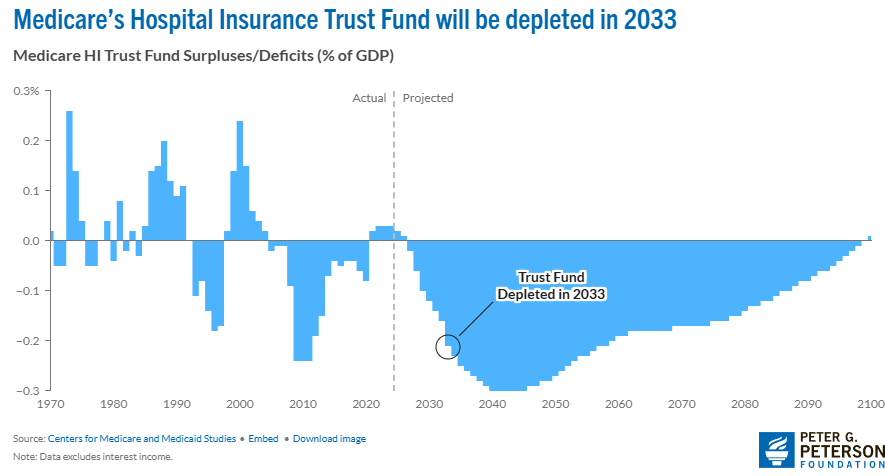
The situation looks bad based on government projections. But those projections tend to be far too optimistic.
Medicaid is a whole separate issue, and isn’t considered an “unfunded liability” due to the fact that it’s paid out of general revenue (no trust fund). But it’s also a huge problem.
Together, Medicare and Medicaid account for about 6% of GDP. A massive, ridiculous number.
$100 Trillion+
Add in another $8.2 trillion for underfunded federal pensions and Veterans Affairs costs.
And we get a number that dwarfs U.S. debt. Let’s call it $100 trillion.
These are America’s unfunded liabilities. Money we have promised but haven’t budgeted for.
In short: Medicare, Medicaid, Social Security and other unfunded liabilities will remain a drag on the economy for many decades to come.
Unless there’s major reform. Cost-cutting, benefit-slashing. But that is a very hot political issue. Too hot for any sane politician to touch. President Trump has announced a major fraud task force, and hopefully something comes of that. Because fraud in Medicare and Medicaid is absolutely out of control.
But the fundamental problem will remain. Too many benefits promised to too many people, and not enough money to pay for it all.
How will we solve these issues?
Money will be printed to cover shortfalls. It’s the only realistic political outcome.
The Next Decade is Key
These big debt/liability situations always take longer to play out than it seems like they should.
But I believe the debt + unfunded liability situation will reach a tipping point within the next decade. We have already passed the “event horizon”, where there’s no turning back. It’s impossible to pay off the debt and fully fund the liabilities with fully-valued dollars.
The debt will need to be paid off with devalued money. The liabilities will be paid for in “full”, but they won’t be worth what they should.
In other words, inflation will eat up a large portion of our debts and liabilities. Which means the people holding U.S. debt (Treasury bonds, bills, notes) will likely get hosed.
At some point people expecting to live off social security will have to lower their expectations. Sure, your check will come every month, but it won’t come close to meeting your needs. Inflation will eat up the purchasing power (cost-of-living adjustments won’t match true inflation).
It’s a bummer, but I don’t see any way around it.
When will we hit this turning point? There are hundreds of factors to consider, so it’s very difficult to say. But we are approaching the “snowball” period on our debt, where interest payments are becoming a huge portion of overall government spending. Not a good sign.
And as far as unfunded liabilities go, Medicare is probably more of a concern than even Social Security. Healthcare costs are simply rising too fast, with no signs of slowing down.
DOGE Never Stood a Chance
Even if DOGE (President Trump and Musk’s plan to slash government spending) had worked, it would have only delayed the inevitable.
But it didn’t work. The swamp remains undefeated. Our political system has become an enrichment scheme for fraudsters and special interests. Call them whatever you want. The deep state, the swamp, or much worse.
No matter who’s in power, unfunded liabilities and debt will continue to grow. It’s a structural part of our economy now. The ponzi must go on.
So the train is accelerating down the mountain with no brakes. And it’ll probably avoid derailing for longer than we expect.
But eventually the bill comes due. And when it does, the Federal Reserve and Treasury Department will go to insane lengths to engineer a “solution”. We’re approaching that point now.
Hint: their solutions will involve lots of money printing, debt monetization, and financial repression. And given the size of the problem, it’ll take at least a decade, and probably longer, to fix.
This is why we own hard assets.

Comments: