
The China Threat to… Everything
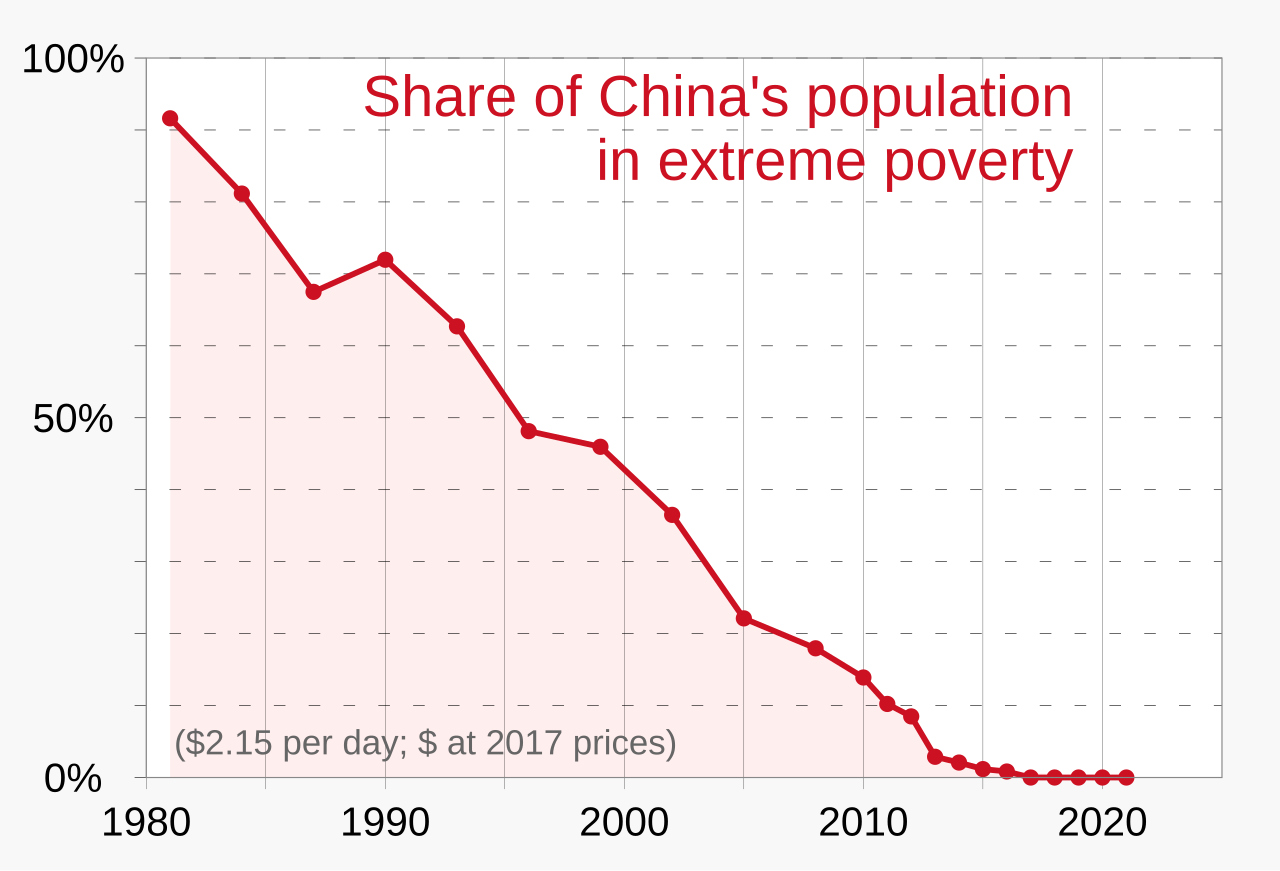
In the 1980s and ‘90s, China was among the poorest countries in the world.
More than 90% of the country’s population lived in extreme poverty in the early ‘80s.
In one of the most remarkable growth stories in history, the country has (at least according to government statistics) eliminated extreme poverty.
Source: Wikipedia
The real change began in 1978, when Chairman Deng Xiaoping began to open China up to foreign investment. He created “special economic zones” in areas like Shenzhen, where companies could take advantage of cheap labor and low taxes.
Industrialists from Taiwan, Japan, and the U.S. moved factories to mainland China to take advantage of the low-cost labor and loose regulations.
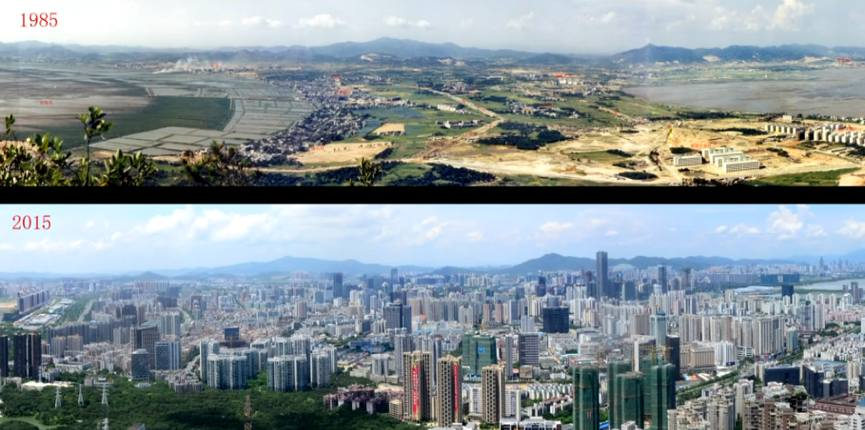
The image below shows Shenzhen in 1985 (top) vs 2015 (bottom).
Source: CGTN
The 1980s were the beginning of China’s industrial rise. The country went from typical communist central-planning (a disaster) to a unique form of “state capitalism”.
Ever since, China’s economic rise has shaken up the global economy. And it’s likely to get more challenging from here.
From Humble Beginnings
At first, China was attractive for its huge pool of low-cost labor. This was the “sweatshop era”, for lack of a better term.
Toys, garments, shoes, plastic widgets, etc. Components were mostly imported rather than made within China.
Since then, China has steadily climbed up the industrial ladder.
In the 1990s, China moved up the chain, creating more of its own components. It shifted into electronics, appliances, chemicals, and low-end machinery.
The 2000s was when explosive growth began. China was admitted to the World Trade Organization in 2001.
The country began to dominate in steel, cement, aluminum, electronics, solar panels, and industrial machinery. The scale of their industry became a serious threat to the world.
The Chinese government supported a massive buildout of industry. Cheap land, cheap loans, and subsidies rained down. It became increasingly difficult for the world to compete on price.
Countries began to put up tariffs on metals and other areas where China was the clear cost leader.
From 2008 to 2015, the China threat escalated. The country continued to move up the value chain, making increasingly complex machinery and products.
Companies that built in China got access to cheaper labor, but sacrificed their manufacturing secrets.
The Everything Threat
Historically, China has not been a hub of innovation. It is an iteration hub. They take someone else’s tech and hone it until the cost is rock-bottom.
Some of the tech is essentially stolen, and some of it China requires as payment for entering the massive Chinese market.
We’ve seen it play out in steel, aluminum, electric cars, high-speed trains, phones, telecom equipment, and more.
Let’s look at two examples where China is threatening major Western industries today.
Pharma
In a recent interview, Pfizer CEO Albert Bourla said, “I go to bed and wake up with two things on my mind. China and AI”.
The company just signed a $10.5 billion licensing deal for oncology treatments from a Chinese firm.
Pfizer isn’t the only one looking to China for new treatments. Last year, pharma companies spent a massive $137 billion licensing Chinese drugs and drug candidates.
Pfizer CEO Bourla said the following about Chinese competition:
“For every one area we have a company working on something novel, the Chinese have ten companies working on it too.”
Bourla warned that in terms of research and development, Chinese companies “do things 3 times faster and at half the cost”.
Pfizer and other pharma firms are currently licensing tons of potential treatments from China, but Bourla warns that won’t last. He says that eventually China will cut out the middleman and attempt to sell these products to the world directly.
China has expanded its mega-scale playbook to pharmaceuticals. This is potentially good for patients (more new drugs), but could be very bad for Western pharmaceutical stocks in the long run.
Auto-Mation Nation
The other area which is especially painful for the U.S., Japan, and Europe is automobiles.
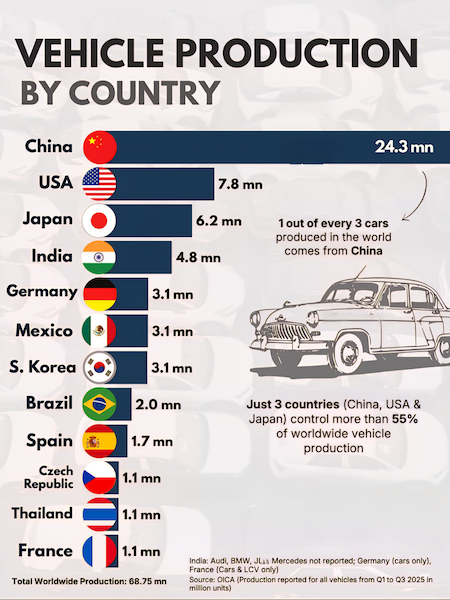
Over the past few decades, China has invested heavily in car production. And today they’re far ahead of everyone else.
Source: Global Statistics
In 2000, China’s auto production was maybe 2% of the global total. Today it’s at least 35%.
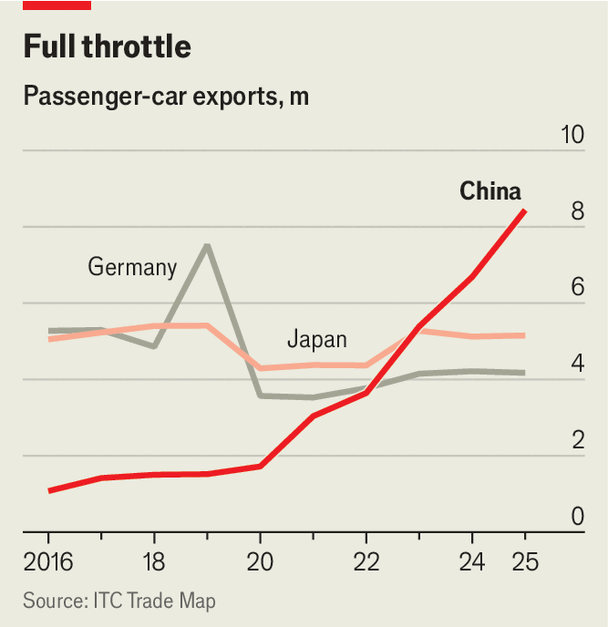
Take a look at the past 10 years of car exports by the top 3 countries.
Source: The Economist
Ouch. China went from exporting around 1 million cars a year in 2016 to around 9 million today.
And in terms of electric vehicles, China is absolutely dominant.
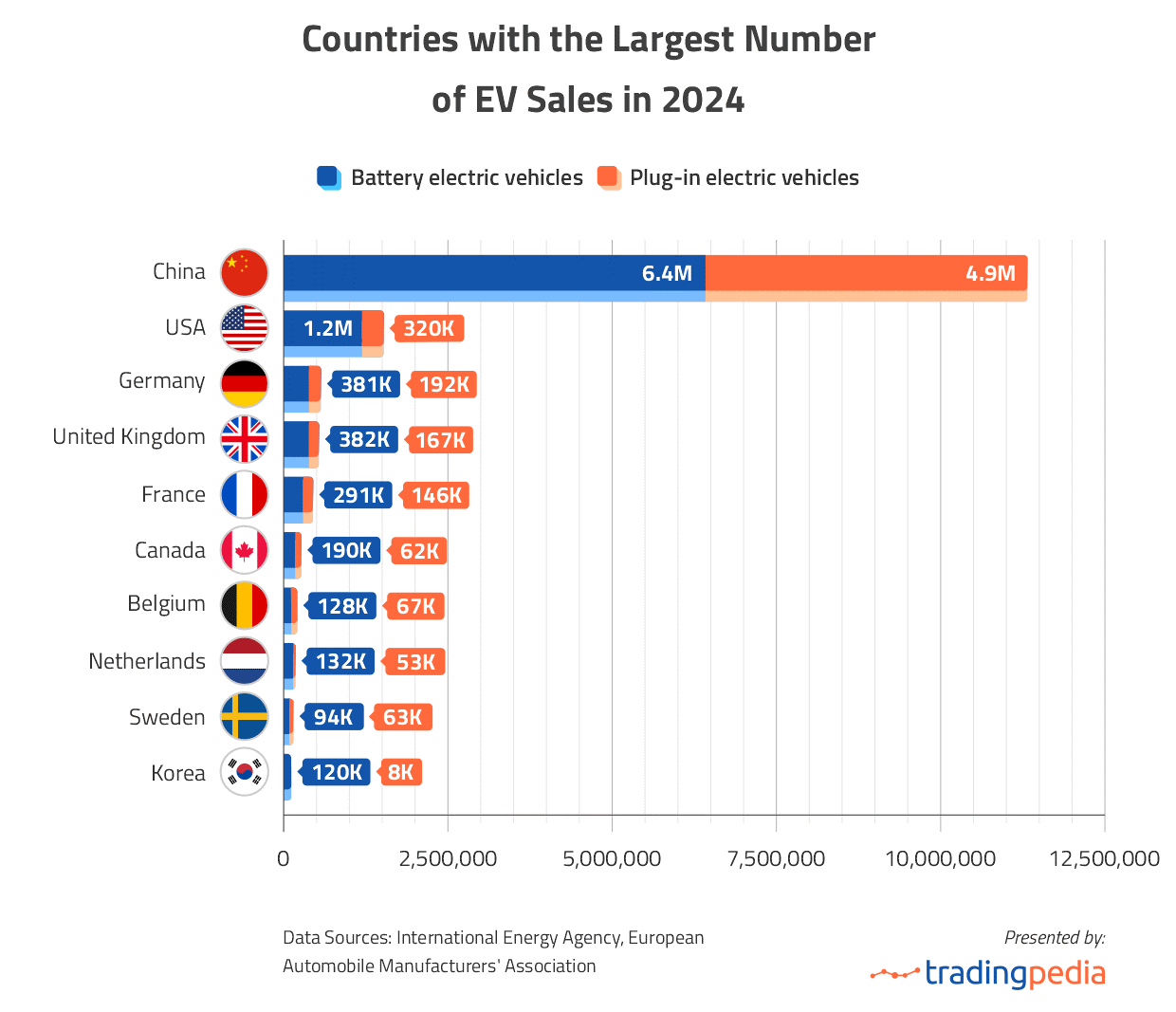
In China, entry-level electric vehicles start at around $8,000 out-the-door. Ford CEO Jim Farley has called Chinese electric cars an “existential threat”, and their manufacturing process “the most humbling thing I’ve ever seen.”
Additionally, Japanese, European, and American car companies are now struggling to compete within the massive Chinese market. Selling into China was a huge profit center for Japanese and Western carmakers over the past few decades. That era is ending.
A Wakeup Call
China has its problems. Too much debt, not enough domestic spending. Citizens save too much, at least according to modern economic theory.
And “state capitalism” is far from perfect. Sometimes the result is “ghost cities” and bridges to nowhere.
But we can no longer ignore the threat of China’s massive scale. When they decide to move into an industry, shock waves radiate throughout the globe.
Today China has set its sights on semiconductors and advanced electronics. They are making a disturbing amount of progress on that front. I expect that within a decade, they’ll be fully caught up with Nvidia, Intel, and the memory giants like Samsung and SK Hynix. Costs and profits at Western giants will plummet as competition soars.
As Americans, we must heed this wakeup call. We can no longer dismiss Chinese goods as low quality junk. The country isn’t just a big pool of cheap labor anymore. It’s an industrial titan like the modern world has only seen following World War II, when America dominated with 50% of industrial capacity.
For too long we’ve coasted off of cheap Chinese goods. Corporations exported their manufacturing to the country to save a few percentage points. This kept corporate profits high, and inflation low, but hollowed out our manufacturing base. Millions lost high-paying jobs.
Now China has moved up the value chain and threatens our most profitable sectors.
We can’t win this war with sanctions. We’ve seen this play out with GPUs and other AI hardware. China has made incredible strides in these areas thanks to these restrictions, which gave them all the motivation they needed to build up domestic capabilities.
America needs to stop importing cheap foreign labor, and lean into empowering Americans to do what they do best: take risks, innovate, and grow.
Tackling fraud and waste must become a top priority. Efficiency is everything in this global industrial competition.
If we do these things, we can regain our place as an industrial titan. But it’s going to take time, sacrifice, and major political reforms.
The Chinese industrial threat is not going away anytime soon. It continues to grow and expand into new areas. What we covered today is just scratching the surface.
To compete, we must streamline regulation, lower taxes, and most importantly – re-industrialize with haste. We’ve made some early progress on the re-industrialization front, with the Trump administration bringing advanced chip manufacturing back to the country with TSMC’s new Arizona fab. But we need much more of this.
We may also need to let the dollar fall in a controlled manner, in order to make our exports more competitive.
The U.S. has all the ingredients required to regain our rightful place as a manufacturing powerhouse. Talent, natural resources, capital, and most importantly – the greatest entrepreneurial spirit the world has ever seen.
The future of American industry can still be bright. But we have work to do first.

Comments: