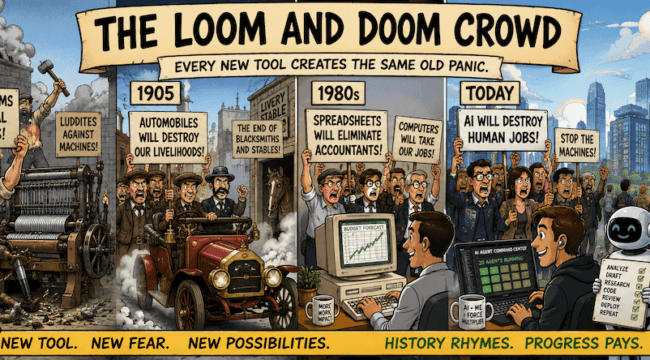

The Loom and Doom Crowd
They were wrong in 1812. They were wrong in 1905. And they’re wrong again.
In 1812, English textile workers stormed mills across Yorkshire and Nottinghamshire. They smashed power looms and burned cotton frames. They called themselves Luddites, after a possibly mythical weaver named Ned Ludd who’d supposedly done the same years before.
Their grievance was simple: the machines were taking their jobs.
They were right about the short term… but spectacularly wrong about the long term.
The power loom didn’t destroy textile work. It created an industry so large Britain built an empire around it. By 1850, there were more textile workers in England than there had ever been, and they were richer, worked in heated buildings, and lived longer.
I call this the Wrecker’s Fallacy: the belief that a tool which replaces one task will destroy all the tasks around it. It sounds sensible. It’s almost always false.
Turning Water Into Wine, Silicon Valley-Style
Marc Andreessen sat across from Joe Rogan last week and tried to explain what AI is. He called it “turning sand into thought.” Chips are silicon. Silicon is sand. Run electricity through them in the right way, and you get something that reasons, generates, and acts. Not merely faster data retrieval or a fancier search box. Cognition.
His broader point: AI is “thought at scale, for everybody, in perpetuity.” Not a tool for the top 0.1%. It’s a layer of capability that any person with a device can tap into… indefinitely.
Yes, there are constraints. Current models are pattern-matchers, not thinkers in the full human sense. They cost a lot of energy. Sometimes, they make up stuff.
The gap between what AI boosters claim and what the models produce is real. Anyone who reads the fine print knows this.
But here is what the critics keep getting wrong: the gap is closing faster than they expected, and the Wrecker’s Fallacy is already running on schedule.
Always The Same Pattern
When Gutenberg invented the printing press, scribes panicked. The Church worried about large-scale heresy. Scholars warned that cheap books would drown readers in bad ideas.
But what happened instead? Literacy skyrocketed. Yes, the scribes disappeared. But new professions like editors, typesetters, publishers, and journalists came into being. The written word had become a generous employer indeed.
When the car arrived, blacksmiths and livery stable owners screamed doom. The auto industry killed its trade.
What also happened? America built 4 million miles of road. Mechanics, gas stations, trucking, tourism, suburbs, and fast food emerged from nothing. It gave us more employment, not less.
When spreadsheets hit in the 1980s, accountants feared mass unemployment. The opposite occurred. Cheap computing made financial analysis so useful that demand for accountants rose sharply for the next two decades.
The Wrecker’s Fallacy assumes fixed demand. If 1 worker can do the work of 10, then 9 workers will lose their jobs. But that’s not how economies work. As costs fall, demand rises. New markets and opportunities open. New needs appear that nobody had articulated because they couldn’t afford to.
As the saying goes, capitalism turns luxuries into necessities.
Capitalism’s Cheat Code
Strip away the Sand-Into-Thought poetry and the point is this: one person, equipped with AI agents, can now do work that used to require a team.
In Silicon Valley’s top shops, developers run 20 AI coding agents at once. Each agent works in parallel, 24 hours a day, 7 days a week. The human provides direction and judgment. The agents do the grunt work.
This will spread. After coders, it hits lawyers. Then doctors. Then writers, analysts, and logistics planners. Everyone who works with information will have access to a tireless, highly capable assistant that never calls in sick, never sulks, and never takes a long lunch.
The fear response says: “Jobs disappear.” The historical record says, “Costs fall, demand rises, new work appears that we haven’t named yet.”
This is not just a productivity story. It’s capitalism leveling the economic playing field.
For most of human history, access to expert advice, whether it was legal, medical, or financial, was rationed by price. The rich got good lawyers. The poor got whatever they could afford. AI breaks that ration.
Accessed on a cheap phone, a good AI model gives a farmer in rural Italy or a small business owner in Ohio the same quality of legal review that a Fortune 500 company pays a partner-level attorney to provide.
AI has created the most significant democratization of expertise since the advent of the printing press.
The Real Risks Aren’t What the Wreckers Fear
The critics aren’t entirely wrong to push back. They just target the wrong risks.
The real risk isn’t AI replacing human workers. It’s governments or quasi-governmental institutions consolidating control over AI. Andreessen calls this “authoritarian capture.”
Technology that democratizes expertise is powerful. But when locked behind government-approved guardrails, that same technology becomes a tool for controlling the masses.
Europe is already moving in that direction. The EU’s AI Act imposes compliance costs so heavy that only the largest firms can shoulder them. In practice, that means it shields incumbents and slows the democratizing effect to a crawl.
Yesteryear’s wreckers smashed machines to protect their guilds. Their modern descendants write regulations to protect their jobs. The motivation is the same, as is the damage.
Wrap Up
If history holds as it usually does, the winners in the AI era will be the people who pick it up first and figure out where it fits.
For investors, the immediate play is obvious: the picks-and-shovels infrastructure like chips, power, data centers, and the critical minerals that underpin it all. But this rally may be long in the tooth already, despite the President’s shout-out to Micron (MU).
A more nuanced strategy is to identify the sectors in which AI significantly reduces the cost of professional knowledge. Look at medicine, education, and financial planning firms that embrace these new cost dynamics by redesigning their operations instead of resisting the change.
Third, and this is key: take Claude 101 from Anthropic Academy. Learn about AI and become a user. You’ll be pleasantly shocked at what AI can do for you. Who knows? You may build what you have always dreamed of building.
The Yorkshire weavers who adapted to power looms made fortunes. The ones who smashed the machines went hungry.
AI has already changed everything. Which side of the loom are you standing on?

Comments: