If You’re a Saver, You’re a Sucker

In the fall of 1923, a German housewife waited at the factory gate for her husband’s pay.
Back then, workers got paid at least once a day because prices rose by the hour. A wife needed to be ready the instant the cash hit her hand. Then, like a relay runner handed a baton, she sprinted to the shops. The bread she bought at noon would’ve cost more by dinner.
By November 1923, 1 U.S. dollar fetched about 4,200,000,000,000 (yes, 4.2 trillion) Reichsmarks. In 1914, it was worth only about 4.
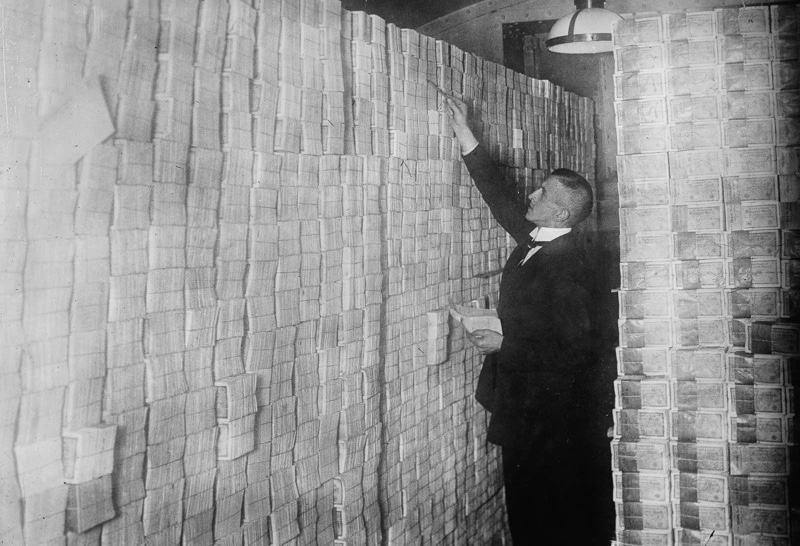
A German banker stacks Reichsmarks into a wall of worthlessness. Credit: Rare Historical Photos
Most people hear “Weimar” and think “wheelbarrows of cash.” But the real damage was done to the people holding the cash.
What Money Teaches
Every price tells you something, especially the price of money, which we call the interest rate. That rate teaches you the most important lesson of all: whether waiting pays.
Economists call it time preference, the question of sooner or later. A healthy interest rate tells you patience pays. A rate near zero tells you patience is for suckers.
Five years ago, I built a simple spreadsheet to show my graduate students how this works. Picture a $50,000 project that pays back a bit more than $10,000 a year for five years. At a 2% interest rate, it's worth building. At 5%, it loses about $2,400 in today’s money: same shovels, same customers, same cash. Only the price of time changed.
Interest rates inform businesses and guide personal decisions. They tell a young man whether to save for a ring or blow his paycheck on Friday night. They tell a young woman if a husband and children are realistic.
When the price of waiting falls to zero, or even below it, as it has in Japan and Switzerland, the lesson is simple. Take what you can right now.
Weimar's Moral Collapse
Germany’s central bank kept lending at rates far below inflation almost to the very end. Borrowers got rich. Savers got wiped out.
This was no victimless crime. The pensioner; the widow living on war bonds; the civil servant who’d put away a little every month for 30 years; the respectable middle class that did everything right; all within mere months, the fruit of their thrift was worth nothing.
Then something worse happened. They drew the obvious conclusion.
If saving is for fools, why save? If the future is a lie, why plan for it? Clerks and cabbies gambled on stocks. Currency speculators became the new aristocracy. Berlin turned into the vice capital of Europe, with cabarets, cocaine, and prostitution on a scale Germans had never seen. Many of the women on those streets came from good families that had simply run out of money.
Dr. Joseph Salerno wrote about this in his essay “Hyperinflation and the Destruction of Human Personality.” He shows how professors and senior civil servants became taxi drivers and waiters almost overnight.
That’s a horrendous outcome, but his conclusion matters to us today: A man builds his character around what he owns and what he’s working toward. If a government kills the money, and private property stops meaning anything, it knocks out the ground a man stands on. Salerno argues that Hitler preyed on exactly those demoralized people.
Weimar’s leaders owed crushing war reparations and controlled a printing press. Every month, printing was the least painful choice. The easy option always wins… until nothing is left to save.
“Weimerica”
I’ve heard that slur from two different people now. But America isn’t Weimar. You don’t need a wheelbarrow to buy a loaf of bread. But look at the incentives, not the numbers.
From 2008 to 2022, the Fed held rates near zero for most of those years. In late 2021 and early 2022, it held them at zero while inflation ran above 7%. For years, savers earned less than nothing after inflation.
And the moral lesson landed exactly as it did in Berlin.
Young men looked at home prices, did the math, and gave up on marriage and a mortgage. Many retreated into video games and sports betting, which spread like a virus after 2018.
Young women saw the same math and found easier routes to wealth through Instagram fame and, for far too many, OnlyFans.
The birth rate sits near record lows. Some economists blame women’s education and careers. I blame arithmetic, and so would Guido Hülsmann, a German economist. If a young couple can’t make family math add up, they don’t start one.
Meanwhile, the casino owners won. Meme stocks. Crypto. Zero-day options.
The man who borrowed to the hilt looked like a genius. The man who saved looked like a chump.
A whole generation didn’t just wake up degenerate one morning. A price signal is amoral, unfortunately. They read the signal and acted on it.
A Tax on Virtue
Professor Guido Hülsmann teaches at the University of Angers in France. In 2008, he wrote The Ethics of Money Production. It treats cheap money as a moral problem.
He draws on a medieval bishop, Nicole Oresme, who warned French kings in the 1300s that clipping the coinage was theft. Hülsmann carries that logic into the paper money age. He argues that when inflation becomes permanent, people form inflation habits. They borrow first and ask questions later. Debt turns into an albatross people carry around their neck for life. And he warned that inflation “slowly but assuredly destroys the family.”
The old Catholic teachers called the habit of planning “prudence” and ranked it first among the cardinal virtues. Thomas Aquinas taught that virtue is a habit. You build it through practice, like a muscle.
But habits need rewards to become permanent. A money system that punishes thrift for a decade is like a gym that fines you for every workout. Sooner or later, people stop working out.
Cheap money raises the payoff for vice and decreases the rewards for patience, fidelity, and self-control.
Why experts wonder why we get less of the second and more of the first is beyond me.
The Road Back
On September 16th, the Fed raised rates for the first time since 2023. The 10-year Treasury yield is above 5%, its highest level since 2007. For the first time in a generation, a saver can earn a real return on boring Treasuries.
In late 1923, Germany had issued a new currency and turned off the printing press. Prices had steadied within weeks. But the fix came too late for the savers who’d already lost everything.
Wrap Up
America still has time.
Honest price signals rebuild habits that distorted signals eroded. When saving pays again, people will save. When a young couple can see a path to a happy home, they’ll start a family.
The only thing you can do is show your kids and grandkids why it pays to invest and wait for the future rewards.
Keep holding the line. Time’s pendulum is swinging back your way.