

Gold Smells a Rat
Boom! It was another great day for gold, silver, and miners.
The GDX gold miner ETF is up a whopping 9% as of mid-day.
Gold moved up 3.5% and crossed the $4,500 level. Silver also popped 3.5% to $66.43.
So… what the heck happened?
We got another signal that the U.S. government is desperate to get debt yields lower. And this is a great sign for gold bugs.
And before you protest, I know. Bonds, interest rates, and yields are boring. But this is critical stuff for anyone who owns precious metals, hard assets, foreign stocks, or fixed-income. So hang with me for a moment.
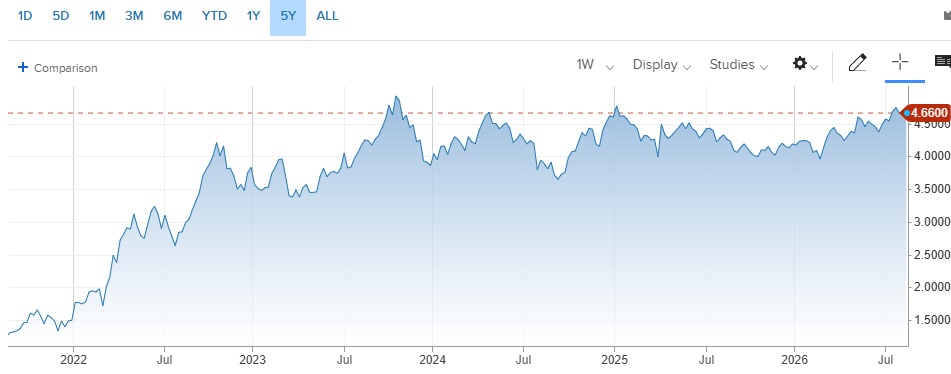
Here’s a 5-year chart showing the yield on the U.S. 10-year Treasury bond:
Source: CNBC
As you can see, 5 years ago the yield was a tiny 1.3%. That meant the government didn’t have to pay a lot in interest back then. Today it’s 3.5x higher at 4.66%. The bond vigilantes have awoken from their multi-decade hibernation.
In 2022 post-COVID inflation caused the Fed to raise interest rates. That was the first leg of the move.
But the last interest rate raise was in July of 2023. Yields have continued to move higher since, even despite six rate cuts.
For the government and Federal Reserve, paying high yields on debt is horrible. In 2026 alone, the Treasury Department will need to refinance about $9 trillion worth of debt, plus issue another $2 trillion to cover the budget deficit. That’s a lot of Treasuries hitting the market at high yields.
If yields stay at current levels or continue to rise, we’re going to be in a world of hurt. The debt snowball will accelerate dramatically.
The Catalyst
Today’s impressive move in precious metals was driven by the Treasury Department announcing they would double the size of their bond buyback program.
Basically, they’re buying long-term (10-30 year) bonds in an attempt to cap yields.
The announcement itself wasn’t even that big. Buybacks will at least double from $2 billion to $4 billion per operation (every few weeks). By itself, the program doesn’t seem too consequential.
But this move, combined with the intervention in Japan, sent a powerful message. The government and central bank cannot tolerate interest rates at this level.
Soon, the government will have to ramp up QE (quantitative easing, AKA money printing) to further keep a lid on rates.
And after that stops working, more… creative measures will be required.
End Game: Crushing Financial Repression
So our government and central bankers are clearly getting uncomfortable with rising yields and deficits.
And investors are finally figuring out that the “solution” to our problems is going to involve endless money printing.
Between the Treasury Dept and the Federal Reserve, there are now a number of active programs in place to lower yields on our debt.
But we are still in the early stages. For years, my theory has been that the Fed and govt will eventually need to institute brutal financial repression in the form of yield curve control.
This simply means that yields on government bonds will be kept low, even if inflation is high. I’ve shown this chart from the 1940s a few times now, but there’s a good reason for it. This is not just our past, but our future too.
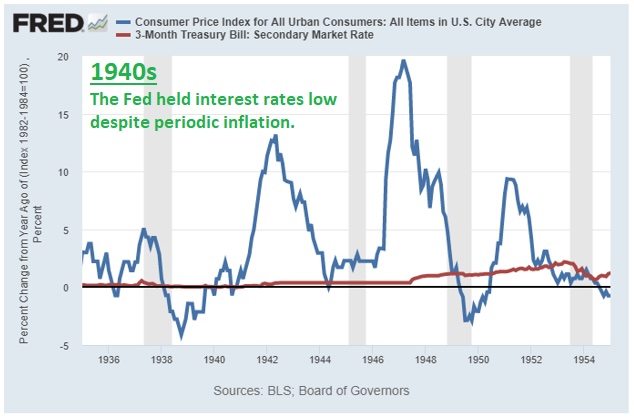
The blue line shows inflation, while the red line is the yield on a short-term Treasury bill.
So in 1942, inflation hit 13%. In a free market, bonds would fall in value and the yields would rise to adjust. After all, bond owners don’t like losing purchasing power.
But the Fed didn’t give them a choice. They got a 1% yield while inflation reached as high as 13 to 20%. Savers and those on fixed income got wrecked.
My prediction is that we’ll find ourselves in a similar situation in the near future.
When a country has a massive pile of unpayable debt, there are limited options. Printing money to patch things up is always the easiest choice, so politicians will default to that.
If this scenario plays out, U.S. Treasuries will initially do well. As yields are crammed down, bond prices will soar.
But when inflation hits 10%, and you’re only getting 1% on your Treasuries, it’s going to sting. And if this inflationary period lasts as long as I think it will, the real value of those Treasuries after 10 years will be minimal.
Sure, you’ll get paid back “in full”, but those dollars will be worth a tiny fraction of what they once were.
What WILL Work
Back in April, I wrote another piece on this topic titled Sounding the Alarm on American Debt. Here’s an excerpt about how investors can prepare for what lies ahead:
Gold wasn’t an option in the 1940s, at least in the U.S. Owning bullion was illegal for American citizens. And the price was capped at $35/oz regardless.
Fortunately today Americans can own precious metals. And they will be key to preserving wealth going forward.
So what did work in the 1940s? Commodities. Hard assets. Industrials. Defense.
I believe a return to yield curve control is inevitable. It probably won’t happen for a few years. If and when it does, you’ll want to have plenty of exposure to select foreign stocks and natural resources.
We are fortunate that today we have precious metals as an investment option. Imagine those investors in the 1940s, facing waves of inflation with no option to buy gold.
In the 1940s investors also couldn’t easily buy foreign and emerging market stocks, which is going to be key to escaping the coming financial repression.
We have more tools available today, and that’s a very good thing. We’re going to need them.
A 60/40 portfolio made up of U.S. stocks and bonds has done incredibly well over the past 40 years. My expectation is that it will struggle greatly over the next few decades.

Comments: