
A Wrench in the Data Center Machine

The U.S. economy relies heavily on AI for growth.
Today we’re going to take a look at how it could all go wrong.
Goldman Sachs says roughly half of current S&P earnings growth is due to the AI boom. Much of the rest is due to high spending from top earners, which is due to soaring stock prices.
So most growth flows back to AI, directly or indirectly.
At the heart of the boom is AI data centers. Absolutely massive projects that require tens or hundreds of billions of dollars to build.
These data centers are being paid for using… creative methods.
Let’s look at Oracle’s massive Jupiter data center in New Mexico. Well, technically Oracle (ORCL) will be the tenant. The owner/developer is a division of Blue Owl Capital (OWL), with financing from a bunch of banks.
Once the data center is up and running, Oracle plans to sell most of the computing power to ChatGPT developer OpenAI.
Here’s a picture of the site from July:
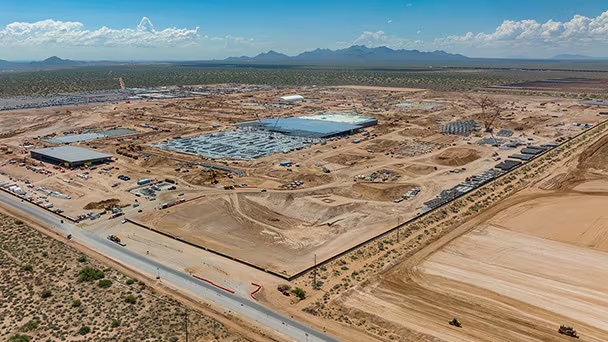
Source: Oracle
It’s a massive site. 1,400 acres. 2.45 gigawatts of electricity (enough to power about 1.8 million American homes). The total cost is expected to reach $165 billion.
And as you can tell, it’s located in a very dry desert. Which could be problematic, seeing how much water data centers require for cooling. But there are other problems to worry about before we get to the drought issue.
First, the site may open later than expected. They need a natural gas pipeline to power their Bloom Energy (BE) fuel cells, and it’s been delayed and redirected multiple times.
The project is too large to connect to the local electrical grid, so they need to generate all their own power on site. That will require a new pipeline, and a ton of Bloom’s fuel cell generators.
For Bloom Energy, it will be roughly 30x larger than any other installation. Can they scale up production in time? So there’s delivery risk here, too.
The Jupiter data center complex was originally set to open in 2028. Now it looks like the gas pipeline may be further delayed. Local opposition to the project is growing.
There’s a risk the site doesn’t open on time. And if it doesn’t, who pays for the delay? That’s the heart of the issue.
Force Majeure
Today, Oracle declared force majeure. This is a legal term that means something beyond their control is preventing them from fulfilling their contractual obligations.
In essence, they’re saying that if the data center doesn’t open on time, they don’t want to pay rent.
Oracle is taking steps to limit its financial exposure to a massive data center planned for New Mexico as the project faces opposition and regulatory hurdles, according to a Bloomberg report.
The company has notified the project's developer, a unit of Blue Owl Capital (OWL), that it is invoking a force majeure provision, according to people familiar with the matter.
According to the report, Oracle is seeking to delay payments if the project, dubbed Project Jupiter, is delayed and the facility does not come online in 2028 as planned.
It appears that Oracle is expecting significant delays at Jupiter. This may not sound like a huge deal, but it is. A big chunk of the economy depends on these data centers for growth and higher earnings.
Now, delays are popping up in data center projects around the country. There’s not enough electricity or water. Getting the proper permits can take many years. And locals are pushing back hard in many areas.
What we’re seeing today at the Jupiter site could happen at many other projects in the near future.
Is Oracle the Canary?
In January of 2025, Oracle announced the Stargate program. A bold $500 billion plan to build gigantic data centers to fuel the AI boom. At first, shares soared higher.
But over the past year, Oracle shares are down about 55%.
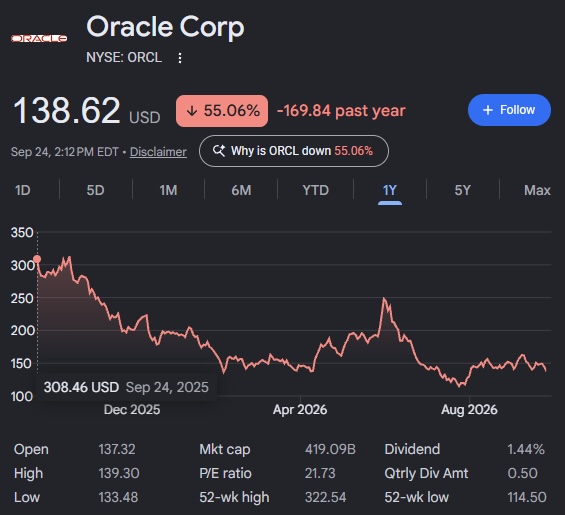
The stress is showing up in Oracle’s debt and credit rating, too. Financial Times:
However, efforts to offload the debt to a broader group of investors have hit a wall due to concerns around Oracle’s massive borrowing and declining creditworthiness. The debt secured a private investment-grade rating from credit rating agencies.
Oracle’s corporate credit rating currently sits one notch above junk following a downgrade from S&P in July. Banks were now forced to hold more Oracle-linked project debt on their balance sheets than initially planned, the people said.
Oracle is a big company. The current market cap is $437 billion. They’re all-in on data centers and AI.
Oracle has disclosed $288 billion of future lease commitments. That’s why it’s so important they declared force majeure today. What happens if there are more delays?
If they continue to struggle, the stress could spread to other hyperscalers. Widespread data center delays are possible, which would cause serious problems all the way up the chain.
All the data center hyperscalers (Microsoft, Google, Amazon, Oracle, Meta, SpaceX) are using similar unconventional financing (though not as aggressive as Oracle). They’re doing it to keep most of the debt off their balance sheets, so that if something goes wrong, they won’t be fully liable.
But all these big tech companies have plenty of exposure. They’ve already committed to trillions of dollars in leases and equipment purchases.
If more data centers start to see delays, or even cancellations, that could signal the end of the party. It would affect the entire AI ecosystem. Semiconductors, hyperscalers, AI model leaders. Up and down.
We’ll be keeping a close eye on this story. Much depends on the outcome.