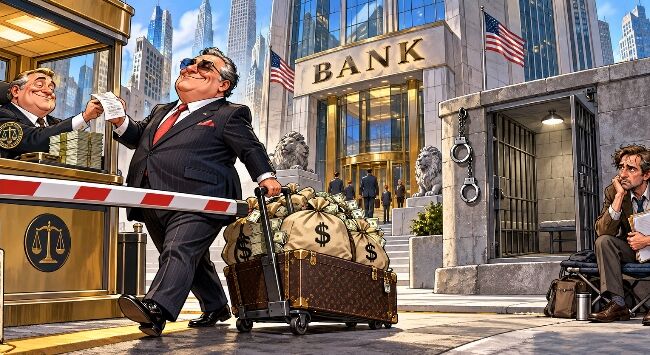

Too Big to Nail
Everett Stern slept on a camping cot because he did his job.
In 2010, he was a compliance officer at HSBC, working out of a back office in New Castle, Delaware. He watched billions move to drug cartels, sanctioned regimes, and terrorist groups. He wrote it up, then escalated it. When the bank sat on its hands, he walked into the FBI.
The result was a $1.92 billion settlement in 2012. By Stern’s math, that was about five weeks of HSBC’s profit. Not one banker was charged, let alone went to prison.
Stern lost his career, savings, and every friend he had in finance. He couldn’t afford a bed, so he slept on a cot in a 300-square-foot apartment and waited tables at P.F. Chang’s.
This week, he wrote an open letter to Treasury Secretary Scott Bessent. It went viral on X, and for good reason.
Fourteen Years Later…
On Tuesday, the US Treasury hit Bank of America with $1.2 billion in penalties. It’s the third largest in the Treasury’s history. The $750 million slice that goes to the Office of the Comptroller of the Currency is the biggest fine that regulator has ever levied.
The bank admitted it willfully violated the Bank Secrecy Act. It failed to report more than $5 billion in suspicious transactions on time. Over $1 billion of that touched what the Treasury calls priority national security risks: Chinese money laundering networks, fraud, and trade-based laundering with a heavy footprint on the southwest border. A separate $11.6 million settlement covered apparent sanctions violations involving Iran, Russia, narcotics, and global terrorism.
Treasury also said the bank failed to fix the problems after it signed a cease-and-desist order in 2024. In plain English, it got caught, promised to clean up, and didn’t.
Bessent said the action sends a clear message that even the biggest institutions aren’t above the law.
And yet, not one individual was charged.
Stern’s reply to the Secretary was polite and brutal: fines aren’t working.
The Twelve-Day Fine
Let’s do the arithmetic Stern did for HSBC.
Bank of America earned $9.1 billion in the second quarter of this year. That works out to about $100 million a day. A $1.2 billion penalty is twelve days of profit.
Twelve days, for five billion in unreported transactions. By Treasury’s own findings, those transactions were executed for people who sell fentanyl to American kids.
The fine comes out of the bank’s capital, which belongs to shareholders like pension funds, index funds, and your 401(k). Nobody who decided the 2024 order could wait pays a dime. On the earnings call next quarter, they’ll be talking about operating leverage.
How the Toll Booth Works
Fines are spread across millions of shareholders. No one feels it. The board doesn’t have to revolt. The regulators got their check and their press release.
Compare that to one executive in handcuffs. That changes the math for every other executive in every other bank, overnight. That’s Stern’s point, and it’s the right one. He says one banker in cuffs would do more than every fine in Treasury’s history combined.
So why does The Swamp keep choosing the toll?
In a word: fear.
In 2013, Attorney General Eric Holder told the Senate that some banks had grown so large that prosecuting them could hurt the economy. He later walked back his comments, but “too big to fail” turned out to be a Frankenstein’s Monster.
And since Bank of America is loaded with $109 billion of unrealized losses from its Treasury bond holdings, that concern is even more acute.
Also remember that a fine is revenue. Treasury booked a tidy $1.2 billion on Tuesday. Like war, prosecution takes years and costs millions. A settlement is a guarantee with a big bow.
Finally, see the incentive for what it is. Each fine justifies a bigger compliance bureaucracy, inside the bank and the agency. Both a bank’s compliance staff and the government’s grow.
Sadly, the fine isn’t the cost of doing business. It is the business. The government sells the pass, and the bank buys it.
Tetzel’s Price List
History tells us the Church learned this the hard way.
In 1517, a Dominican friar named Johann Tetzel toured Germany promoting indulgences. Catholic doctrine held that an indulgence remitted temporal punishment for sins whose guilt had already been forgiven.
It was never supposed to be a license to sin. But Tetzel’s fundraising pitch made spiritual relief sound suspiciously like something you could buy. Part of the proceeds helped finance the rebuilding of St. Peter’s Basilica in Rome.
A monk in Wittenberg objected. Luther’s Ninety-Five Theses helped ignite the Protestant Reformation and split Western Christendom.
The Church eventually confronted the abuse. At the Council of Trent, it reaffirmed the doctrine of indulgences but condemned the financial abuses surrounding them. In 1567, Pope Pius V abolished indulgences tied to payments.
DC has learned no such lesson. It still collects the money and leaves the sinners in business.
Indeed, the Treasury’s arrangement is worse. An indulgence was never meant to excuse future sins. A bank fine that leaves the responsible executives untouched encourages the next offense.
And everyone watching learns that consequences are negotiable, as long as you’ve got the money.
The Last Whistleblower
So why did nobody inside Bank of America come forward the way he did?
Stern answered that question: because everyone in American banking knows what happened to him.
That’s the quiet cost of the toll booth. It releases the guilty and publicly punishes the honest. The next honest man shrugs and shuts his mouth.
Credit Where It’s Due
This fine is bigger than any of Bessent’s predecessors managed. The Treasury forced the bank to admit willful violation in writing. That’s more than HSBC ever conceded.
But fines are the limit of what he can do. The Justice Department must prosecute. Stern knows this, which is why his first ask is a referral, not a conviction.
The good news is that Stern’s three fixes are all within reach of this administration:
- Refer the executives who set the thresholds, not the analyst in the queue.
- End too big to jail, since a bank can’t be too big to fail and too big to jail at once.
- Finally, if a bank with America in its name won’t act like America’s bank, review its charter.
These fixes only require a Secretary willing to take down the toll booth.
Wrap Up
Before Stern walked into the FBI building in 2010, he stopped at the Great Seal in the lobby and read the words under it: Justice is the defense of our liberty.
He believed it then. He says he still wants to believe it now.
Don’t take my word for how this works. Take his.
He paid for the privilege with everything he had, and he wrote it down for the man who can change it. Read the letter, then decide for yourself whether Tuesday’s fine was a punishment or a receipt.
A nine-figure bank fine is just a toll. It’ll stop being that when bankers get perp-walked out of their shiny glass towers.

Comments: