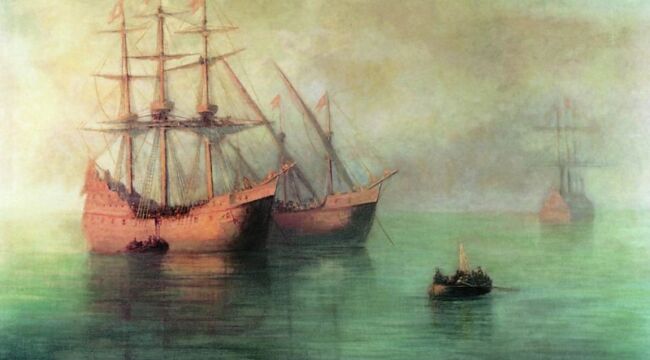

Admiral of the Ocean Sea: Columbus and the Hinge of History
It’s Columbus Day, a federal holiday: no mail, no banking, courthouses and most government offices are closed, as well as bond markets. But stock markets were open for trading.
And Columbus Day brings out the usual arguments. One side honors the mariner whose 1492 voyage pioneered sustained contact between two hemispheres. The other side condemns him due to what happened later: conquest, enslavement, disease, and dispossession.
Of course, history is what it is. And pro-Columbus or not, his efforts are worth recalling because reflection is neither indictment, acquittal or canonization. Whatever you think, no one can deny that Columbus’s first voyage marked a unique moment in time that opened a vast new door in human history.
And to all you Vikings out there: Yes, Norsemen reached North America pre-Columbus, around 1000 A.D. and established a short-lived settlement at L’Anse aux Meadows in Newfoundland. But their adventure left a near-negligible archaeological footprint. They were here and gone, with no durable corridor of migration, commerce, or exchange. Which makes Columbus’s distinction even more important.
So no, Columbus was not the first European across the Atlantic. But he developed a workable method to cross that mighty sea, and I mean both ways! That’s what was important. He sailed southwest from Spain to the Canary Islands, then west to the Caribbean; and returned to Europe via the southern rim of the Gulf Stream. He invented the transatlantic round trip.
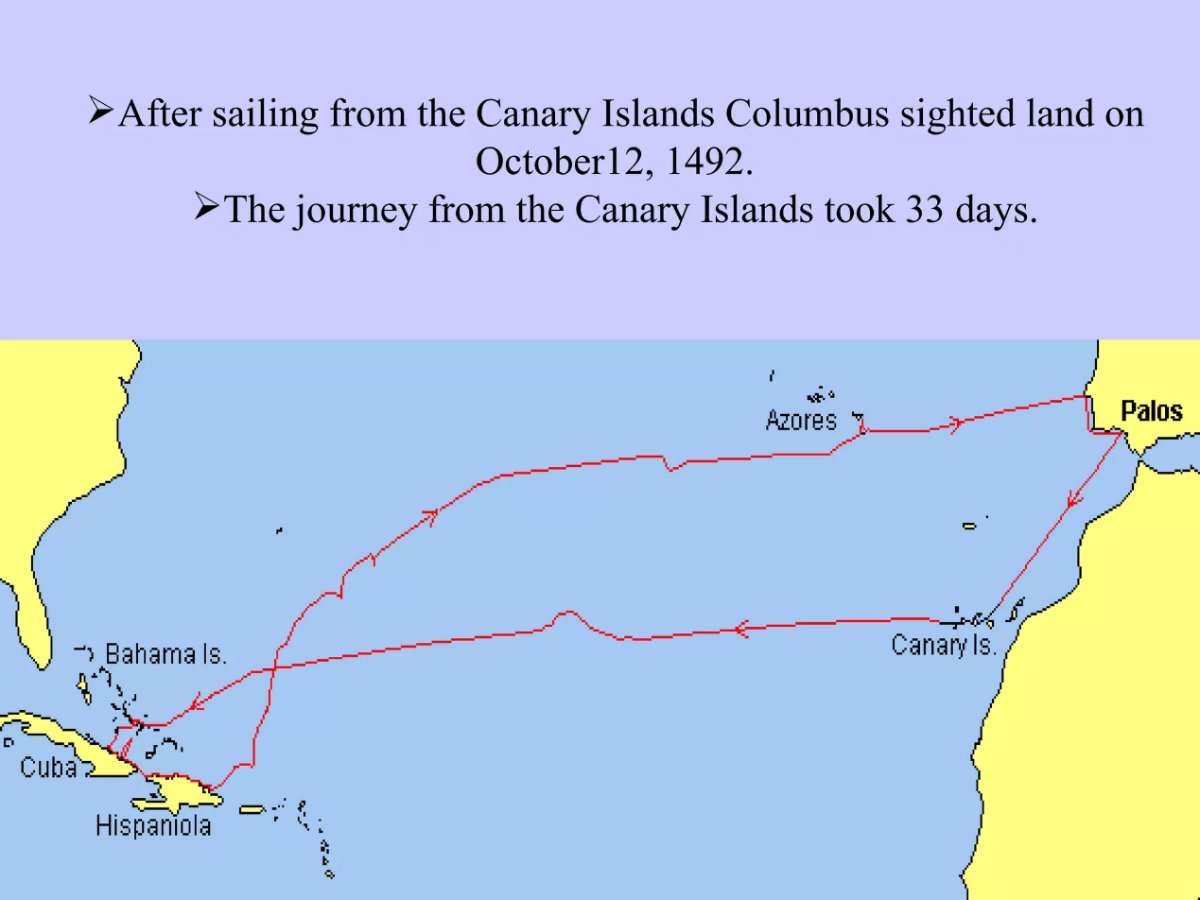
Route of Columbus’s first voyage: Canaries to Caribbean.
Columbus’s 1492 mission charted a route based on favorable trade winds and oceanic currents. It was repeatable by others, and this is what transformed his voyage into a hinge of world history, which is also where Columbus’s critics get things wrong.
That is, Columbus was an explorer who redrew Europe’s maps. But he didn’t write the script for subsequent events. His voyages set vast forces in motion, and many things happened that were disruptive if not brutal. But beware thinking in terms of post hoc ergo propter hoc; because it does not follow that Columbus personally created or intended the next 500 years of what ensued.
Plus, keep in mind that the world that evolved from Columbus’s voyages – migration, exchange, conflict, discovery, and adaptation – is the only world we have. So, on Columbus’s Day the question is not whether he was a modern man with modern values. (Hint: no, he was not.) It’s why his voyage changed history.
Morison’s Test: Columbus the Sailor
At root, the triumph of Columbus begins with seamanship, geography, and the Canary Islands, where an audacious idea became a successful, repeatable Atlantic passage.
In the late 1930s, Harvard historian (and sailor) Samuel Eliot Morison retraced Columbus’s routes under sail while researching what became his Pulitzer Prize-winning 1943 book, Admiral of the Ocean Sea. Morison wanted to test the story of Columbus’s voyage against the realities of wind, current, rig, speed, landfall, and navigation. And the result was a portrait of Columbus as an ambitious and fallible man, and also a first-rate mariner.
Columbus’s three ships – the Santa María, Pinta, and Niña – left Spain on August 3, 1492, and reached the Canary Islands six days later. There, his crew made repairs, took on water and provisions, spoke with other sailors who had ventured into the open Atlantic Ocean, and waited for the winds. Then on September 6, Columbus sailed west.
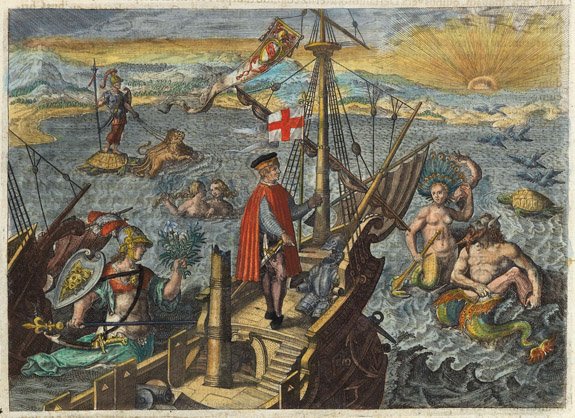
“Les Grand Voyages” by Theodore De Bry. Credit Paulus Swaen & Co., Mapmakers.
In Morison’s telling, Columbus was a man of human scale, doing his best with what was available. Columbus compared conflicting reports, read the weather, understood his ships, kept his anxious crews focused, mapped a dead-reckoning track, and decided when to press on.
Columbus’s error about reaching Asia, versus “merely” the Western Hemisphere, doesn’t erase his nautical or leadership qualities. He didn’t just drift with the sea. He led a fragile expedition across a vast and unknown ocean, and by doing so helped swing open a door between worlds that would never again be closed.
How Basalt Islands Became Atlantic Infrastructure
While we ponder Columbus’s voyage, keep in mind the Canary Islands; a tourist destination today, but not mere beaches and scenery back then. In fact, those protruding rocks offshore of Africa were the launch point that made Columbus’s westward crossing both possible and repeatable. Couple the islands with ocean currents, and here’s the geographic and logistical secret to Columbus’s success.
The Canary Islands are volcanic mounds piled upon relatively old oceanic crust within the African Plate, and far from any active plate boundary. They’re the result of a deep-earth, long-lived hotspot in the mantle. For about 20 million years, fractures and stresses in the African plate have fed repeated eruptions, mostly basalt.
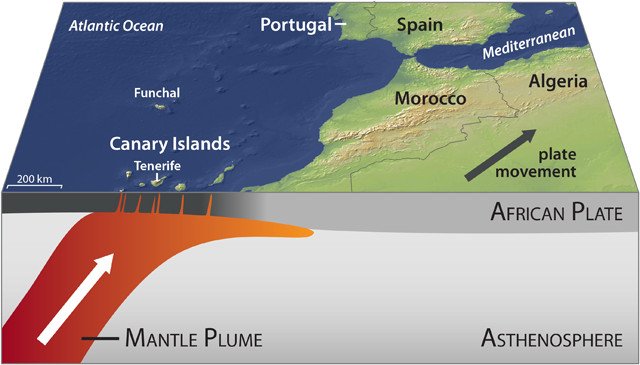
Canary Islands, offshore Africa. Credit University of Minnesota.
The Canaries make for an unusual geologic setting; they don’t present the smooth eruptive and age progression of, say, the Hawaii island chain. Instead, with the Canaries, the slowly moving African Plate allowed old magma pathways to pause, revive, and overlap, producing older eastern islands and generally younger western ones without a conveyor-belt sequence.
Eruption after eruption raised durable basalt above the deep Atlantic seafloor, resulting in tall peaks visible from far offshore. And this high ground has long shaped cloud patterns and local winds, while lee shores offer shelter from exposed coastlines. Add in other aspects of eroded volcanic terrain and you have communities, farms, fresh water, labor, anchorages and places to repair ships.
In short, ancient geology created the platform. Human settlement made it useful. And location completed Columbus’s advantage. His small, square-rigged vessels could sail southwest from Spain, replenish in the Canaries, then turn west with the trade winds.
Then, the return track required a different course; north into what we now call the Gulf Stream, and east toward Europe. And certainly, the shortest line on a map was not the fastest route at sea. Had Coumbus sailed straight west from Spain, he’d never have accomplished anything and we’d never have heard of the guy.
Instead, Columbus’s achievement was to combine basalt, latitude, wind, currents, and island logistics to remarkable effect. His choice of geography became what we now call infrastructure, and his use of wind and waves supplied the energy.
Critically, Columbus created a repeatable crossing pattern for others. And repeatability was decisive because it transformed raw exploration into a durable, low(er)-risk form of passage. And thus, people, goods, ideas, faiths, ambitions, and conflicts reshaped the world.
Post-Columbus, an “Atlantic” World
Later voyages confirmed Columbus’s pattern. In 1493, a much larger Spanish fleet – 17 ships – staged through the Canaries, carrying settlers, animals, seed, tools, and institutions westward. Then again and again, through one expedition after another, the Canary Islands served as workshop, storehouse, lookout, and point of departure westward.
Post-Columbus, other navigators followed the same wind-and-island geometry. Voyages became routes; routes became settlements and commercial circuits; those circuits moved plants, animals, soldiers, settlers, technologies, beliefs, capital and enslaved people among Europe, Africa, and the Americas.
All along, the Canaries were a geographic and logistical hinge, and Canarian sailors and settlers became part of communities across the Caribbean and well into the mainland Americas. In this sense alone, Columbus Day remains relevant because this vast, mixed, creative, violent, and irreversible Atlantic world did not simply appear; it emerged through a unique oceanic channel that Columbus opened.
Again, keep in mind that historical consequence is not the same as personal authorship. Columbus was a skilled sailor who opened a route to the New World (well, new to Europe). Governments, merchants, soldiers, colonists, clergy, and countless later generations chose what else to move through that door, and they themselves determined what to do on the other side.
The World After Columbus—and the World Ahead
To sum up, Columbus did not create the modern world, and he alone is no explanation – let alone a scapegoat – for its flaws or evils. To disdain him as the root cause of slavery, disease, war, or empire is lazy thinking that gets us back to that line about post hoc ergo propter hoc: it confuses sequence with causation. Indeed, the worst one can say of Columbus is that his efforts created the first true template for sustained transatlantic contact.
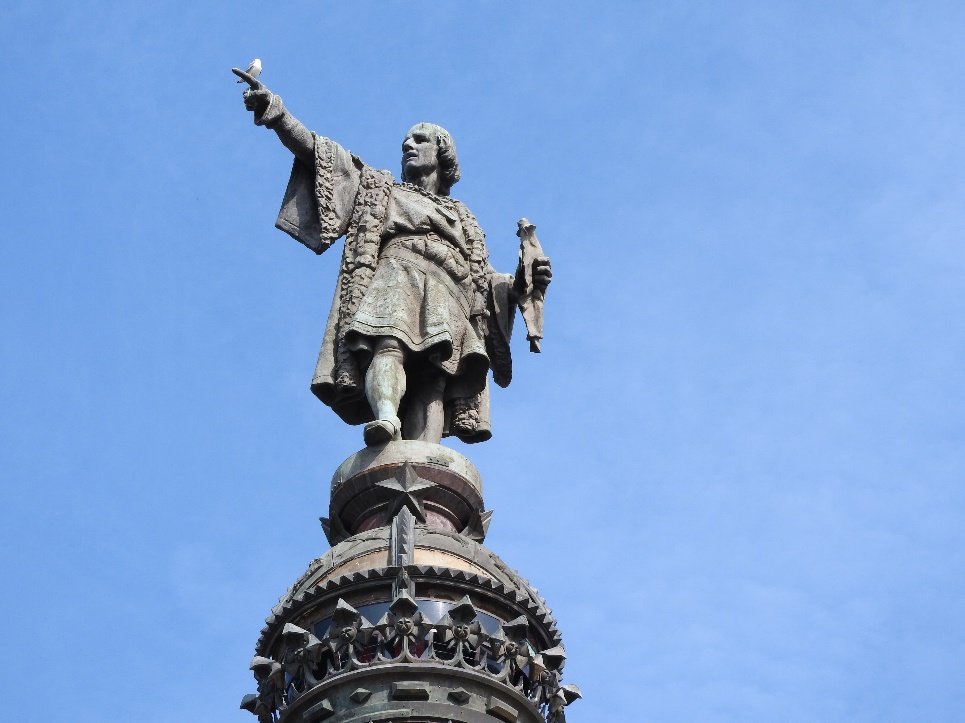
Christopher Columbus statue. Credit City of Barcelona, Spain.
The world after Columbus is the world our ancestors made and which we inherited. And like it or not, there’s no reversing history with all its encounters, discoveries, explorations, migrations, exchanges and even crimes. We can only understand how they came together, judge them honestly, and decide what to do with the inheritance.
In this sense, Columbus Day offers a recurring civic occasion to think: to remember the mariner without denying what followed, and to study his mission without pretending that its consequences were simple.
And no… remembering Columbus is not to declare him flawless or to excuse anything that followed. It’s more to recognize that history can turn on vision, skill, courage, error, and consequence all at once.
As with the Atlantic Ocean in 1492, our own future will not deliver perfect people or absolute certainty. Really, “AI” anyone? Where is that going?
But it’s fair to say that the future belongs to those with enough vision to see beyond the known horizon, enough skill to navigate, and enough responsibility to answer for the world they help set in motion.
That’s all for now. Thank you for subscribing and reading.

Comments: