
Three Takeaways from the Rule Investment Symposium
I spent last week in Florida at Rick Rule’s annual investment symposium. And as the old saying goes, “What a Crowd! What a Crowd!”
I was surrounded by geologists, mine builders, financiers, 800 paid attendees — the fire-department limit — and about 3,000 online viewers who still believe that rocks, rigs and real assets matter. There’s more to tell than I can fit into one note, but three themes stood out:
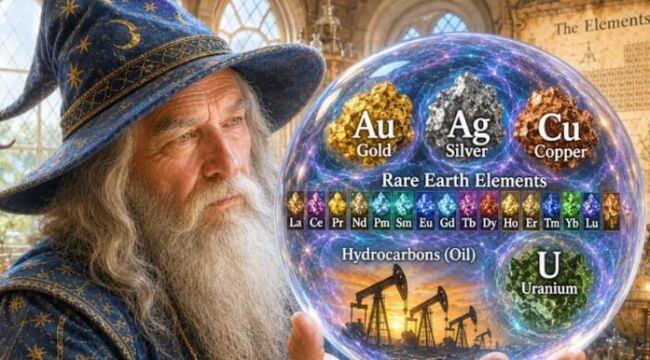
First, gold had an early run this year, then a pullback. But it’s not done.
Second, copper and rare earths are not merely “green” metals; they are essential, irreplaceable innards of modern civilization and national power.
Third, energy prices — oil, gas and, increasingly, uranium — set the cost of everything else.
Let’s dig in.
Takeaway No. 1: Gold Is Money… Again!
Early this year, gold prices moved fast, up into the $5,500-per-ounce range. Then came March, the Iran conflict, a stronger dollar and the market’s old familiar “risk-off” reflex. Gold prices faded and many mining shares got hit with a cave-in.
Still, it’s odd — almost bizarre — to see investors sell down producing miners, many of which are reporting record earnings on solid gold prices, with silver, copper and other metals helping the mix.
Consider Alaska’s Contango Silver & Gold (CTGO): a profitable gold producer with exceptional exploration upside in Alaska and British Columbia, yet shares are down almost 50% from its early 2026 high.
For now, market psychology favors future speculations in tech, space, semiconductors and the like over present cash flow from up-and-running businesses that are — literally — mining old-fashioned money.
Well, look at the bright side: the pullback across precious-metal plays has shaken out the tourists.
Meanwhile, despite gold’s ups and downs, the larger monetary story remains intact for the yellow metal. Central banks continue to diversify reserves. Investors still want an asset that is no one else’s liability. And the dollar, for all its current strength and historic staying power, is no longer the unquestioned storehouse of global trust.
I spoke with Andy Schectman of Miles Franklin, a gold and silver dealer who dwells close to the beating heart of physical metal markets. His point was simple: the world is still buying gold, and much of that buying is strategic, not speculative.
China, for example, has used the recent slump to buy gold “off the books,” so to speak. This means Chinese buyers are accumulating metal outside reportable state-level channels. According to Andy, you just have to know where to look — and yes, airplanes are flying beaucoups gold to Chinese ports of entry.
Brien Lundin, who runs the annual New Orleans Investment Conference, made a similar point from the Florida stage. Monetary debasement has not gone away; it has merely been upstaged by louder headlines: Hollywood celebrities, World Cup soccer and Washington soap-opera politics.
Meanwhile, about 40% of the annual U.S. budget is outright deficit, and the national debt continues its space-shuttle trajectory upward. Can or will the U.S. ever pay down its approximately $40 trillion of debt — and that’s just the on-the-books debt? No way.
In fact, annual interest on the national debt already far exceeds the Pentagon budget. Follow that trend far enough, and every tax dollar Uncle Sam collects heads toward the payout window for interest. After that, the U.S. government will only run on the magic phrase: “Take this legal tender, or else.”
Meanwhile, the mining side may be profitable for operators, but it’s not easy by any means. Good gold deposits are scarce after two generations of underinvestment in basic geology. Permitting is slow almost everywhere. Capital costs are high because the industry competes with many other sectors for top-flight labor and basic materials — concrete, steel, electrical equipment, machinery and much else.
Put another way, mining now competes for labor and capital goods against data centers, reshored factories, shipyards, aircraft builders and every other sector with urgent demand.
Sean Roosen, who runs Osisko Development (ODV), shared thoughts about his first big mine-building project, Canadian Malartic, now Canada’s largest gold mine, which he sold off to Agnico Eagle Mines (AEM).
Sean said he wished he had drilled deeper, sooner and “not left so much for the next guys to find.” That explains his drill-drill-drill approach with ODV at Cariboo in British Columbia, a locale that looks like a pincushion but shows eye-popping numbers for gold in the ground and ore grade.
Sean’s lesson is both geological and investable: there is no substitute for drilling that delivers really good numbers; and he has 11 rigs working this summer up there. Ounces in the ground become more valuable when you have a lot of them close together, with grade to match. “I built Canada’s largest gold mine,” he said. “Now, I have a billion dollars and I’ll do it again with this new project.”
Takeaway No. 2: Copper and Rare Earths Are Strategic, Not Optional
Steve Enders of the Colorado School of Mines reminded the room that most of the world’s copper — about 70% — comes from what geologists call “porphyry” deposits. Don’t worry about the petrologic details; the point is that juniors can find them, but juniors don’t build them.
In fact, major companies build big copper mines because a porphyry deposit is not something to develop with a small-cap company approach: a couple of geologists, a helicopter and drilling program, and (one hopes) a string of strong finds and assays.
No, building a big mine is a multi-year, multibillion-dollar industrial, capital and political project: social license from locals, regions and even national capitals; plus roads, power, water, mills, tailings, permits and patient effort up and down the line.
Just ask Rudi Fronk of Seabridge Gold (SA). Up in northern British Columbia, he has spent 27 years advancing one of the world’s truly great copper-gold deposits toward development. Now he’s in the late innings of finding a “big guy” with whom to partner and transform this phenomenal asset into a producing project that could last a century or more. Rudi is taciturn about details, but he is also smiling.
Stock-picking is nice, but this kind of mine development is crucial because copper is key to electrification. Data centers need it. Power grids need it. Electric vehicles need it. Defense systems need it. Even the oil patch needs it. You cannot “software” your way around copper wire, bus bars, transformers and electrical gear.
You either have copper, or you don’t. And if you don’t, you will not go far.
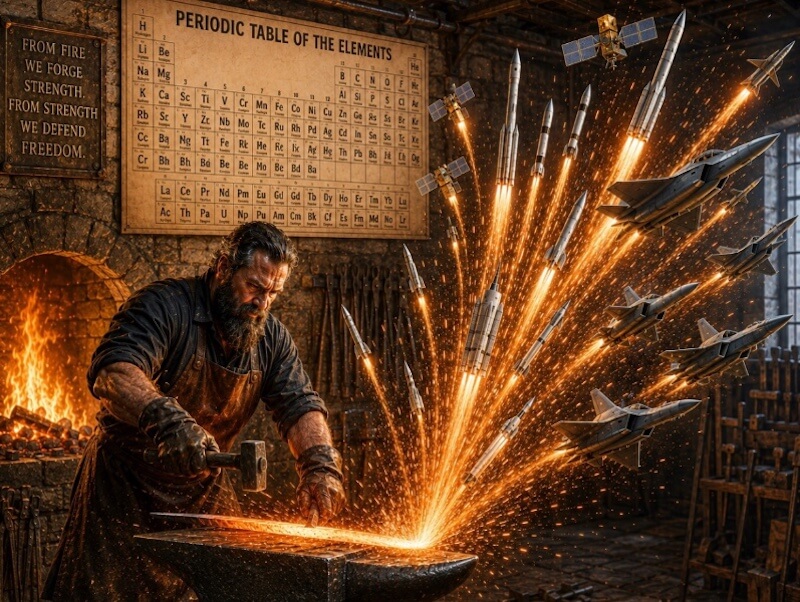
Rare earth elements (REEs) and other critically needed materials are the same story, only with more geopolitics baked in. My keynote address was titled “Mass in Orbit,” and I focused on what goes into rockets, satellites and space systems.
The plain-English version is that everything that reaches orbit begins on Earth. It begins as rock from a mine, then metal from a mill, refinery or separation plant. Magnets, alloys, rocket motors, batteries, power systems, sensors and every other facet of high-performance technology depend on REEs and other specialty metals. And right now, a shockingly large percentage of almost every key supply chain runs through China.
At the Florida symposium, I met with one company that gets it; its flow sheet shows the future for the West. The company’s project will produce copper, lead, zinc, gold and silver. But from the same ore material, it also aims to extract indium, selenium, tellurium and bismuth.
These last elements are not household names. They don’t get breathless cable-news coverage. But they matter in electronics, defense, energy systems and advanced manufacturing. The West must rebuild the ability to find, process and use these materials. That’s a megatrend, a very investable national-security theme.
Takeaway No. 3: Energy Prices Run Through Everything
As noted above, the Iran conflict in March threw the proverbial monkey wrench into the global energy machine. Oil and natural gas prices spiked, then backed off, and now are moving up again on renewed fighting. We’ll see where it goes, but the lesson is already clear.
Higher energy prices run straight through the hard-asset world. They raise the cost of drilling, blasting, hauling, milling, smelting and shipping. They raise mine operating costs and lift the price floor for metals. Then they ripple outward through food, transport, chemicals, plastics and every product that moves by truck, ship, rail or aircraft.
That’s why the energy conversation cannot stop at oil, natural gas and even good old coal.
Looking ahead, uranium will grow in importance over the years ahead, because nuclear power is scalable, high-density and round-the-clock — exactly what the grid needs when it’s loaded with data centers, new factories, electric transport, defense demand and all manner of new battery systems.
For a pure-play American uranium name, have a look at Uranium Energy Corp. (UEC), with operations in Texas and Wyoming.
I had a long discussion with company president Scott Melbye, who described UEC as the “American champion” in a market crowded with national-scale competitors. “We’re up against uranium companies with state backing from Russia, China, Kazakhstan and many more,” he said. “If you want American uranium in our country’s nuclear power plants and Navy submarines, then UEC is out in front to do this.”
If the goal is reliable baseload power, industrial heat, and assured grid stability, uranium belongs near the center of the discussion. After several decades of raw emotion, bad policy and slogan-driven energy debate, parts of the world are rediscovering a basic point: electric power does not come from green-sounding bumper stickers.
The bottom line is that energy comes from oil, gas, coal and uranium, with much help from steel, concrete, copper and deep levels of engineering. There’s no room for wishful thinking about energy.
The Bottom Line
So, here we have three takeaway messages from Boca Raton: Gold protects against monetary disorder. Copper and REEs are essential to running the modern world. And energy prices decide whether the whole system works at a profit or at a loss.
In other words, hard assets are not a sideshow. They are stars of the show: gold is money again; copper and REEs are critical to industry; and everything needs energy.
Investors who understand geology, energy and supply chains before the crowd begins its next stock market stampede will have the advantage.
That’s all for now. Thank you for subscribing and reading.

Comments: