Our Four Fathers Were Right

For most of its history, the United States treated debt with suspicion, if not outright fear. That instinct came from four men who understood, in ways modern policymakers seem to have forgotten, debt is less an economic tool and more a political weapon.
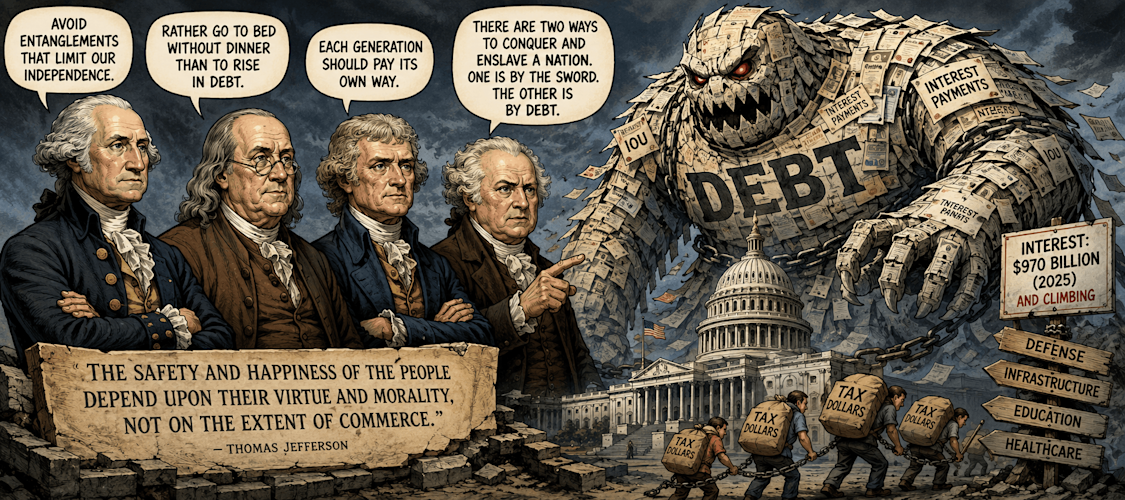
George Washington, Benjamin Franklin, Thomas Jefferson, and John Adams, America’s founders, architects, and revolutionaries, were students of history. History taught them one simple lesson: nations don't collapse overnight. They decay under the weight of obligations they can’t control.
Washington warned against entanglements that could drag the young republic into endless commitments. Today, America is entangled in alliances abroad and its balance sheet at home.
Franklin, the pragmatist, understood the corrosive nature of excess. “Rather go to bed without dinner than to rise in debt,” he said. Today, the United States does neither. It spends without restraint and borrows without consequence… for now.
Unlike that statist Alexander Hamilton, Jefferson feared centralized financial power and permanent debt, arguing that each generation should pay its own way. Now, that idea is almost quaint. The current system doesn’t just pass the bill to the next generation; it compounds it.
Adams was blunter still: “There are two ways to conquer and enslave a nation. One is by the sword. The other is by debt.”
We chose the latter.
Now comes the reckoning. Not in soft theory, but hard mathematics.
When Interest Becomes the Budget
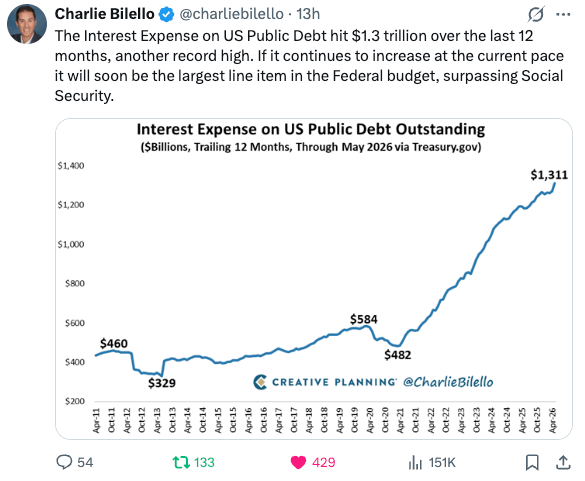
Within a few years, interest on the national debt is projected to become the single largest line item in the federal budget — overtaking defense, Medicare, and eventually Social Security, if nothing changes.
This is one obscenely incredible post:
Credit: @charliebilello
The numbers are already brutal. The government paid roughly $882 billion in net interest in fiscal 2024 — nearly triple the $345 billion paid in 2020, and more than it spent on national defense or Medicare. In 2025, that figure climbed again to an estimated $970 billion, or about 19 percent of all federal revenue collected.
Read that again. Nearly 1 in 5 tax dollars now goes just to pay interest. That’s before a single soldier is paid, a single pension check is mailed, or a single road is repaired.
Based on CBO projections, annual interest costs will exceed $1 trillion around 2026 and continue to climb to roughly $1.8 trillion by 2035. Over the next decade, cumulative interest payments will run into the tens of trillions. Over the next 30 years, the U.S. is on track to spend nearly $100 trillion on interest alone if current policies persist.
This is nothing if not a slow-motion transfer of national income from taxpayers to bondholders.
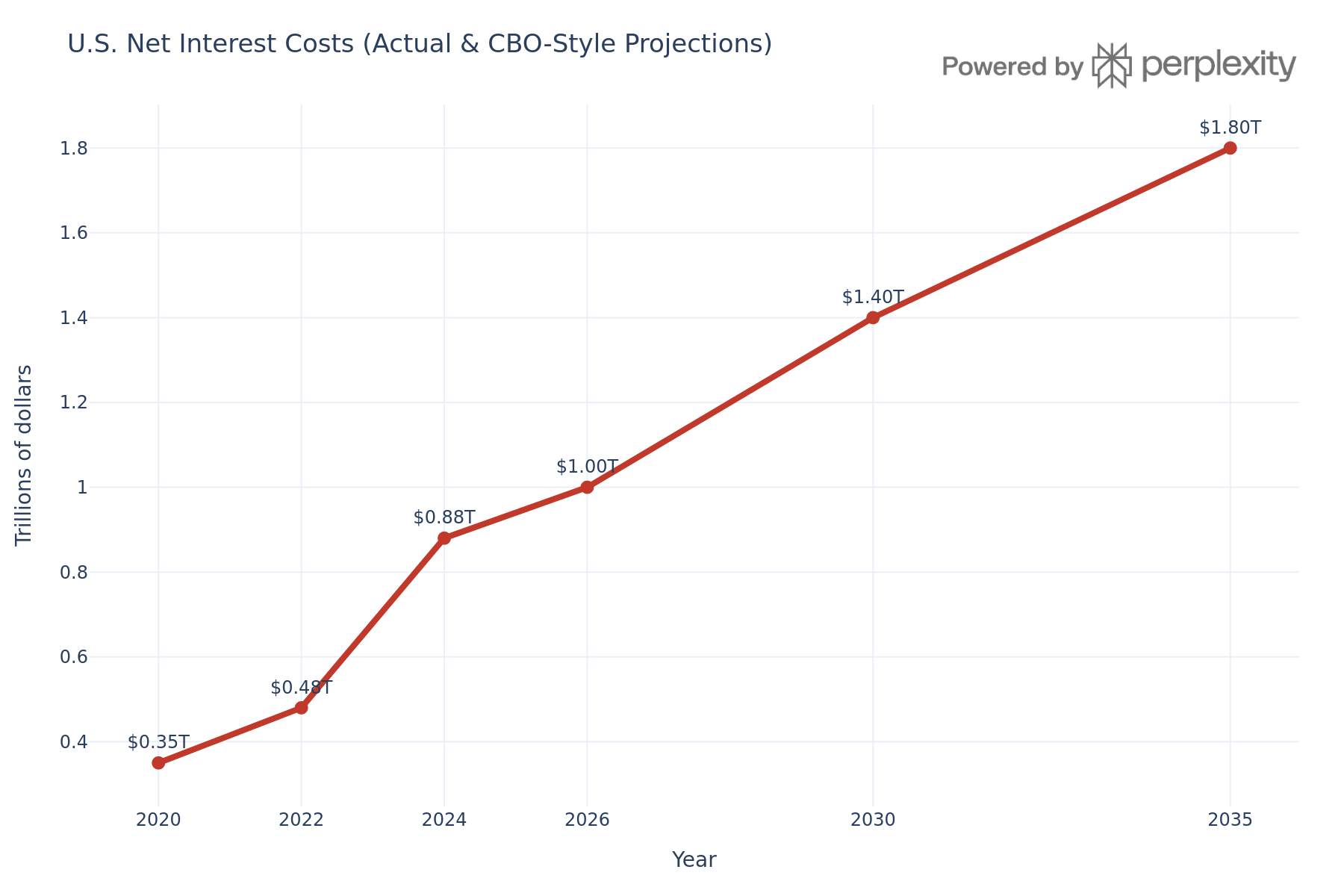
You can see this in the above chart. Net interest costs are rising from a few hundred billion in 2020 to roughly $1 trillion by the mid-2020s, then marching relentlessly toward $1.8 trillion by 2035. It’s not a gentle slope. It’s an accelerating curve.
From Spending Priorities to Interest Tribute
The more alarming story isn’t the nominal dollars. It’s the changing composition of the federal budget itself.
Interest costs have already become the government’s second-largest expenditure, trailing only Social Security and outpacing every other major program. As a share of total federal spending, interest is projected to reach 15–16 percent by the end of this decade — surpassing the prior peaks of the 1990s, but this time on a far larger debt base with far less room to maneuver.
As a share of the economy, interest is heading into uncharted territory. CBO-style projections show net interest rising from just over 3 percent of GDP in the mid-2020s to around 4.5 -- 5 percent by the mid-2030s, and higher still beyond that.
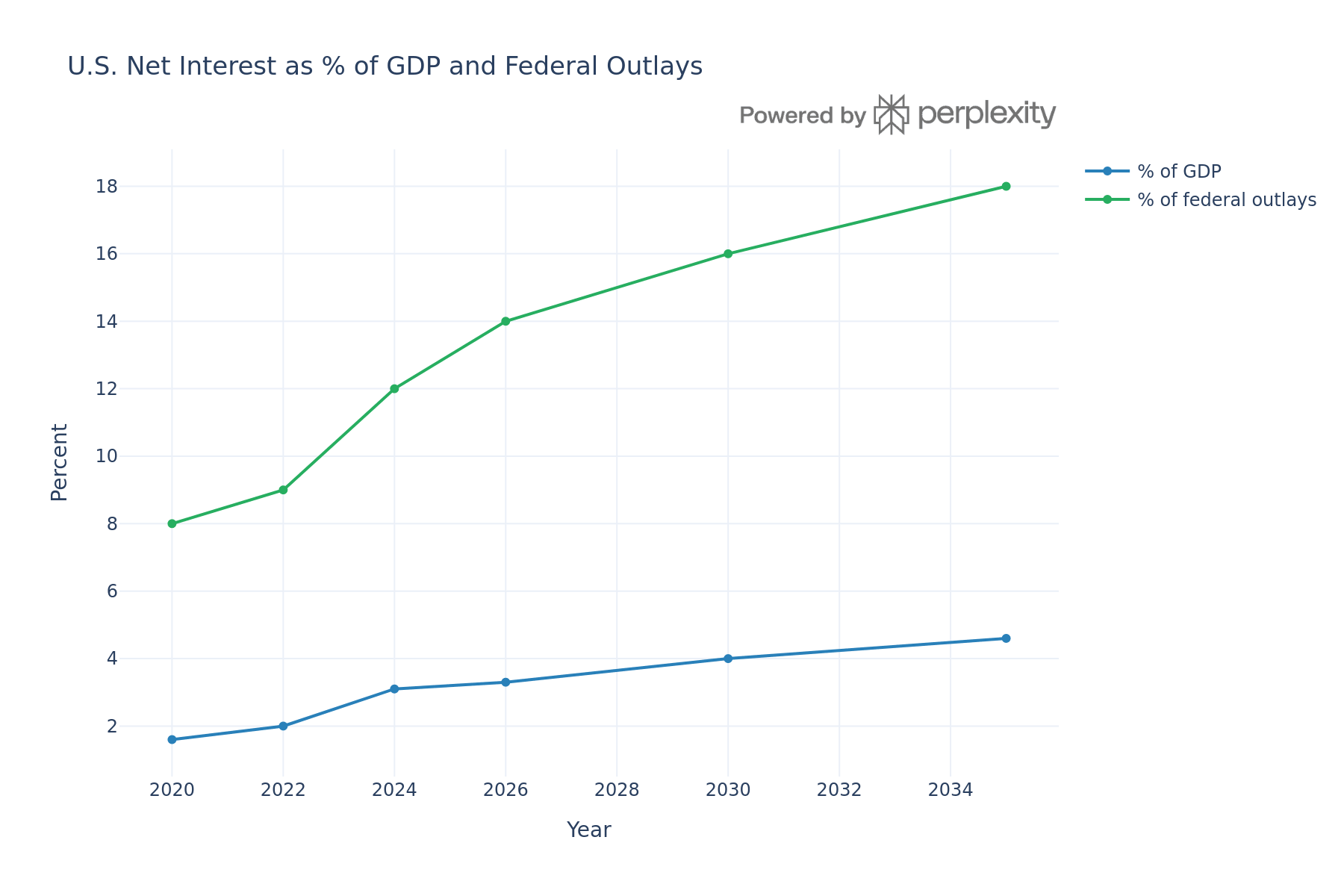
The above chart tells this story cleanly: one line shows interest as a share of GDP grinding higher; another shows it climbing through the mid-teens as a share of federal outlays.
At some point, the budget is no longer about national priorities. It’s about servicing past decisions.
That’s the tipping point the four founders would have recognized immediately.
Once interest becomes your largest expense, you’re not governing freely. You’re managing liabilities.
Debt as Stealth Political Control
Every dollar spent on interest is a dollar that cannot go to defense or infrastructure. It’s a transfer from citizens to creditors. Those creditors include foreign governments and large institutional investors whose only concern is that America keeps paying.
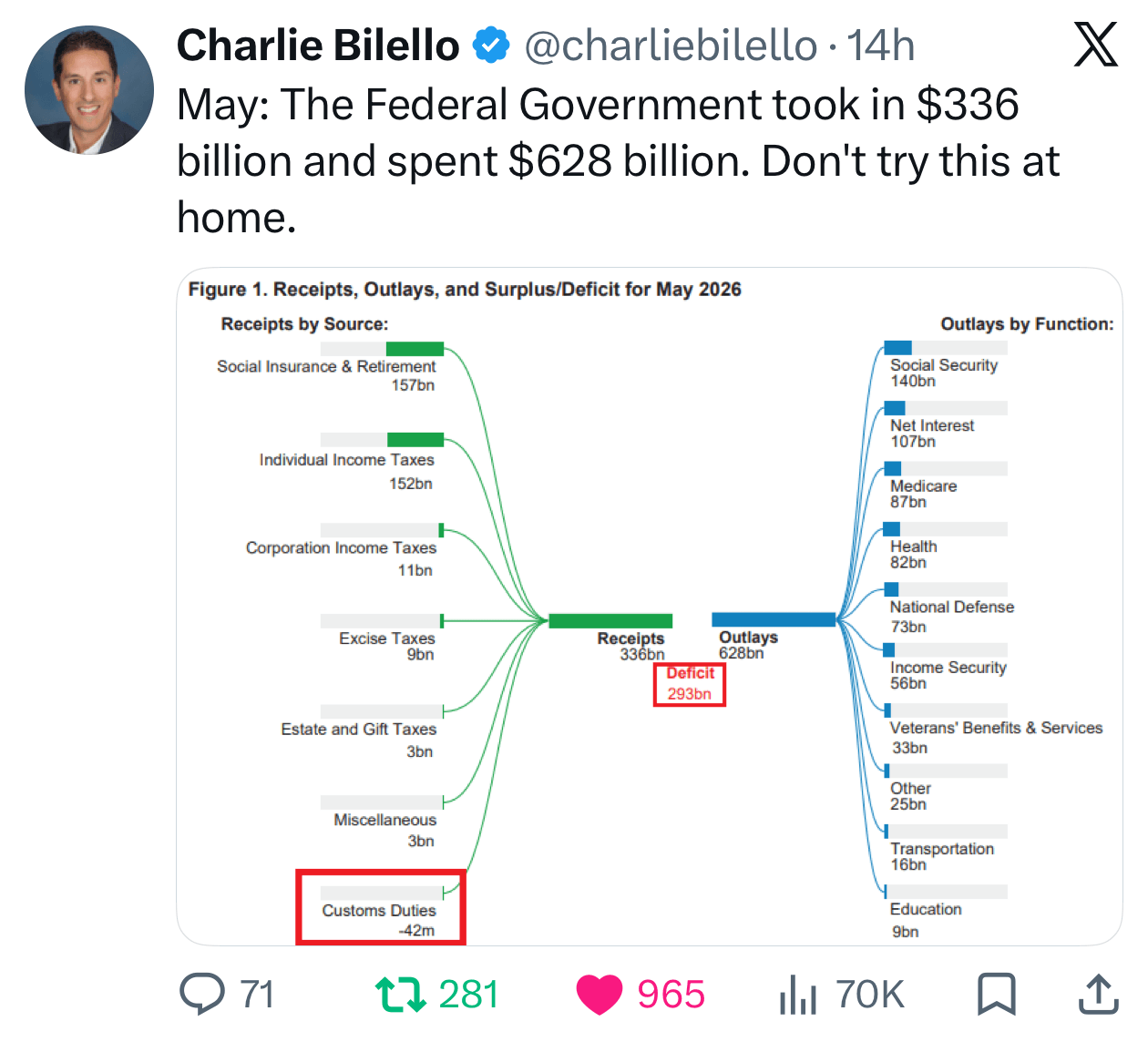
To put a finer point on it, let’s look at the numbers for this past May, thanks again to Charlie Bilello:
Credit: @charliebilello
You read that right: $107 billion spent on interest in the month of May 2026, just behind Social Security.
This is where the founders’ warnings stop sounding like philosophical musings and start sounding like a risk memo.
Washington feared entanglements that would limit the republic’s independence of action. A government that must roll over trillions of dollars at ever-higher rates is not fully independent. It’s constrained by what markets will tolerate. One only needs to monitor The Donald’s war-on/war-off policy, which depends only on when the markets are open.
Jefferson’s skepticism of permanent debt was not anti-growth naivety. It was a recognition that a state that lives forever in arrears slowly mortgages its future policy choices.
Adams’ line about conquering a nation by debt rather than by the sword was not hyperbole. It was a description of how power actually operates: not through the now passé direct coercion, but through the more modern means of controlling cash flows.
We’re living in that world now. The U.S. is still nominally sovereign, militarily dominant, and the issuer of the world’s reserve currency. But its fiscal trajectory is increasingly dictated by a simple math problem: how to service a ballooning stock of debt in a world of higher rates.
When interest consumes 15–20% of your budget and a quarter of your revenues, you’re working for your bondholders, not your citizens.
What Happens When the Bill Comes Due
The markets will tolerate this… until they don’t.
There is no precise breakpoint on a chart where confidence disappears. But the mechanisms are familiar:
- Borrowing costs rise as investors demand compensation for fiscal risk.
- The currency weakens as foreigners question its long-term purchasing power and store-of-value status. (Just check out TLT’s dreadful returns since 2020.)
- Policymakers are forced into bad choices: higher taxes, sudden spending cuts, financial repression, or higher inflation.
The CBO’s long-term outlook already assumes that interest rates stay elevated enough to keep interest costs outpacing growth in both revenues and the underlying economy. That’s how you get to projections where interest alone may be the single largest category of federal spending within a decade.
None of this would surprise Washington, Franklin, Jefferson, or Adams. They had all studied what happened to overextended empires like Spain, France, and Britain. Their reach exceeded their revenue. Our Four Fathers understood that debt, if abused, was a slow form of national subjugation.
Unfortunately, their successors (and their voters) ignored them.
Wrap Up
The result is visible now, not in abstract theory, but in the federal budget line where interest is about to eclipse everything else.
The successors systematically dismantled every cultural, political, and fiscal safeguard its four founders had tried to leave in place to stop this from happening.
Debt becomes destiny. And the charts are telling you: destiny is getting closer.