
Trump's 3 Bad Options in Iran
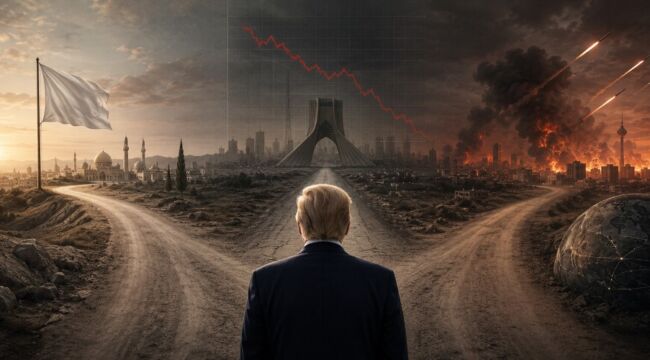
Trump has three ways out of the Iran War.
While the choices are all bad for Trump, they are not all bad for the U.S. economy. Some are better than others. Trump’s choice will not only determine the outcome of the war, it will determine the path of the U.S. economy over the year to come.
Choice One is surrender.
Basically, the U.S. would withdraw from the Iran War without having achieved any of its major goals (not that those goals have ever been well articulated by the administration). Iran would still have its highly-enriched uranium (HEU).
The Iranian regime, consisting of the Iran Revolutionary Guard Corps (IRGC) and Supreme Leader Mojtaba Khamenei or a successor, would still be in charge.
The Iranian people would be largely unified behind new leadership who are younger than the leaders Trump killed. This new group, in their 40s instead of their 70s and 80s, would feel more nationalist and more comfortable in power than their predecessors.
Iran would suffer enormous infrastructure damage, but it can repair and replace those assets over time. Most importantly, Iran would have de facto control of the Strait of Hormuz — something it has threatened but never actually accomplished in the 47 years since the Iranian Revolution.
Choice Two is stalemate.
This is basically the current state of the war. Calling it a ceasefire is a joke. Iran recently attacked the Kuwait airport and Israel. The U.S. bombed radar facilities in Iran. Israel struck Iranian energy infrastructure. Hezbollah and Israel continue to fight it out in southern Lebanon.
This is a low-intensity conflict — all sides back off after a few strikes. But it’s not a ceasefire.
The stalemate suits Iran because it gives them time to dig out missile sites, build more drones and receive financial assistance from Russia and China. The stalemate suits the U.S. because it gives us time to rebuild stockpiles of cruise missiles and Patriot anti-missiles.
Most importantly, the stalemate favors Iran because the Strait of Hormuz remains closed. Iran can suffer economic consequences longer than the world can do without Persian Gulf oil, liquid natural gas, helium, nitrates and sulfur. It’s a game of chicken, and the U.S. will swerve first because it has more to lose.
Choice Three is escalation.
The logic is simple. Trump won’t surrender, and the game of chicken can’t go on much longer.
Trump will unleash the U.S. Department of War to bomb Iranian infrastructure, including bridges, railroads, key highways and telecommunications. Bombing may include sites believed to hold the Iranian HEU.
More extreme versions of escalation could include a special operations mission to seize the Iranian HEU or precision bombing aimed at Iran’s oil export facilities on Kharg Island, or even desalination plants. The idea is to bomb Iran into submission and get the deal Trump wants while avoiding the stigma of surrender.
All three choices will fail.
A surrender might be papered over with some kind of memorandum involving an “agreement to agree” in the future, but the world will see it for what it is — just another Iranian stalling tactic that preserves the status quo for Iran and solidifies the rule of a new younger regime.
Iran won’t give Trump the satisfaction of saving face because Iran is winning. Trump won’t accept surrender because of ego and the bad optics. Neither side will accept the deal the other wants. So there will be no deal.
Choice Two will fail because the current stalemate is unsustainable.
The world has been without Persian Gulf oil exports for almost four months. A combination of Gulf oil already underway in tankers before the Strait was closed, some increased production from the U.S. and Russia and a drawdown of strategic reserves by various countries has kept the global industrial economy going.
Those lifelines are running out. There is no more Gulf oil in tankers on their way. Reserves are reaching critically low levels, at which pumps and pipelines begin to break down. The U.S. and Russia can supply some oil to their friends, but there’s not enough to go around.
Time is almost up on the stalemate. Something has to give.
Escalation may be attempted, but it will fail also.
There is no history of a side being bombed into submission without boots on the ground.
Germany tried to bomb Britain into submission during the Battle of Britain, the first major military campaign fought entirely with air forces. It failed. Germany was never able to invade.
The firebombing of Dresden did not defeat the Germans. It took D-Day, the Battle of the Bulge and the Red Army marching on Berlin after destroying Warsaw.
The firebombing of Tokyo, which used napalm on wooden structures, did not defeat the Japanese. The atomic bombs may have ended World War II, but that’s an exception that proves the rule. Is anyone up for using nukes in Iran?
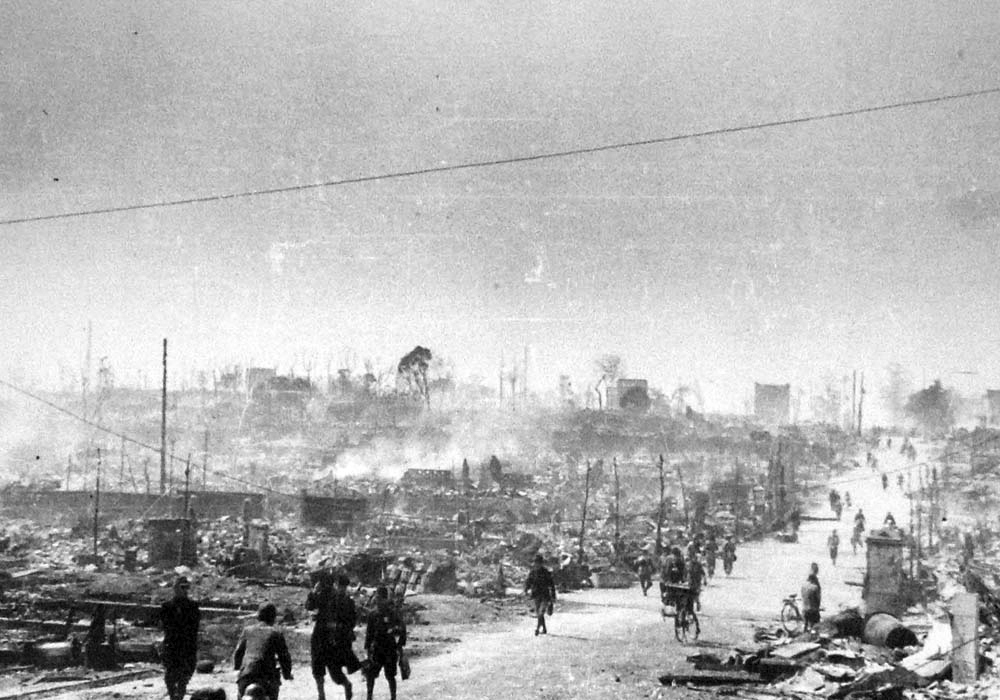
Tokyo after the firebombing raids of March, 1945
Ten years of bombing North Vietnam did not win the war in Vietnam. The U.S. never invaded the North in that war.
In short, bombing doesn’t work without a land invasion.
Invading Iran would be a military undertaking on a massive scale. With 80 million people and a landmass roughly the size of the U.S. east of the Mississippi River, Iran would require perhaps 60 divisions organized into six armies and two Army Groups, backed by air power, naval aviation and submarine-launched missiles.
Anything short of that would risk defeat. You can escalate all you want, but it won’t win the war.
Surrender would be the best result for the U.S. economy.
It would be embarrassing, but not necessarily more embarrassing than the outcomes in Vietnam, Iraq, Ukraine and Afghanistan. Better to cut your losses and live to fight another day.
The Strait of Hormuz would reopen (possibly with tolls paid to Iran as reparations), but the oil would start flowing and oil prices would gradually return to the pre-war $60 per barrel level. The American people might actually be relieved that we got out of the Middle East. They’re more focused on the economy anyway.
A stalemate would be negative for the U.S. economy in the medium term because it would keep oil prices high and disrupt other critical supply chains, including helium for semiconductors, nitrates for fertilizers and sulfur as a precursor chemical for many important industrial processes.
It could lead to a global recession in the second half of 2026 and weigh heavily on stock markets. But because a stalemate is non-sustainable, it could eventually lead to surrender, which would be a much better outcome.
Escalation would produce the worst economic outcome by every measure.
It would offer all of the disruption of a stalemate, but for a longer period, at a higher cost and with no better outcome. If Trump pursued escalation, large parts of the global industrial economy could grind to a halt, putting millions at risk of starvation.
For those reasons, escalation would likely be abandoned in the end, but not before historic damage is done. Escalation could produce a market crash and a new Great Depression.
Our estimate is that the U.S. will pursue the current stalemate for another month and then turn to escalation because of the warmongers in the Republican Party.
The best strategy for investors is to reduce stock exposures, increase holdings of cash and gold and keep your car’s gas tank full. You may need it to flee from social unrest.

Comments: