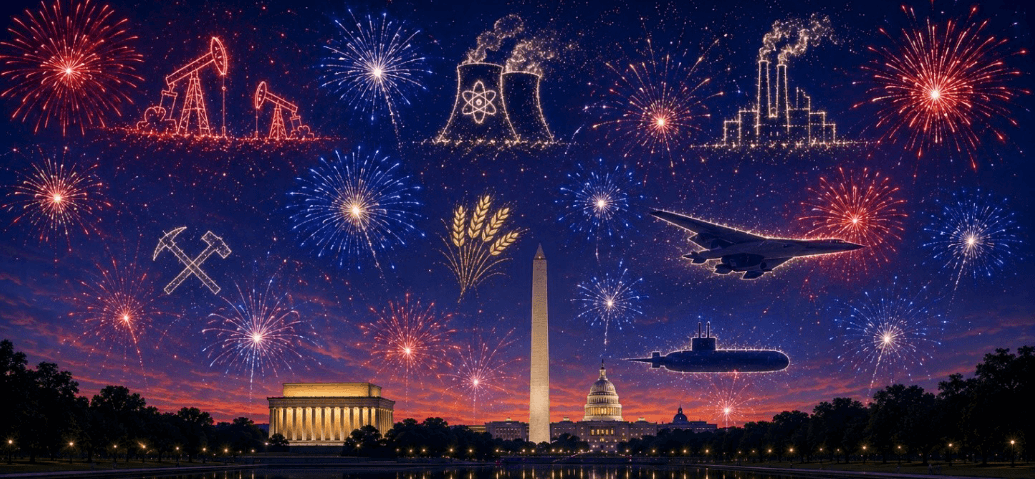
The World Reprices Risk

In a moment, we’ll get to economic trends and investment themes; but first… I hope you had a great Independence Day holiday: America 250.
Over the past few days, if you — and your family and friends — were in the right place you saw things you’ll remember for a long time, maybe for the rest of your life.
For example: “I’ve never seen anything like this,” texted my sister from Washington, D.C.
She was there this weekend and witnessed all-day military flybys, followed by a stupendous fireworks display. Absolutely, it was red-white-and-blue pageantry. But it was also national memory embodied in jet noise and aerial pyrotechnics.
Alas, I missed the spectacle. I was 245 miles to the west, in Pittsburgh, on the other side of the Alleghenies, doing my own thing. But I was there in spirit, as I suspect were millions of others.
Frankly, only President Trump could have made this happen. Indeed, try this thought experiment: Imagine the institutional pushback if President Somebody-Else had been in office:
- “Umm… no, we can’t fly the airplanes to Washington cuz it would interrupt our vitally critical training cycle.”
- “Umm… no, we can’t have huge fireworks cuz smoke and air pollution and net-zero.”
- “Umm… no, we can’t do public safety for big crowds cuz, y’know, criminals have rights, too.”
Love him or not, you must admit that some things happen only when the guy in the Oval Office pushes the envelope. In other words, yeah... Only Trump.
On To Other Things, Like Iran & Oil
Now, in a roundabout way those jets and big boom-boom explosions bring us to Iran. And with each passing day the outcome of the recent unpleasantness is becoming clearer: American’s overseas expedition was no mere punitive military action. It was a diplomatic earthquake and market-shaping event of long-term global scale.
Some people talk about TACO, meaning “Trump Always Chickens Out.” That’s cute, in the way that bumper stickers are cute until reality arrives wearing steel-toed boots.
And the reality is that Iran tested American patience and military power, and discovered the sharp edge: fifteen thousand airstrikes speak for themselves.
The Islamic Republic still issues communiques, parades its militia and fake missiles through Tehran, and summons rent-a-mobs to perform tired old faux-revolutionary theater. But true power is not measured by how loudly people held hostage inside a criminally mismanaged country and society can yell “Death to America!”
No, in this matter power is measured by what bankers will finance, what insurers will insure, what refiners will buy, and what ship captains will risk. And right now, Iran is on the outside looking in. Because indeed, Iran can barely sell its oil.
Per Bloomberg News, “A hoard of Iranian oil is building up at sea, as the Islamic Republic struggles to find buyers before the expiry of a 60-day window granted by Washington. More than 58 million barrels of Iranian crude and condensate was on-the-water as of July 1. … More than 90% has no clear destination.”
Yes, per that infamous “MOU” (Memorandum of Understanding) that Trump inked, the U.S. lifted sanctions-pressure from Iran, but only for a limited time.
Now, though, Iran’s problem is that refiners across the world — even in China — worry that anything they buy today may become untouchable tomorrow. And it’s how serious sanctions work; they transform every barrel into a legal problem, every cargo into a balance sheet liability. Or as the man says, “Sorry, bro, you’re uninsurable.”
Meanwhile, tankers full of other nations’ oil defy the hollow threats of the Iranian Revolutionary Guard Corps (IRGC) and transit the Strait of Hormuz via Omani territorial waters, backed by U.S. naval power.
Which brings us to geography, which defines Hormuz as a narrow maritime chokepoint through which about 20% of global petroleum has moved in recent years. Over time, uninterrupted transit through Hormuz seemed immutable; although since World War II, naval planners have worried about keeping that channel open. (Long story.)
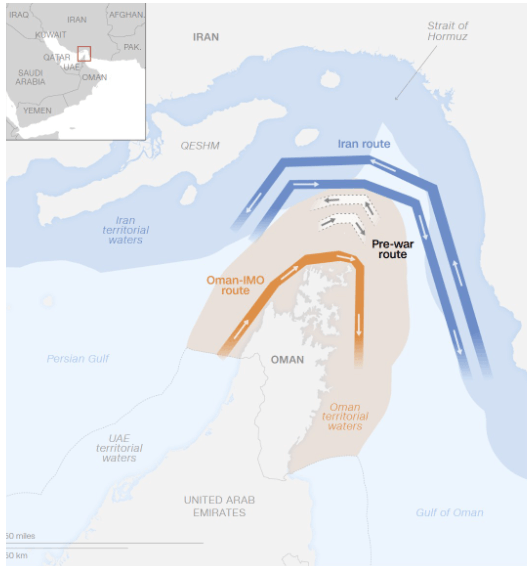
Hormuz transit separation zones. Credit Institute for Study of War and CNN.
When kinetic conflict broke out, Iran promptly announced that Hormuz was “closed” and any transiting ships – sailing only by Iran’s permission – were required to pay tolls. For a while the threat mattered, but no more. Now, talk of closure is just another noisy, noisome Iranian claim, more propaganda than nautical reality.
On occasion in recent weeks, the IRGC has launched small rockets or drones at passing vessels. And the response was U.S. military airstrikes against well-chosen spots. Thus, it’s clear that the U.S. will bomb the tar out of Iranian targets, and fear of “Death-by-JDAM” has a way of clarifying even the most obtuse minds.
While in other news, Omani leaders have announced that they do not support Iran’s toll scheme. And Trump has declared that every dime Iran collects in “tolls” will come right back out of Iranian assets presently under seizure.
And all of this is not diplomacy like in some college government class. This is political-military-financial leverage.
Rewriting Global Rules
Now, let’s address the part of this geopolitical drama that many armchair strategists seem to have missed.
When the U.S. Navy is offshore, it doesn’t merely “show the flag.” It derisks certain dangers, and rewrites commercial assumptions. A carrier battle group reprices hull & cargo insurance. A destroyer escort changes the decision-process behind a ship-owner’s decision to sail or not. A show of persistent force alters the thinking of bankers, oil traders and refinery managers who must keep their cracking towers fed.
Meanwhile, Iran’s problem is not just oil. Because right now the theocratic dictatorship cannot convince enough ship owners to haul basic cargo to Iran’s ports. Hence, the country’s economy is in a tailspin. Inflation is catastrophic.
Iran imports a large share of its food and consumer necessities. And when cargo ships don’t call, those empty shelves are not an abstraction; they are politics by other means. And of course, few players want to do business with a pirate state that takes potshots at passing commercial traffic.
Iran’s regime can command propaganda channels, but it cannot command the trust of serious global money. And that trust is what lubricates world trade.
From the U.S. side, Iran has failed to uphold its end of the MOU and thus has not received even a dollar in unfrozen funds or Gulf development aid. Evidently, the MOU was a legal and political test to see whether the IRGC could behave rationally after losing its military and economic leverage. It failed.
The Global Rise of “Plan Bs”
Recently, the Iran conflict has entered a bizarre stage of Negotiate-but-Don’t-Negotiate, but the world still turns. And yes, during the hot combat phase oil prices spiked. But in the past few weeks they have eased. At the start of kinetic hostilities, global trade was disrupted, but now it’s beginning to rebalance.
Meanwhile, projects that once lived on the back shelf as “maybes” are now front-burner priorities: projects like cross-land pipelines, alternate ports, more LNG flexibility, refinery adjustments and attack-hardened terminals.
This is how history works. Crisis exposes weakness; the solution is to reboot and reroute. For example, oil shocks of the 1970s rewired assumptions about Alaska, the North Sea, conservation, strategic reserves and the entire idea of energy security. Eventually, new thinking led to fracking.
The current Iran shock will do something similar for the global oil markets: change pipeline systems and tanker routes, emphasize port security, increase refinery flexibility, and revive appreciation for non-Gulf production, whether offshore or onshore but certainly in underdeveloped basins with the right geology.
At the heart of the action in the Gulf, Saudi Arabia, the UAE and other producers are pushing alternative pipelines east across Oman, west to the Red Sea, and even northwesterly lines to the Med. It’s not because engineers suddenly discovered geography, but because the Iran-risk premium finally became high enough to justify the steel, pumps, terminals and security.
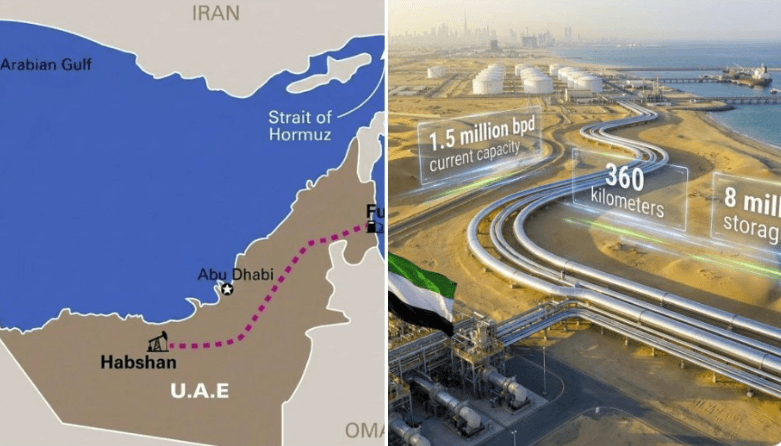
UAE oil line to increase exports and bypass Hormuz. Credit @saif_aldareei.
In strategic terms, this makes Hormuz less magical but not obsolete. No chokepoint disappears, but every alternate pipeline, expanded port, and reconfigured refinery reduces Iran’s leverage.
Elsewhere, China has deep economic problems after years of malinvestment in flashy, money-losing boondoggles: empty housing blocks, half-used rail corridors and local-government debt pyramids. But the Chinese are practical. They’ll reboot and move ahead.
And speaking of China, it holds solid cards in the form of supply chains for critical metals and materials that the rest of the world neglected for two generations: rare earths, graphite, magnet supply, battery chemicals. And these are not just abstract goods with odd names, they are innards of modern industry.
On the other side of the planet, Europe is a hot mess, figuratively and literally. Begin with its maniacal energy policy which has driven continent-wide deindustrialization. Crackpot net-zero mandates have made a virtue of expensive electricity. So now, as summer unfolds, entire nations sweat through heat waves while people scramble to buy imported Chinese air conditioners.

Brawl at French store over air conditioners. Credit @RMXnews, screen shot.
Then there’s the Ukraine war, a black hole for lives, money, equipment and collective Euro-political credibility. Because nothing says “stability,” and “we know what we’re doing,” and “invest here” like a festering aerospace war with Russia on the eastern front, fought amid energy scarcity, fiscal exhaustion and public distrust.
So, yes… Start thinking about the Plan B’s of the world.
USA – “Winning”
Which country benefits most from this reset? C’mon, man, take a guess… Yes, the United States of America, which returns us to America 250.
As smoke clears from the July 4th fireworks, America has entered another phase. From seabed to space, the U.S. has newfound leverage at many levels.
In the U.S., electricity, natural gas and transport fuels are structurally cheaper than in Europe or Asia. And cheap, reliable energy is a hidden wage boost for American workers and measurable margin for American manufacturers.
Not every lost factory comes home; nothing is that clean. But the balance has changed. The old model of global trade assumed stable sea lanes, cheap freight, predictable insurance, tolerable politics and endless outsourcing.
Now add hostile regimes, chokepoints, drones, missiles and sanctions. Suddenly, a new plant in Pennsylvania or Louisiana looks less like nostalgia and more like prudence. Secure supply beats fragile supply.
As for Iran, the country is a shell of what it was six months ago. Increasingly, it’s isolated from the global economy, an awkward counterparty even for supposed friends. Buyers that once gamed Iran’s oil on black-markets now look elsewhere because U.S. and U.S.-friendly oil suppliers matter more.
Elsewhere, China must rethink its energy security. India must recalculate exposure. Europe must face the thermodynamic cost of Green fantasies. Russia, too, has issues with energy, exports, revenue and refinery capacity.
Overall, in recent months the world has relearned old lessons; that shipping lanes, energy flows and supply chains are not academic issues. Geology is destiny, abetted by downstream refining and output. And policy determines timing, which is why we now see capital shifting to safer jurisdictions, to places that can deliver molecules.
Another point is that markets are maps of power, focused on resource flows and industrial capacity. And these maps change depending on how global markets gauge confidence and credibility.
Okay, here’s where investors must pay attention. Because not every headline is a trade, nor does every crisis create fortunes. But when routes change, premiums change. When premiums change, margins change. And when margins change, capital eventually finds companies, regions and technologies that solve the problem.
Yes, those airshows and fireworks over Washington, D.C. were splendid, even glorious. But the real display of American power is spread out across the dark plains of the Republic, where fresh-poured concrete is setting and the future is being repriced in real time. That’s the true reckoning after the July 4th celebration.
Over the weekend, America turned 250 beneath fireworks and flyovers. The world, meanwhile, received a reminder that hard power, energy, deep industry and serious money still decide outcomes.
The lesson isn’t complicated: nations that can produce and protect set terms. Everyone else negotiates from behind.
That’s all for now. Thank you for subscribing and reading.