
Why College Grads HATE AI
I saw a fascinating clip on Twitter/X recently.
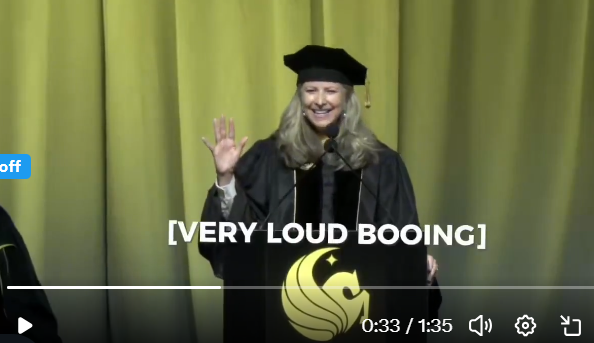
At the graduation ceremony for the University of Central Florida, the commencement speaker brought up AI.
“The rise of artificial intelligence is the next industrial revolution.”
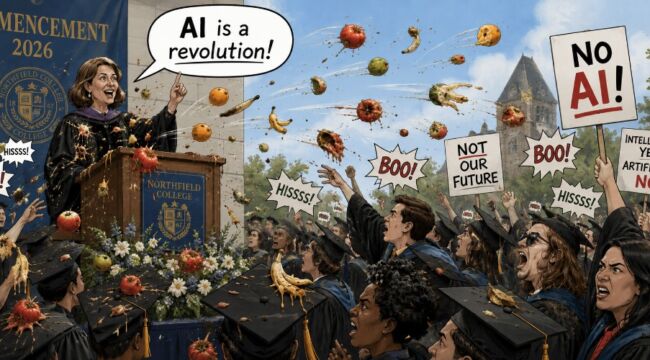
BOOOOOO! HISS! The new college grads are not fans.
Source: X
Gloria Caulfield, the speaker, was shocked by the negative response. “What happened?”, she asked in a Long Island-tinted accent.
Eventually the speaker continued:
“Only a few years ago, AI was not a factor in our lives.”
And the crowd goes wild cheering at that nostalgic thought. But then…
“And now, AI capabilities are in the palm of our hands…”
The crowd absolutely hated this line. More, louder booing and hissing. The speaker said it hesitantly. She knew it wasn’t going to go over well, based on prior reactions. If this young crowd would have had rotten vegetables handy, a volley of tomatoes and eggplant would have been launched in Gloria’s direction.
Young People (Understandably) Hate AI
Put yourselves in the shoes of a young American for a moment.
Houses are unaffordable. Rent and food are almost as bad. To have children comfortably, you’ll need to be in the upper 10% of earners (depending on the area).
You’re watching the stock market zoom ahead, but have little or none invested.
Your country is importing hundreds of thousands of foreign workers, mostly from India, to fill tech jobs. They’re willing to work 60-80 hours a week for far less pay.
And now, along come AI agents. Autonomous artificial workers who plan, complete, test, and complete complex tasks. Coding is currently the primary target, but agents will rapidly expand to every corner of the white collar world.
Ken Griffin’s Revelation
Billionaire Ken Griffin, founder of giant hedge fund Citadel, has been an AI skeptic. Up until now.
With the latest agents, his team is making a disturbing amount of progress. Ken says he went home on a recent Friday afternoon “depressed” about the societal changes these agents would bring.
An excerpt from Fortune’s reporting:
For Griffin, the most striking proof isn’t in coding or content—it’s in high-end financial research. Work that Citadel would previously have assigned to teams with master’s degrees and PhDs in finance, work that took weeks or months, is now being completed by AI agents in hours or days.
“To be blunt, work that we would usually do with people with master’s and PhDs in finance over the course of weeks or months is being done by AI agents over the course of hours or days,” Griffin said at Stanford.
We’ve entered the disruption stage now. And young people are on the front-lines. The first jobs cut were entry-level, but now AI is eating its way up the food chain.
Fortunately AI is still horrible at picking stocks and writing, which is our speciality. And honestly, I don’t see them getting significantly better anytime soon. AI models are trained on the entire internet, good, bad, and horrible. But anything is possible, and nobody is 100% safe from the coming wave.
Three Paths – Blue Collar, AI Master, or Entrepreneur
As I see it, young people today have three primary paths to choose from.
First, they can take the blue collar route. As I’ve mentioned before, my 16-year old son will be starting an apprenticeship to become an electrician this summer. I’m proud he chose this path, and think it’s a great decision.
Opportunities for plumbers, electricians, welders, mechanics, and other blue collar workers are wide open. It will be many decades before robots replace these jobs.
And of all people, Nvidia CEO Jensen Huang recently acknowledged this trend.
“AI gives America the opportunity to build again. Electricians, plumbers, iron workers, technicians, builders—this is your time. AI is not just creating a new computing industry, it is creating a new industrial era.”
Isn’t it fascinating that the primary beneficiary of the AI boom is touting blue collar work? There’s a good reason for it…
Path #2: AI Masters
The second path young people can choose is a bit riskier, but has a higher upside. They can attempt to become an “AI master”. After all, there will still need to be people in the loop.
We will still need people checking the code AI writes, assigning projects, and overseeing progress.
Over the past few years a saying has taken hold, and it’s worth repeating. There are a few different versions, but here’s mine: “Your job won’t necessarily be taken by AI, but it will be taken by someone using AI better than you.”
Path #3: An Entrepreneurial Boom
The third path, of course, is becoming an entrepreneur. And AI makes this easier than ever. Even non-technical people can write solid code now, so the tech part of building a business has certainly become easier.
I expect many young people will take the entrepreneurial path. They may not have much of a choice in the matter, assuming they’re determined to enter the white collar world.
I fully expect a small-mid sized business boom over coming years. And though these businesses won’t hire as many people as they used to, there will still be significant opportunities to hire smart people.
A Breaking System
For many decades, the goal of most parents was to send their kids to college so they can find a good white collar job.
This era is ending. The transition may take another few decades to complete, but we are now headed in a different direction.
The future of white collar work will look like a smaller number of “AI masters” managing fleets of AI agents.
Blue collar work is on the rise. It will become an increasingly popular option. But many people are still stuck playing the status games, where the “rules” say we must send our kids off to university. They don’t want to tell the neighbors that little Billy’s going to be a plumber. This will change rapidly if AI plays out like I expect it to.
Young people today have many things to be upset about. And they’ve thought about these issues far more deeply than we have. So consider reaching out to the young people in your life, and asking them about their plans.
If they seem confused about what to do, ask if they’ve considered a blue collar career. I’m convinced that it’s the best path for millions of young Americans.

Comments: