
The Shanghai Silver Secret
Things are finally getting exciting in silver again.
Today we broke out above $85/oz in the U.S.
There was some stiff resistance around the $82 level that gave us trouble for a bit, but today we cut through like butter.
According to our friend Sean Ring, if we can stay above this key $82 level, the uptrend will be confirmed and the technical outlook much improved.
Personally, I’m more of a fundamentals guy. But when technical + fundamental views converge, it’s often worth paying attention.
Meanwhile in Shanghai, China, silver is trading at $96/oz. That’s a hefty 12% premium. In the chart below, the red line is the Shanghai price, and the blue line is the Western price.
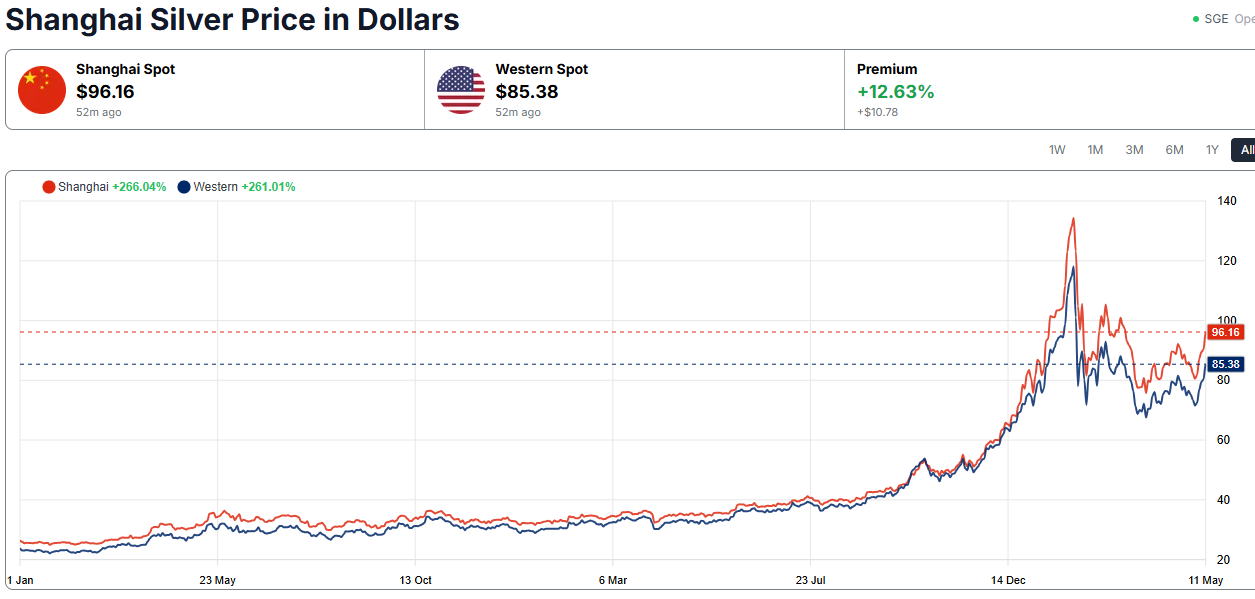
Source: GoldSilver.ai
As you can see, Shanghai silver pricing tends to lead the West. This is because Asia has become the primary consumer of physical silver. Especially China.
In March, China shattered silver import records. The orange line represents 2026 data through March.
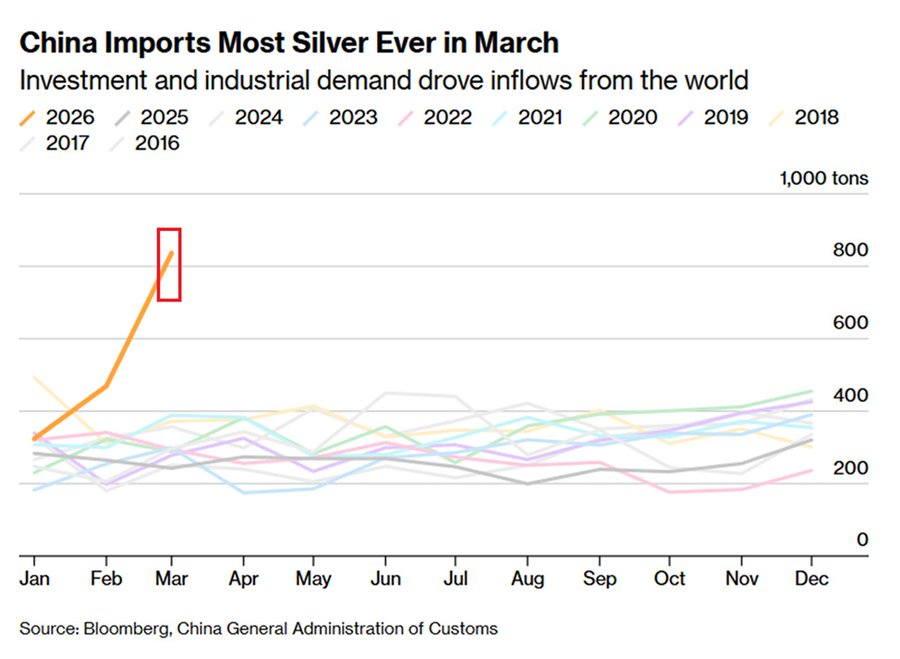
Over 800 tons of silver, imported in a single month. And China mines a lot of silver as well.
Here’s an excerpt from the Bloomberg piece which the above chart comes from:
Demand was bolstered by retail investors piling into small silver bars, an alternative to pricey gold, and solar manufacturers front-loading production ahead of the removal of the export tax rebates on April 1. The solar industry consumes about a fifth of annual supply, and is overwhelmingly located in China.
So two catalysts are fueling a demand spike simultaneously. First, it’s the solar panel boom we’ve been talking about for a while. More than 20% of total silver demand comes from solar alone.
The spike in fuel costs related to the Iran war has caused countries around the world to diversify their energy mix with solar. Many countries rely almost entirely on fuel imports, so this crisis has been a wakeup call. Solar combined with battery storage is the quickest solution to increase energy production, by far.
The second catalyst is fierce silver buying by Asian investors. In China, they’ve essentially outlawed crypto. So speculative demand often flows into silver.
Silver has thousands of years of history as money in China. The country has had dozens of paper money disasters (hyperinflations) over the past thousand years.
So the fact that prices are 12% higher in the home of physical silver is a very promising sign. The physical market remains tight, which is bullish for silver stackers.
New Markets
Some of you may be wondering: why is he spending so much time on silver demand in Asia, and China in particular?
Because during most modern silver bull markets, Asia was not a significant player.
Both India and China were too poor to buy all that much investment silver. And solar hadn’t yet taken off like it has today.
So this is a whole new world for silver. Today Asia has significant saving and investment dollars. In China, the personal savings rate is over 30%. A lot of that money will find its way into silver coins and bars.
And solar is a whole new animal as well. China controls up to 85% of that market.
During the 1980 bull market we had photography driving industrial demand for silver. At its peak, photo development accounted for around 30% of silver demand.
Today solar, electric vehicles, medical, and electronics have taken over as the primary industrial uses. And I don’t see these sectors slowing down anytime soon.
We’re in an extended “price discovery” period where silver will find its new trading range. It will continue to be volatile, but the trend should be higher for years.
Remember, it was just last October that we finally broke through the 1980/2011 prior high of $50.
Personally, I believe prices are going far higher. I plan to hold my silver investments for at least 5 years, and possibly longer.
A Proper Silver Mania
Eventually there will be a true silver mania. That brief spike above $100 we saw at the start of the year wasn’t the finale. Not even close.
I don’t claim to know exactly when it will happen. The price could fall if the Iran situation escalates (but then most assets would likely fall).
But sometime in the next few years, we’re going to enter a more chaotic financial period. The effects of the debt bubble will become apparent.
The Fed will print vast sums of money, lower rates, and the government will send out stimulus checks. Inflation won’t stay this low for much longer.
Demand for silver coins, bars, and jewelry will spike. Silver is one of those rare assets that is both a monetary and industrial asset.
Long-term predictions are tricky, but I could certainly see silver trading above $200 sometime in the next 3 years.
And whenever the next inevitable wave of inflation begins, we should see a flood of new money coming into precious metals. And for most people (at today’s prices) that means silver.
So we’re in a situation where both industrial and investment demand for silver are rising strongly. The catalysts driving these moves (diversification into hard assets, and energy insecurity) are durable and should last for many years to come.
Earlier this year, the move in silver got ahead of itself. But that spike from $50 in October to $115+ in January shows what’s possible.
When silver breaks out, it behaves like no other commodity. That’s because for many thousands of years, our ancestors used silver as money. We still have a cultural attachment to this metal.
Silver has been a safe haven for just as long as gold. But today it also benefits from growing industrial demand.
When these two types of demand rise together, as they are today, the result can be powerful.
Silver remains my favorite long-term hard asset. Yes, the price will jump around quite a bit. But the long-term trajectory remains unchanged: higher.

Comments: