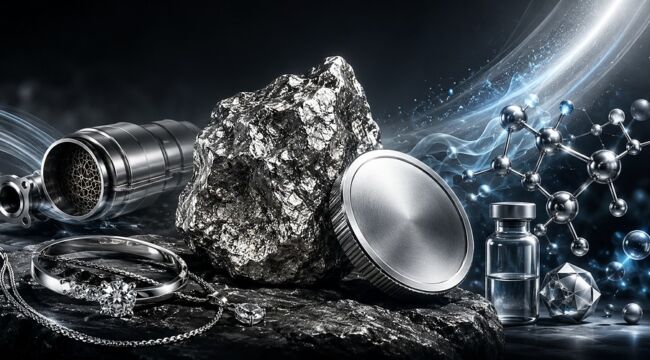

Gray, Dusty and 20X Rarer Than Gold
We spend a lot of time talking about gold and silver.
But there is another precious metal worth paying attention to.
It’s 20 times rarer than gold. It has a higher melting point, so it’s harder to refine and work.
But it has some very unique properties. It’s a key ingredient in many anti-cancer drugs, which are prescribed to about 15% of patients.
It doesn’t tarnish or corrode, is non-allergenic, and is highly durable. Hence its popularity in jewelry. And cathodes made with this metal are used in critical applications like pacemakers.
It has unique chemical properties that make it invaluable for certain industries.
If you haven’t guessed by now, it’s platinum.
Platinum is the magic metal that cleans up nasty diesel exhaust. It converts toxic carbon monoxide to harmless carbon dioxide. It also breaks down toxic hydrocarbons into water.
This is why thieves often steal catalytic converters from cars and trucks. They can contain $500 or more worth of platinum.
Platinum is also used to manufacture nitric acid, a key ingredient for fertilizers.
Here’s a breakdown of platinum’s top demand sources:
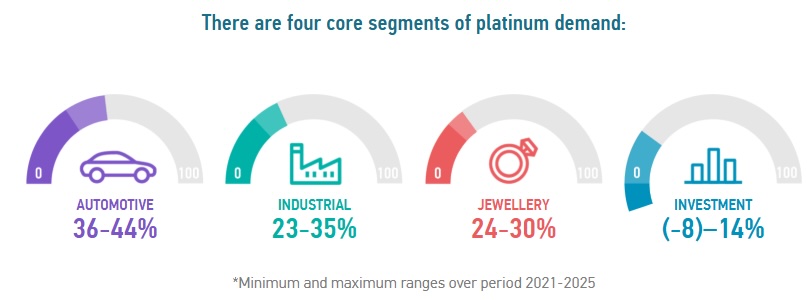
Source: World Platinum Investment Council
As you can see, investment (coins and bars) makes up a relatively small part of platinum demand. Up to 14%, and as low as -8% (it goes negative when investors are selling). Then again, if you count jewelry in the investment category, it’s steadier and more significant.
The Volatile Trend
Let’s pull up a 1-year chart of platinum prices.
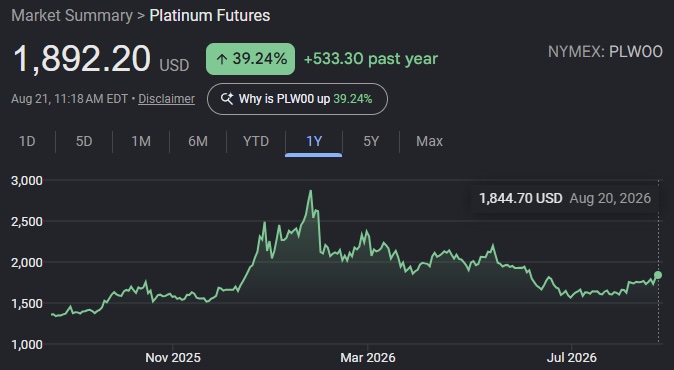
As you can see, this metal is a hot tamale. One year ago it was trading around $1,363 per ounce.
By early 2026, it had soared all the way to $2,890. Today it’s back down to $1,892.
Sketchy Supply
Why is platinum so volatile? One big reason is where it’s mined. Primarily in South Africa, but also Russia to a lesser extent.
South Africa is a notoriously risky place to do business. And ever since the war in Ukraine kicked off, trade with Russia has been limited.
So that’s a big part of why platinum prices move so wildly. This is a metal for those who are comfortable with high volatility.
But the metal itself has such unique properties that I think most precious metals investors should own at least some.
Investment Options
The simplest way to buy platinum is coins. This is a beautiful 1 ounce platinum American Eagle made by the U.S. Mint:
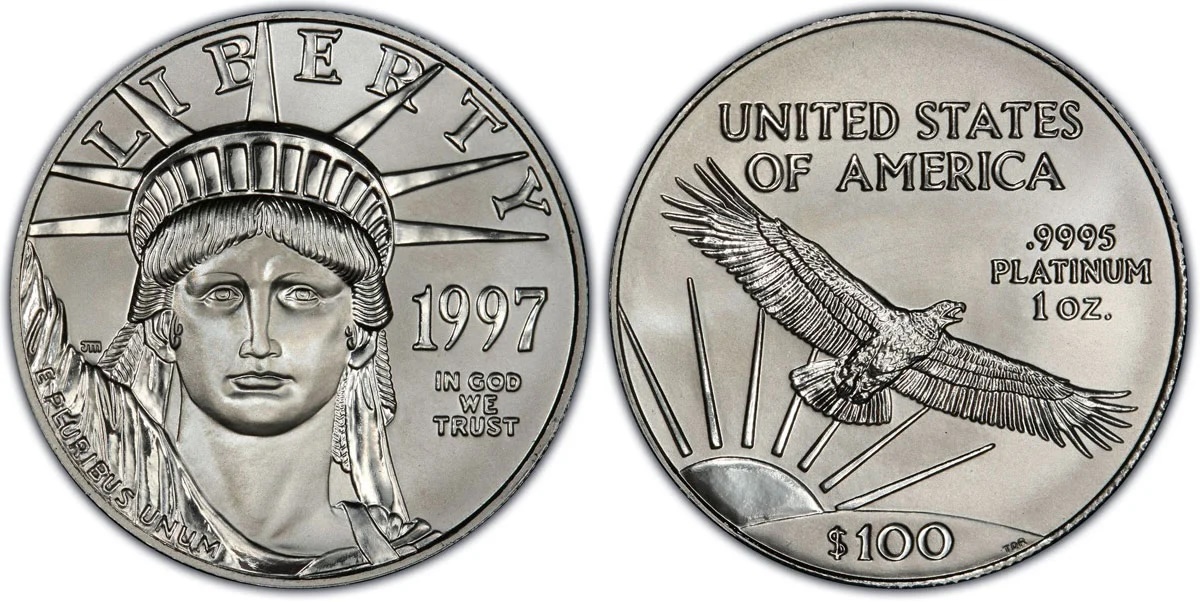
One of these coins costs about $2,100 today. Less than half the price of an ounce of gold. You can also buy 1/10th oz coins.
For those who prefer ETFs, there’s the Sprott Physical Platinum and Palladium Trust (SPPP). That offers exposure to physical platinum and palladium in a Canadian vault. Sprott is a well-known name in the space and I like their products.
For those with a high risk-tolerance, platinum mining stocks offer even more juice.
Sibanye Stillwater (SBSW) is a South African miner with a nice 4.2% dividend yield. They mine platinum, palladium, rhodium, and gold.
Sibanye is a well-run company, BUT it does operate in South Africa, a notoriously risky country to do business in. So there’s a reason why that yield is so attractive.
I’ve been waiting for a significant dip to buy, but it hasn’t materialized yet. Maybe next week precious metals will take a breather and we’ll get a chance to pounce. I’m kicking myself because in May of 2025, I wrote a piece titled “Is It Finally Time to Buy Platinum?” when the metal was trading under $1,000/oz. Oh well.
Platinum is a nice diversifier for gold and silver bugs. This metal has a bright future. Its catalytic and anti-cancer properties make it utterly unique.
Demand from jewelry and investment is a nice bonus, and once the debasement trade heats back up, it should do well.
For a long time, the metal traded at a premium to gold. But it’s fallen behind over the past few years.
I suspect that platinum still has catching up to do.

Comments: