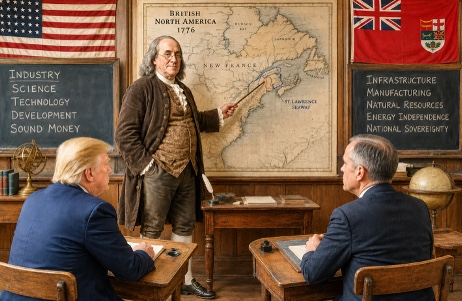

Dear Canada, Please Read the Map
On July 31, I wrote about Canada, and how Donald Trump seems to be channeling his inner Benjamin Franklin. And I received more negative responses to that article than anything I’ve written over the past two decades.
Most critics were from Canada, a place where I’ve traveled and done business for over 40 years. So, perhaps I’ve missed something in my explorations in Canada; or perhaps some Canadians lack a sense national self-awareness.
“Trump-Trump-Trump,” you say?
Well, okay… if you insist: “Trudeau-Trudeau-Trudeau!” And “Carney-Carney-Carney!”
Seriously, Canada. Look inward. What have you done to your country? And now, over this past weekend U.S.-Canada trade talks cratered, and we have a new tariff war. Let’s dig in.
Can Canada Defy the Map?
A few weeks ago, I recalled how, in the 1760s-80s, Franklin was involved with Canada, or what was then called “British North America.” The point was that Franklin viewed North America as a strategic whole: rivers, ports, farms, mines, workshops, shipyards, roads, canals, defenses and markets, all tied together by geography and necessity.
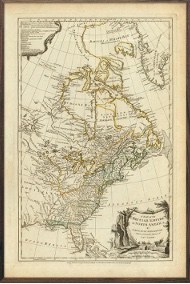
British North America in 1776. Credit: Muir-Way.com.
I suspect that Trump understands this as well. And despite hyperbolic criticism from Canadian readers, my July 31 thesis still stands. That is, the U.S. and Canada are two continent-scale neighbors, deeply intertwined by supply chains and common defense, but now arguing as if geography was just an opinion.
And I’m sorry to break the news, guys & gals, but Canada can’t win a trade war with the U.S.
Sure, Canada can impose counter-tariffs. It can ban U.S. liquor and boo the U.S. anthem at hockey games. But Canada can’t replace the world’s largest economy – located right next door! – with distant dreams of Europe or China. And here’s where Canada’s political class has a huge problem.
Begin with Prime Minister Mark Carney, a globalist in every respect; except that he keeps his money mostly in U.S. investments (look it up!). Then add how much of official Canada, as well as Canada’s mainstream media and academic factions, collectively view their nation as a European country, cruelly condemned by fate to occupy North American real estate. Meanwhile, vast numbers of Canadians want Scandinavian social policy, Brussels-nanny-state regulation, Davos-approved climate virtue, along with wide open American market access, and then — somehow — massive trade with China on Canadian terms.
Yeah, right… Dream much? On China alone, Canadian trade goals are absurd. That is, China doesn’t view Canada as a partner in value-added manufacturing or high tech. China can produce all the steel, aluminum and auto parts it needs, and at far lower internal cost than anything Canada can offer for sale.
Meanwhile, Beijing eyeballs are focused on Canada’s vast, post-glacial landscape of water, energy, minerals, farmland and timber, and a modest-sized (by Chinese numbers) market for Chinese goods.
In purely strategic terms when it comes to China, Canadian trade aspirations risk turning the place into just another of the Middle Kingdom’s worldwide resource appendages: dig, pump, cut and ship; then import back the higher-margin finished products from Asia.
The Benjamin Franklin Frame
It brings us back to Ben Franklin, who would have recognized the problem. He was not a “free trader” in the modern, graduate-seminar sense. He built institutions: libraries, fire companies, postal routes, schools, militias and civic machinery. He understood that prosperity requires production, infrastructure, credit, skills, security, law and the strong habits of serious people.
In the 1760s – 70s, before there was a United States, Franklin saw North America as strategic geography. Then during the Revolution, and later while negotiating the Treaty of Paris, he argued in terms of waterways, boundaries, trade routes and particularly the St. Lawrence. And in 1783 the Articles of Confederation even offered a standing invitation for British North America to join the new American union, but the people up north declined and history unfolded accordingly. Fair enough; Canada is Canada for a reason.
But the fact that, today, Canada is a separate country does not divorce the place from North American reality. The U.S. and Canada share a continent, an oceanic and aerospace defense problem, plus rail corridors, power grids, pipelines, lakes, ports and Arctic approaches. No tariff schedule can repeal the map.
All of this is why Franklin and Trump belong in the same conversation. Tariffs are not just a revenue grab or a fit of pique by the Orange Man. They’re part of a 250-year-old American argument over how trade should serve national development.
In Ottawa’s telling of the tragic trade tale, the U.S. moved the goalposts at the last minute; something about refusing to print French language on the packaging of American goods. Huh? Umm… no, I don’t think so, mate.
In Washington’s telling, Canada has long and openly permitted Chinese goods to enter, and then trans-shipped them down into the U.S. with a “Made in Canada” label. In other words. Canada has distorted trade while expecting privileged access to American markets.
An “American System,” Whether Canada Likes It or Not
After Ben Franklin came Alexander Hamilton in the 1790s, who gave the young U.S. republic a program: national credit, sound money, manufacturing, infrastructure and a legal order friendly to productive enterprise. Later, Henry Clay put a name to it: the “American System.” This meant tariffs, internal improvements, banks, canals, roads, railroads, mines, mills and farms. And these weren’t just isolated policies; they were a method to turn a continent into a powerful nation.
Now, Canada wants not merely to remain independent — which is understandable — but to abjure a school of economic logic that would make North America much stronger. Indeed, one wonders: what’s so wrong with Canadian development, infrastructure, value-added industry, energy abundance, reliable defense, and deep integration with the only market that can absorb that country’s output at scale?
Instead, modern Canada encourages internal policies that, for example, block pipelines, delay mines, litigate ports, tax capital, subsidize favored sectors, protect sacred political cows. Then, people wonder why investment per worker and productivity lag. Where’s the economic growth?
It’s not enough that Canada controls energy resources, minerals, farmland, water, etc. A strong country must build systems that convert resources into durable wealth. And this is the “resource country” question that Canadian elites hate to discuss.
Indeed, Canada’s elite tend to view resource development as an insult, if not a sin. Quite unlike their Chinese friends, Canada’s ruling apparatchiks apparently lack an appreciation for how energy and resources translate into wealth creation and national power, certainly when developed through the downstream levels, to where people can have good-paying jobs.
Industrial Policy Before the Term Existed
Over 40 years, I’ve seen how Canada’s political class tends to be reflexive and defensive, certainly vis a vis America. But really, any serious U.S.-Canada bargain would not reduce Canada to an American gas station or rock quarry; in fact, expect the opposite. Canada can create a trade regime in which it becomes indispensable to a North American system: Canadian energy and minerals; Canadian engineering; Canadian infrastructure from the U.S. border up into the Arctic. The future should be hemispheric.
In other words, let Canada be Canada! But be a Canada built on energy and resource development, along with high tech and modern industry; not Canada as an American colony (and not the 51st state). Also, definitely, not Canada as China’s mine mouth, nor a far-off Euro-wannabe with fewer people and no old castles.
Meanwhile, the U.S. has its own work. Tariffs can shape economic development, but alone they don’t issue construction permits, build mines and factories, train workers, or launch ships and merchant marine capacity. Industrial policy must be more than a White House press release about tariff rates.
The bottom line for Canada is that access to American markets comes with conditions. If Canada wants favored treatment, then Canada must help build a secure North American production base and not use U.S. access to shoehorn Chinese supply chains across the border, while indulging in European regulatory fantasies.
China Is Not Canada’s Escape Hatch
Let’s revisit the China card, because the fact is that China buys what China needs, on terms useful to China. And China wants Canadian resources and access, not lectures about values and definitely not a partnership in advanced manufacturing.
Beijing already dominates most of the world’s critical, value-added supply chains, which includes just about everything Canada produces. So, why would China invite Canada to move up the ladder when it can buy raw inputs, add value at home, and sell finished goods back to the world? In other words, the “China option” is a mirage (unless it’s a sellout).
Meanwhile, in commerce, geography is destiny and the U.S. is right next door. The roads, rails, pipelines, power grids, legal practices and business relationships already exist. And don’t forget the defense umbrella, under which Canada is well-defended at strategic levels by the U.S.
In fact, if Canada were not located beside the United States, Ottawa would have to spend staggering sums to protect its coastlines, airspace, Arctic approaches and infrastructure. And deep down, Canada’s defense problem is inseparable from America’s.
Obviously, Canada must look after Canada. But this requires a strategy that marries resources and goals. Bashing America may feel good, along with booing the U.S. at hockey games; okay, get it out of your system, kids.
But when the sugar high wears off, it’s time to get productive: develop energy resources, build mines and mills, open ports, shorten permitting processes. Indeed, reverse the trend in which de jure regulation is de facto veto. Lower internal trade barriers, reward investment, rebuild fiscal discipline, and stop confusing bumper-sticker slogans with national development strategy.
At higher levels of policy, Canada is hamstrung by a widespread sense of globalism, especially the so-called “Davos view” of the world. Indeed, too many Canadians frame their nation as some sort of administrative platforms within an agenda of global governance, where energy is a moral problem and industry is a net-zero carbon-accounting nuisance. This kind of worldview is toxic to a country whose natural geologic-geographic strengths are energy, resources, engineering, agriculture, transportation and hard infrastructure.
To be prosperous, Canada must make things: mine stuff, grow crops, produce and refine energy, etc. Oh, and read the map! Canada is in North America. This is not hard.
What a Deal Should Look Like
What should Washington and Ottawa do after this week’s failed talks? First, stop pretending that this sordid tariff drama is an end state.
Tariffs are leverage, but the end state ought to be a continental compact built around industry: secure U.S. access to Canadian oil, gas, uranium, potash and critical minerals; Canadian access to the U.S. market for genuinely North American goods. Plus, tighter enforcement against third-country transshipment (i.e., slapping “Made in Canada” stickers on overseas goods!), along with joint investment in processing, transport, power and defense production.
Second, fix the loopholes. If Chinese steel, electronics or components can just enter Canada, do a paperwork makeover, and then roll into the United States under preferential treatment, it’s not “free trade;” it’s money-laundering. Industrial strategy without border discipline is a euphemism for organized crime.
Third, Canada should choose value-added development. Don’t just sell raw materials cheap and buy back finished goods dear. Instead, climb the value chain inside North America.
Fourth, the U.S. must treat Canada as a strategic partner, not a convenient target to bash at political rallies. After all, Canadian workers from the mines of Yukon to the mills of Hamilton and Quebec City are not America’s enemy; most are exactly the people a renewed North American industrial system needs.
America’s argument with Canada is against a long-evolved, protectionist and self-dealing system that has blocked its own development, while demanding access to American markets for favored sectors.
Tariffs Are Now the Message
So, now we have new tariffs in effect, a regrettable point that should be sobering to both sides. Washington has reminded Ottawa that access to the U.S. market is valuable. And Canada demonstrates how nationalism-theater works in the modern media age. But neither point addresses the larger question.
That is, can North America move ahead as an economically integrated, industrial continent? Or is the Canadian border line just a no-man’s-land where mutual grievances confront each other?
Franklin would have understood the answer: develop energy, increase output, build infrastructure, and create wealth at home in North America, with friends, on terms that don’t leave the continent dependent on long-term adversaries.
Understandably, Canada doesn’t want to be seen as running up a white flag; but neither does barstool rhetoric and political swagger solve any problems. Canada can develop or decline. It can make a deal, enforce rules, build infrastructure, and join an “American System” that is evolving one way or the other. Or not…
Meanwhile, Canada’s alternative is a mishmash; be a boutique-Euro-wannabe, pursue China-trade fantasies, maintain open-immigration policies that swamp the country’s welfare state, and see where it goes. Again… good luck, guys.
Which brings us back to Ben Franklin, whose efforts failed to bring British North America into the new U.S. republic. But still, over the past 250 years the big, continental map has not changed, and Franklin’s ideas still pertain. One way or another, geography rules, and the question is whether today’s leaders understand that, and can build upon reality.
That’s all for now. Thank you for subscribing and reading.

Comments: