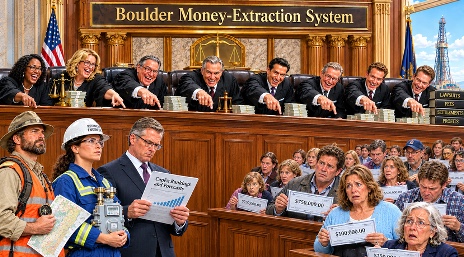

Boulder, Colorado Wants Your Money
The title says it all: Boulder wants your money.
Oh wait… You don’t live in Boulder, or even Colorado? Too bad. Fork it over.
At least, that was the argument last week in the U.S. Supreme Court, in a case called Suncor Energy v. Boulder County. If Boulder prevails, consumers everywhere will pay big-time. And if you’re worried about so-called “climate change,” this case won’t change even one raindrop or gust of wind in the weather. Because the idea is to take your money!
A “Local” Lawsuit with YOU as Unnamed Defendant
In 2018, Boulder sued Suncor Energy Inc. (SU) and ExxonMobil (XOM) for damages related to future costs from heat, drought, wildfire and flooding. That is, Boulder sued for fanciful things that have not yet occurred. There was no oil spill, refinery fire, or any other definable, direct injury to people or property.
In essence, the lawsuit claims damages because Big Evil Oil Companies produce hydrocarbons, which are alleged to cause… Climate Change!
So, Boulder named the two oil companies as defendants in a state court case and now wants them to write huge checks. But what it really means is that Boulder wants YOU to pay because any monetary damages will flow through the companies to what they charge at the pump for gasoline, diesel, jet fuel and a myriad of other hydrocarbon products.
“But wait,” one might say. “Even if the so-called ‘climate’ is changing, isn’t that a global issue?”
Well, yes… It’s not as if Colorado has its own air, let alone Boulder. And it’s not as if any given molecule of carbon dioxide comes with a blockchain ID on it. Nobody can trace the source of atmospheric CO2 directly back to Suncor, Exxon, or any of a near incalculable number of global producers of oil, gas, coal, wood, other biomass, or even natural sources of CO2 like volcanoes.
Meanwhile, why Boulder? Who appointed Boulder as King of the World, let alone Czar of the Climate? Why can Boulder sue two oil companies in state court over CO2? And really, what about me? What about you? Where’s my lawsuit? And where the hell is MY money?
Okay, just kidding… sort of. But you see where this goes, right? If Boulder shakes down Suncor and Exxon, then the costs get spread across those companies’ operations. Maybe they go out of business (which I doubt, although that is one key goal of the Green-Left); or… maybe we all pay more at the pump and furnace, while Boulder cashes the checks.
And perhaps you’ve never set foot in Colorado (full disclosure: I’ve been to Colorado). But that doesn’t matter. If you buy or use fuel, electricity, food, plastic packaging, medicine, airline tickets, anything delivered by truck, and much else – pretty much everything in the entire economy – then Boulder’s local lawsuit picks your pocket. You are simply the unnamed defendant here.
From Activism to Lawfare
Several years ago, my colleague Jim Rickards coined the phrase “Green New Scam” as a shorthand method to describe much of what passes for environmental policy in certain sections of American and global politics. Indeed, what we have here, with Boulder, is a local climate scam acting via pure, unadulterated lawfare; that is, Boulder is using litigation to obtain what activists and their political lapdogs have not secured through federal law.
Boulder seeks what it calls a “fair share” of “adaptation costs,” which are undefined in any meaningful legal sense. At root, it’s an exercise in speculation; a shakedown aimed at deep-pocketed companies that are – in some quarters – politically unpopular. So, they sue Big Oil in state court; versus seek a remedy against entire nations like China and India, which burn immense amounts of coal and oil; let alone sue billions of people around the world who use hydrocarbons every day.
In one sense, Boulder’s lawsuit is a classic courthouse pressure campaign. Sue somebody and demand Big Buck$ under broad, arm-waving legal theories. Create legal bills and litigation exposure. All along, the process is the punishment, while setting up leverage for a payoff-settlement.
And one lawsuit may be leverage, but if Boulder blazes the trail here we can expect dozens more such suits. It’s the beginning of a vast system of rent-seeking against the energy industry. In fact, per briefs filed in the Suncor case, over 60 local governments have brought similar lawsuits across the U.S., and thus this particular case is not a mere one-off.
If Boulder’s lawsuit moves ahead, a barrel of oil, refined fuel, or other downstream feedstock will be priced not just based on internal costs such as finding, development, lifting, transport, refining and movement to point of use. Instead, that barrel will carry a massive markup for bottomless, endless litigation and claims under a constellation of different state laws.
Litigating the Global Atmosphere in a County Courthouse
Boulder’s lawsuit against Suncor and Exxon alleges nuisance, trespass, unjust enrichment, conspiracy and other state-law claims. Boulder says the companies produced and promoted fossil fuels while misleading the public about climate risks, leaving taxpayers with those ill-defined “adaptation costs.” The companies deny liability and argue that federal law forecloses claims rooted in global emissions.
Procedurally, Suncor and Exxon petitioned to do what’s called “remove” the state case to federal court. And after a convoluted pathway of litigation, the case wound up still in the hands of Colorado courts, so the defendant oil companies petitioned the Supreme Court to hear arguments and make a determination on what’s called “venue.” And that’s where things stand now, with arguments last week.
Of interest, Justice Alito recused himself, presumably because he might own stock in SU or XOM (he didn’t say). Thus, the outcome of the case will be determined by eight justices, versus nine, and there’s a distinct possibility that Court politics will deliver a 4 – 4 vote; which means that the case stays in Colorado courts.
Again, CO2 in Colorado is chemically identical to that from China, India, Russia, Europe, ships at sea, aircraft in the sky, and factories, farms and billions of vehicles everywhere. There’s no true accounting for what’s in the earth’s atmosphere. But welcome to American jurisprudence, where a small jurisdiction like Boulder can claim damages for planetary conditions related to the world’s massive, globalized economy.
What, Exactly, Is Defective?
During oral arguments last week, Boulder’s lawyer compared the case to ordinary product liability. Really? Then what’s the defect? That is, tort law creates a claim where, say, a defective brake fails to stop a car, or contaminated food makes you sick. Traditional product liability links back to an identifiable flaw, product and injury.
But hydrocarbons from Suncor, Exxon or anybody else do exactly what buyers expect. Gasoline powers engines; diesel moves freight; jet fuel lifts aircraft; natural gas heats buildings and feeds chemical plants; petroleum becomes asphalt, plastics, lubricants, fertilizer inputs, medical supplies and thousands of useful materials.
Liability-wise, Boulder’s alleged “defect” is not some malfunction of refined products. Indeed, Suncor and Exxon can rightfully brag that their products work as intended and are successfully used every day at continental and intercontinental scale, with CO2 as a well-known product of combustion.
The long and short is that Boulder has no claim for ordinary product liability. Boulder is just bellyaching about the long-term, cumulative consequences of modern civilization’s entire energy system. And that’s hardly an issue for a state court anywhere. Aside from the money. Which will be paid by YOU, did I mention?
Colorado’s Courts Are Knocking at Your Front Door
And let’s make this easy: follow the money! Because a legal victory for Boulder will create open-ended liability against energy companies everywhere, tied to weather, infrastructure and this ill-defined “future adaptation” thing. No oil company manager, business executive, lender or insurer could know which city would sue them next, let alone what conduct triggers liability, or even how many times the same emissions might be counted.
At the very least, Boulder’s legal theory means that fewer energy projects be developed by U.S. companies, although America’s energy demand will still remain, which is a recipe for higher prices. We’ll all pay more for motor fuel, heat, electric power; and on and on and on…
And how much is enough? Ha! From long, personal experience I know that environmental activists live in their own world. To the extent they consider energy costs (especially costs paid by others), it’s an abstraction. At the end of the day, Boulder’s lawsuit is local lawfare that transforms into a national-scale, deeply regressive, so-called “net-zero” energy surcharge.
Meanwhile, Boulder’s lawsuit will not remove a single molecule of CO2 from the atmosphere. Specifically, the world runs on hydrocarbons: about 83% of total global energy output comes via hydrocarbons (look it up). And the world will run on hydrocarbons long into the future.
If Suncor and Exxon sell fewer barrels, China, India, and the entire rest-of-the-world will still fire up their furnaces and engines. And if American companies exit the energy biz, somebody else will develop the oil and gas, and sell it to willing users.
Of course, that “somebody else” will be an overseas producer, far away from the nettlesome legal reach of Boulder, Colorado. And those foreign actors will laugh and scoff at the utter stupidity of not just Boulder and its crackpot lawyers, but at ridiculous American courts, and gullible voters who allow this kind of legal lunacy to handicap America’s entire energy and economic system.
Bottom Line
If Boulder prevails, activists will celebrate their victory over Big Oil. But the practical victory will belong to trial lawyers, foreign producers and every municipality that copies the complaint.
The losses, of course, will hit everywhere: costlier capital, fewer domestic energy projects, tighter supply, weaker industrial capacity, lower returns, more expensive food, power, transport and goods. None of this will respect Boulder’s boundary line, and all of it will trespass on your wallet, bank account and investment array.
The so-called “defect” in this case is not in the gasoline, diesel, jet fuel or other hydrocarbon products. Every day, all around the world, these molecules deliver their promised energy and feedstock. No, the real defect is in a demented legal system that might transform worldwide energy use into a local cause of action, and then assume that the invoice stops with a corporate defendant.
Ideally, the Supreme Court will toss out Boulder’s case and issue a strong opinion that clamps down on future copycats.
But if not? Well, the first check might come from Suncor or Exxon, but all along the money will come out of your pocket. So, and as noted above, fork it over.
That’s all for now. Thank you for subscribing and reading.

Comments: