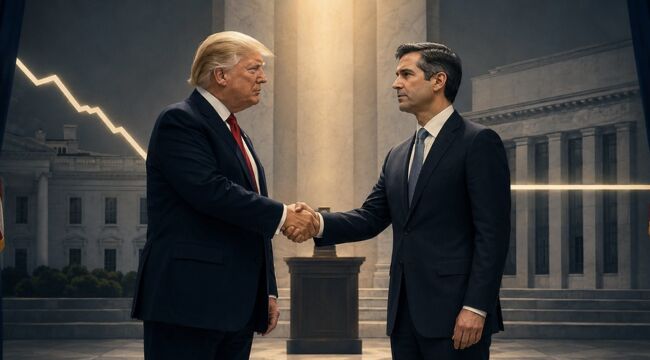

This “Trump Myth” Will Cost You
We need to talk about Kevin Warsh.
Today I need to dispel one of the biggest myths in financial markets.
And in so doing, prepare you for one of the biggest market events of the last three years – set to play out over the next three months.
Due to a confluence of factors…
Namely the war in Iran…
The midterm elections…
And this market event I’m referring to…
The next three months could be extremely volatile.
We’ve already gotten a taste of it over the last couple of weeks.
AI stocks have been breaking down. Risk-on assets have gotten the wind knocked out of them.
But we need to prepare for the real possibility that things could get worse – much worse – before they get better.
I promise, there’s light at the end of the tunnel. Before the end of this year, I believe the bull market will continue.
But this doesn’t mean you need to bury your head in the sand until then. There are ways to profit through volatility. We’ll discuss them today.
In fact, today I’ll even give you a sneak peak at a new trade I just issued to a special group of my top subscribers.
So let’s get into it…
“A Good Family Fight”
On Wednesday, Kevin Warsh gave his second press conference as the new Chairman of the Federal Reserve.
For the second time in his tenure, the Fed left interest rates unchanged.
At first, markets loved it.
Then, something happened.
He referred to a series of “shocks” – meaning economics shocks – and suddenly, markets started to roll over.
He said he didn’t characterize yesterday’s decision as a “pause.” He referred to it multiple times as a “good family fight,” indicating several Fed governors were ready to raise rates.
And he pointed out, correctly, that markets aren’t waiting for them.
Real rates – meaning interest rates set by the market – have risen in the last 42 days, in response to incoming economic data, and in anticipation of what looks like an official interest rate hike from the Fed.
Trump’s Guy?
This brings me to the myth that we need to dispel.
President Trump nominated Kevin Warsh for the position of Fed Chairman in January.
This came after a very dramatic, high-profile dispute between Trump and the outgoing Fed Chair, Jerome Powell.
Between 2022 and 2023, the Fed engaged in the sharpest rate hike in 40 years, due to historic inflation caused by massive government stimulus, surging energy prices from the war in Ukraine, and supply chain disruptions caused by the Covid-19 pandemic.
In 2024, the Fed cut rates by a full percent. A year later, they did it again.
Trump wanted more.
He demanded that Jerome Powell cut rates further to his own personal target of 1-2%. That would drive economic activity to the heights of his first presidency, and allow the government to refund the debt at lower rates (placing less burden on taxpayers).
He called him a numbskull, a moron, a dummy, and a stupid person for not doing as asked.
But, there’s a problem.
1 on 12
The Chairman of the Federal Reserve does NOT control interest rate decisions.
That’s a myth.
The Fed is an independent body composed of 12 voting members who make up the Federal Open Market Committee (FOMC). It includes seven Fed governors (including the Chairman), the president of the Federal Reserve Bank of New York, and 4 regional presidents representing the remaining 11 regional Fed banks.
These 12 men decide policy. Not the Chairman. The Chairman has just one vote like the rest of them.
All the Chairman does is preside over meetings and let his voice and opinion be heard – both behind closed doors and in facing the public.
That’s it.
Today, there’s this public perception that the Chairman alone has the power to change rates. He doesn’t. This myth materializes because President Trump kept calling Powell to cut rates, as if he could just wave a magic wand and make it happen.
And, because Trump picked Warsh, people seemed to believe he would come in and get the job done.
Now, people are scrambling to make sense of how Trump’s guy could threaten to do the opposite.
Water is Wet. A Hawk Is Hawkish
This comes as no surprise to people who know Warsh’s history.
When he served as a Fed governor in 2008, he was the lone, standout voice who warned that the Bernanke-led Fed’s decision to conduct an unprecedented, zero percent interest rate (ZIRP) policy would inevitably lead to runaway inflation.
Ultimately, he voted with the majority – but he stood out as the sole monetary hawk, noting in September 2008 that he was still hesitant to let go of his concerns regarding inflation.
At the time, deflation was the concern, so his warning fell on deaf ears.
He continued this hawkish stance through additional rounds of quantitative easing. In November 2010, he published a public critique warning of inflation and asset bubble risks.
For years, inflation remained muted, but certainly, the stock market went on to post its longest run in history, with the Nasdaq surging more than 1,000% from its 2009 lows to its 2021 peak.
When supply chain disruptions hit in 2020, and interest rates were still at zero, his prophecy on inflation proved correct – albeit 12 to 14 years later.
And when the Fed responded too late – you can probably guess, he called them out on it then, too.
The Good, and the Bad
The good news, of course, is that Kevin Warsh has been right on policy at every major market inflection point of the last 20 years.
This means he can influence the Fed to raise rates when necessary, and cut when appropriate.
In 2022, the Fed let inflation get to 9% before they made any decisions.
As for the bad news…
When the Fed raises rates – which it looks increasingly likely they will during the FOMC meeting on Sept 16 – the markets will react badly.
Market participants are currently pricing in a 60% probability of an interest rate hike during that meeting. Let’s point out, though, that this probability was closer to 80% on Wednesday. So, these numbers can change.
The probability of a hike by the end of this year, however, is over 80%. So, we need to brace for the high probability that a hike is coming before the end of the year.
As for interest rate cuts? Investors are forecasting just a 0.3% probability of lower rates one year from now
The Caveat
When you add this dynamic into the other driving forces in the market – namely the war in Ukraine, and energy supply shortages due to the buildout in AI data centers – all of this points to higher inflation, which points to higher rates, and soon.
There is one caveat. Employment numbers have been coming in lower. The economy added just 57,000 jobs in June, although the unemployment rate ticked down. June’s consumer price index also decreased by the single largest month-over-month drop since April 2020, a full 0.4%, although inflation remains higher than the Fed’s target at 3.5%. Yesterday, we also learned that the U.S. economy slowed to just 1.5% growth, offsetting some of Warsh’s comments about “strong” economic conditions.
If these trends continue – lower employment, inflation and growth – then they could fend off the impending risk of higher rates.
But for now, the specter of higher rates remains.
1 Stock to Buy Now
The midterm elections also cast uncertainty on the future. And markets hate that.
Betting markets are forecasting an 87% chance that Democrats take the House. Republicans have a slight edge when it comes to keeping the Senate, but it’s not baked in.
When you consider all of these factors – war, elections, economic conditions and inflated asset prices – we need to brace for continued volatility, at least through the November election.
This is when you need to be extra selective with your investments.
If you’re a trader, you need to take small bites of the apple whenever opportunities present themselves. For instance, I captured a 1,000% return on some weekly call options this morning, on an AI compute company that I bought yesterday into the close. I suspected Microsoft and Meta’s earnings would show continued demand for AI spending.
If you’re not an active trader, then I have one idea for you.
Today, the war in Iran is creating enormous inflation in one sector of the market – energy.
Oil recently spiked over $100 per barrel.
And right now, this is my top way to play it…
It’s a stock our managing editor at the Daily Reckoning, Adam Sharp, has talked about before – Petrobras (PBR).
It’s the largest oil producer in Brazil, the largest economy in South America.
It pays a 6% dividend and trades for just 4-times forward earnings.
In other words, the company is willing to pay you 6% per year to hold shares that are almost guaranteed to be higher in four years. You never see that.
A near term catalyst – this morning Exxon Mobil reports earnings, and they’ve already hinted at massive profits due to inflation.
Traders might consider call options on PBR that expire in August or September. You can go at the money, or just out of the money, for very cheap. And the company reports its own earnings next Thursday. I plan to recommend calls in 10X Trade Club this morning.

Comments: