
Trump Takes Aim at Passport Tourism
“We’re ahead of schedule and landing early,” said the pilot. My wife and I were on a flight from Tokyo, and the aircraft was descending towards SeaTac Airport, south of Seattle.
“There’s something else,” said the voice from the cockpit. “We have two airliners from China behind us. So, when we reach the jetway, please deplane quickly. Get yourselves to customs, or you’ll wind up in a big backlog of passengers.”
Forewarned, we made haste to International Arrivals and joined a fast-growing line. Then, from another hallway, a crowd of passengers emerged, fresh off those other two airliners from the Middle Kingdom, and this new mass of inbound humanity included a group of about 40 very pregnant Chinese women headed towards the non-citizen passport line.
To be perfectly clear: it was beyond obvious that these ladies were pregnant, although I should add that my keen powers of observation were enhanced by a sharp elbow to my ribs, as my spouse said, “What’s with those pregnant gals? They look like they’re at seven months.”

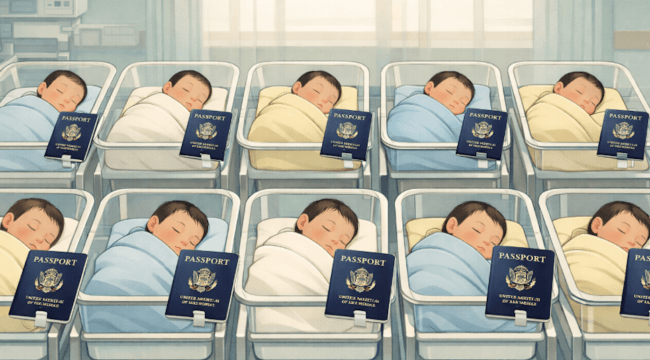
Hey everybody! Your US passport is an airline flight away. Image via ChatGPT.
Definitely, women notice these things. And then, it was our turn with U.S. Immigration and Customs, but hold that thought…
“The Same Constitution”
You may already suspect where this is going; namely, to discuss what’s euphemistically called “birthright citizenship,” although another term for the phenomenon is “passport tourism.”
That is, current U.S. law interprets the 14th Amendment to the U.S. Constitution as conferring citizenship on any person born in the U.S. or territories, aside from limited exceptions such as children of foreign diplomats. Otherwise, it doesn’t matter who is born to whom, or under what circumstances. When a baby pops anywhere inside U.S. territory, the outcome is a brand-new U.S. citizen.
At least, that’s the conventional legal wisdom, now under review by the U.S. Supreme Court in a case called Trump vs. Barbara (S.Ct. Docket 25-365), which was argued two weeks ago on April 1, with no less than President Trump in personal attendance.
People write scholarly books and law-review articles on the 14th Amendment and birthright citizenship. Plus, there’s a large cadre of legal pundits on the topic, who jealously mark this territory like dogs at fire hydrants. And of course, within a few months we’ll have a Supreme Court decision on the matter. Case closed? Well, we’ll see…
Meanwhile, at this point in life I’m just a humble, taxpaying Navy veteran and geologist, not a bigshot Constitutional lawyer. Still, though, I’m intrigued at this quirky feature of American law, the principle that almost anybody can walk in (or fly; see above), deliver a live birth, and presto we have a new citizen, eligible for every sort of private right and public entitlement. So, I listened to the Supreme Court oral arguments.
Frankly, one line of discussion perplexed me. In fact, it troubled me deeply; namely, an exchange between Chief Justice John Roberts – full disclosure; he’s an old Harvard classmate – and U.S. Solicitor General John Sauer.

Undergraduate John Roberts, circa 1973. Courtesy Harvard Crimson.
In opening remarks, Sauer referred to “birth tourism” and stated that “uncounted thousands of foreigners from potentially hostile nations have flocked to give birth in the United States in recent decades, creating a whole generation of American citizens abroad with no meaningful ties to the United States.”
Well, yeah… Sauer’s point rang true to me; see my anecdote above about the pregnant Chinese ladies at SeaTac. Obviously, these women were coming to the U.S. to deliver babies. And one need not be Sherlock Holmes to understand that this was not a one-off thing, because it happens across the country many times, every day. Look around. In essence, there’s an entire travel-birth-citizenship industry at work here.
Then in a follow-up question, Roberts asked Sauer: “Do you have any information about how common that is, or how significant a problem it is?”
Sauer responded that “media reports” estimate over one million people have come from China alone to give birth in the U.S. And he mentioned a Congressional report about “Russian elites” who travel to Miami to have babies, via “birth tourism companies.”
Sauer added that, “Based on Chinese media reports, there are 500 birth tourism companies in the People’s Republic of China whose business is to bring people here to give birth and return to that nation.”
Roberts replied with a rhetorical question: “Having said all that, you do agree that that has no impact on the legal analysis before us?” In other words, Roberts essentially called Sauer’s point irrelevant to the case.
Sauer replied that, “We’re in a new world now, as Justice [Samuel] Alito pointed out, to where eight billion people are one plane ride away from having a child who’s a U.S. citizen.”
And Roberts answered, “Well, it’s a new world. It’s the same Constitution.”
Huh? Hey, wait a minute. That’s a pretty glib, uncurious wave-off of an important fact-set. Indeed, it’s gratuitous, especially coming from the Chief Justice of the United States.
Suicide by Constitution
In other words, it’s not as if the Supreme Court has not interpreted and reinterpreted that so-called “same Constitution” mightily over the centuries to accommodate all manner of human advancements.
And that’s before we get to the relatively modern idea of a “living Constitution,” under which the Court has allowed the federal government to do pretty much anything that the political powers desire. Indeed, the past 90 years of Supreme Court jurisprudence speaks for itself.
The idea of the “same Constitution” should not mean that the nation’s foundational document is some sort of unchangeable fossil record of the world of 1787, from the time when the document was composed.
For example, does the First Amendment, which protects freedom of speech and press, only apply to communication technology of 1787? The question practically answers itself. American free speech is wide open, and per countless Supreme Court cases over many decades, federal, state and local governments restrict it at their legal peril.
Or does the Second Amendment only pertain to muskets of late-1780s vintage? Does it mean that you can own only a flintlock rifle, and even then, only if you are in a “well-regulated Militia?” No, of course not, and the Supreme Court has evolved its views on firearms laws to change with the times.
How about the part of the Constitution that empowers Congress to “raise an Army” and “maintain a Navy.” Does that mean the country cannot have an Air Force? Because obviously, there were no airplanes in 1787 flying over the Philadelphia Constitutional Convention. And again, it may come across as silly to argue the point, except that somehow the so-called “same Constitution” is now a barrier to progress if we follow the Roberts logic to where it seems to be headed.
Last, and not to overwhelm you, there’s Wickard vs Filburn, a 1942 case that empowered the federal government to regulate the smallest details of daily American life – in this case, farming – under the guise of “regulating interstate commerce.” Indeed, the small family farm in America traced its roots literally to Jamestown in 1620. And for over 300 years, farming was a taproot of American freedom. Yet after Wickard, the simple act of planting seeds in the ground fell under the jurisdiction of the U.S. Department of Agriculture.
Which brings up a line that popped into my head when Roberts rebuked Sauer, namely that “the Constitution is not a suicide pact.”
The exact historical record is unclear, but President Abraham Lincoln supposedly coined this phrase in response to charges that he was a tyrant for suspending the Writ of Habeas Corpus during the Civil War. Today, we have the luxury of second-guessing the man, but in his day, he had battles to fight, and keeping certain people off the streets served a purpose.

President Lincoln. Courtesy Library of Congress.
More recently, the “suicide pact” phrase was used by Justice Robert Jackson in his dissent in a 1949 case, Terminiello vs. Chicago, a free speech case then before the Supreme Court. And the phrase saw more daylight in 1963 in Kennedy vs. Mendoza-Martinez, in an opinion grounded in due process rights, authored by Justice Arthur Goldberg.
And now, here we are, dealing with new developments in a rapidly changing world, namely birth tourism. Fly in, have a baby, make a so-called “citizen,” and… then go home.
My anecdote above, about the pregnant ladies at SeaTac, is from 2015, or more than a decade ago. But it still resonates. Both the New York Times and New York Post have recently run stories about Chinese women traveling to the mainland U.S. or territories (eg., Mariana Islands) to have babies. They fly in, hang out, deliver a baby, and in due course obtain U.S. citizenship for the child, plus a social security number and passport.
Clearly, per those above-noted Supreme Court discussions, this is a new world. It’s not the olden days of the 1860s, when the 14th Amendment was drafted in the wake of the Civil War. And obviously, coming to America no longer involves a long sea voyage on a sailing ship. Just buy an airline ticket, and voila!
Meanwhile, it’s one thing when foreign visitors come to America to see the sights, do tourist things, and then go home with, say, a T-shirt, coffee mug, or maybe some refrigerator magnets.
But now, there’s also a vast subset of the tourism industry that brings late-term pregnant women to America, to have babies and return home with a child and U.S. passport; or perhaps call it a “refrigerator magnet passport.”
To be fair, these almost-mom arrivals are not sneaking into America. They’re not “illegal,” not in the way the term is commonly used. Nor are they coming here to go to take a job away from an American worker. Although their little anchor baby now dilutes your own citizenship, in the big scheme of life.
Indeed, the pregnant ladies walk through the U.S. entry system, usually with a B-1 visitor’s visa, and get a stamp on their own passports for a six-month stay. And they go home with a nice, new, bundle-of-joy American citizen, to raise in, say, China under Communism.
A Crazy Way to Run a Country
To me, at least, this is all very odd: granting citizenship based on an airline ticket and six-month tourist visa. Is this really what the 14th Amendment authors meant when they were working to clean up the societal mess after the Civil War?
Plus, we have the raw, blood-sport politics of the entire matter, the idea that President Trump wants to end this passport tourism business, which is enough for many people simply to dismiss the idea out of hand. Cuz… Trump, yes?
Then again, all systems have flaws, and the world is filled with people who want to take advantage. But the more curious thing – scandalous, actually – is that this matter has grown to such size that it’s actually a demographic and political issue, now sitting on the bench of the Supreme Court.
It’s in front of the Black Robes, with all of the subtle, but critical, in-group virtue signaling that they must perform to impress their Washington, D.C. career managers. And face it, there’s a certain, leftward-drifting agenda in America, with Washington as Ground Zero. And the Supreme Court is part of it.
At the end of the day, each justice has his/her own future personal and career goals, if not their income and ego. Are they there to serve the nation? Or have they gone native inside the Washington Swamp?
In general, the question is how “birthright citizenship” serves the national good? More specifically, how does “passport tourism” advance the national agenda?
Well, we’ll find out in a couple of months. And that’s all for now.
Thank you for subscribing and reading.

Comments: