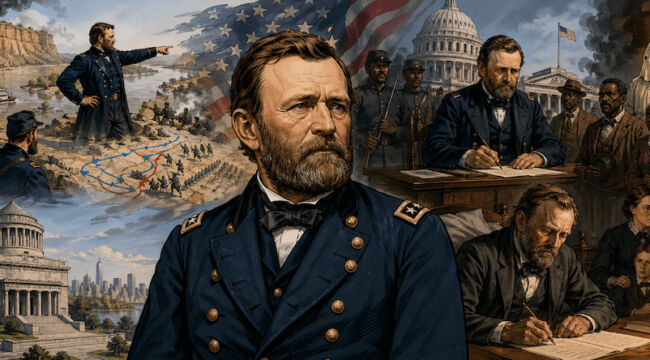

The Quiet American Giant
“You know who’s buried in Grant’s Tomb?” asked Philosopher-Truck Driver John Ring, many moons ago.
After a long and considered think, I replied, “I dunno. Who, Pop?”
“GRANT!”
My father got me with that at least 10 times before I figured it out.
Those were the good old days, when my father, mother, and I would take a ride up River Road, along the Jersey side of the Hudson River. I’d stare in awe at the most majestic skyline in the world, lucky to have seen it before the Hudson Yards developers destroyed the view.
When we’d get to Edgewater, we’d see the tower of the Riverside Church, which sits to the southeast of the General Grant National Memorial, or, as it’s more commonly known, Grant’s Tomb.
And then, the inevitable exchange would occur.
I’m not sure why, but I’ve always preferred the Revolutionary War to the Civil War. I stand in awe of Civil War buffs. And now, after living in England for a decade, my reading of America is slightly more nuanced than a red-blooded, dyed-in-the-wool Yankee or Rebel.
And yet, when Grant’s name came up on Tuesday, on what would have been his 204th birthday, I wanted to find out more.
And since the man deserves far better than I could give him, I thought I’d merely write about 3 things that make him an outstanding American, in the hopes that you’d be curious to explore this patriot in your free time.
So who was this man?
Most folks remember Ulysses S. Grant for one or two things.
He beat Robert E. Lee. And his presidency had some scandals.
That’s it. That’s the whole picture for the average American.
And that’s a damn shame… for the average American.
The truth is, Grant was one of the most remarkable men this country ever produced. A brilliant strategist. A fearless defender of Black rights when it cost him everything. And a dying man who wrote one of the finest books in American history.
It’s time to show you why this quiet Ohioan deserves a spot on your hero list.
The General Who Outsmarted Everyone
Forget the “butcher” myth. Grant didn’t just throw men at the enemy.
His 1863 Vicksburg Campaign was a work of art.
The city sat on bluffs over the Mississippi River. Confederate guns made a head-on attack suicide. Every Union general before Grant had failed to take it.
So Grant did something nobody expected.
He marched his army down the wrong side of the river. He cut his own supply lines. He crossed the Mississippi south of the city. Then he turned inland and crushed multiple rebel armies one by one before they could join up.
He fought five battles in seventeen days. He won them all.
Then he laid siege to Vicksburg. The city fell on July 4, 1863.
This wasn’t just a battle won. Grant split the Confederacy into two. He gave the Union total control of the Mississippi. The South was cut in half and bleeding.
Grant had proven an army could live off the land and move like lightning.
He was a chess master with mud on his boots.
The President Who Crushed the Klan
Quick question: Which American president was toughest on the Ku Klux Klan?
U.S. Grant, that’s who.
After the Civil War, white supremacist gangs spread across the South. They were ugly racists and political terrorists. Their goal was simple: stop Black Americans from voting and kill anyone who tried to help them.
Most Northern politicians wanted to look the other way. The war was over. People were tired.
Grant refused.
He knew the real fight didn’t end at Appomattox. It just shifted from battlefields to ballot boxes.
So he acted.
He pushed Congress to pass the Enforcement Acts. These laws gave the federal government real power to go after the Klan. He sent federal troops to protect Black voters in the South. He created the Department of Justice in 1870 to prosecute civil rights crimes.
Then he used it.
Federal marshals arrested hundreds of Klansmen. Federal courts convicted them. In parts of South Carolina, Klan violence dropped sharply almost overnight.
This wasn’t easy. It was wildly unpopular up North. Newspapers attacked him. His own party got nervous. But Grant didn’t care.
He had freed men in his army. He had promised them their rights. And that was that.
The “Lost Cause” myth would later paint Reconstruction as a disaster. That’s propaganda. The real disaster was what happened after Grant left office, when the federal government walked away.
For a brief, shining moment, Black Americans had a president who had their back.
The Dying Man Who Wrote a Masterpiece
Grant’s last act might be the most heroic of all.
After his presidency, he got swindled. A business partner cheated him blind. Grant lost everything. He was broke and humiliated.
Then came worse news. Throat cancer. Terminal.
He had no money to leave his wife and children. He was facing a slow, painful death.
So he made a choice. He picked up a pen.
His great friend Mark Twain offered him a publishing deal with an unheard-of 70% royalty on his memoirs. Grant took it. Not for glory. For his family.
He wrote in agony. The cancer made speaking nearly impossible. He took just enough painkillers to keep going, never enough to dull his mind. Some days, he could only manage a few pages.
He finished the manuscript. Just four days later, he died.
Critics still rank Grant’s Personal Memoirs among the greatest books ever written by an American.
Nearly every critic who’s commented on it claims it’s clear, modest, and honest. Grant praises his enemies. He admits his mistakes. He tells the truth about a brutal war in plain American English. It’s now on my reading list.
Grant’s final, Herculean effort paid off. The book sold like wildfire. Grant’s widow eventually received about $450,000 in royalties (equivalent to over $16,000,000 in today’s money). His family was saved.
A dying man, broke and in pain, sat down and wrote a classic to take care of the people he loved. If that’s not heroism, nothing is.
Wrap Up
Strip away the myths. What’s left?
Grant was a general who outthought every rebel he faced. He was a president who wielded federal power to protect Black lives when nobody else would. But perhaps he should be remembered as a family man who turned his last breaths into a legacy.
That’s Ulysses S. Grant.
That’s a great American.

Comments: