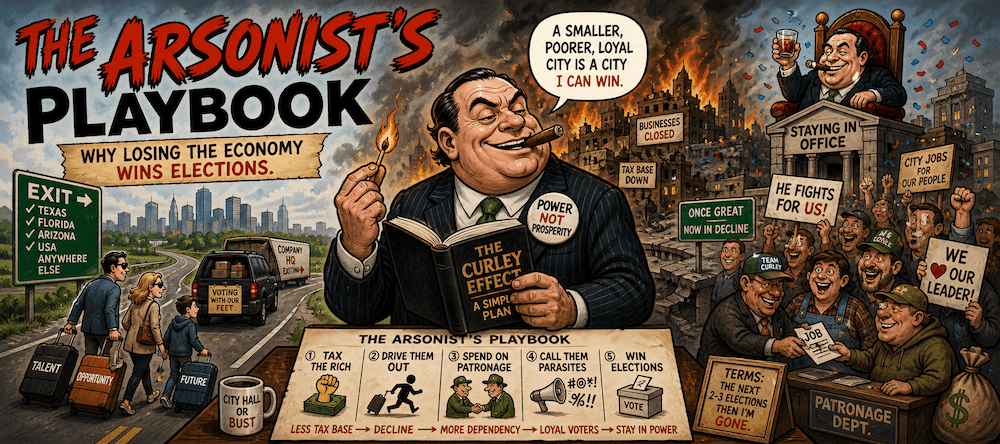
The Arsonist’s Playbook

My good friend and colleague, Greg “Gunner” Guenthner, and I were chatting on X when he introduced me to a term I had never heard. It knocked me for a loop, so much so that I had to research and write about it.
This piece is the result of that research, and it won’t cheer you up. But I hope naming what’s happening to America’s once-great cities will help end their rot.
You see, we tell ourselves a comforting story about bad politicians. They mean well. They got the models wrong. They're in over their heads.
What if that's not the right story?
What if some of them know exactly what they're doing? What if the decline is the plan?
Meet James Michael Curley
Two economists, Edward Glaeser and Andrei Shleifer, gave this dark idea a name. They called it The Curley Effect.
The name comes from James Michael Curley. He was the mayor of Boston 4 times. He was governor of Massachusetts once. He ran the city in the first half of the 20th century.
Curley built his power base on poor Irish voters. He went to war with the wealthier, mostly Yankee, middle class. He raised their taxes. He handed city jobs and contracts to his loyalists. He sneered at the people paying the bills.
Capital fled. Productive families moved to the suburbs. Boston stagnated.
Curley lost businesses. He lost taxpayers. But he kept the only thing he cared about: City Hall.
The Game He Was Actually Playing
Glaeser and Shleifer's big insight was simple. Curley wasn't failing. He was winning a different game.
The public's game is "make the city rich." His game was "stay in office." Those games aren’t the same.
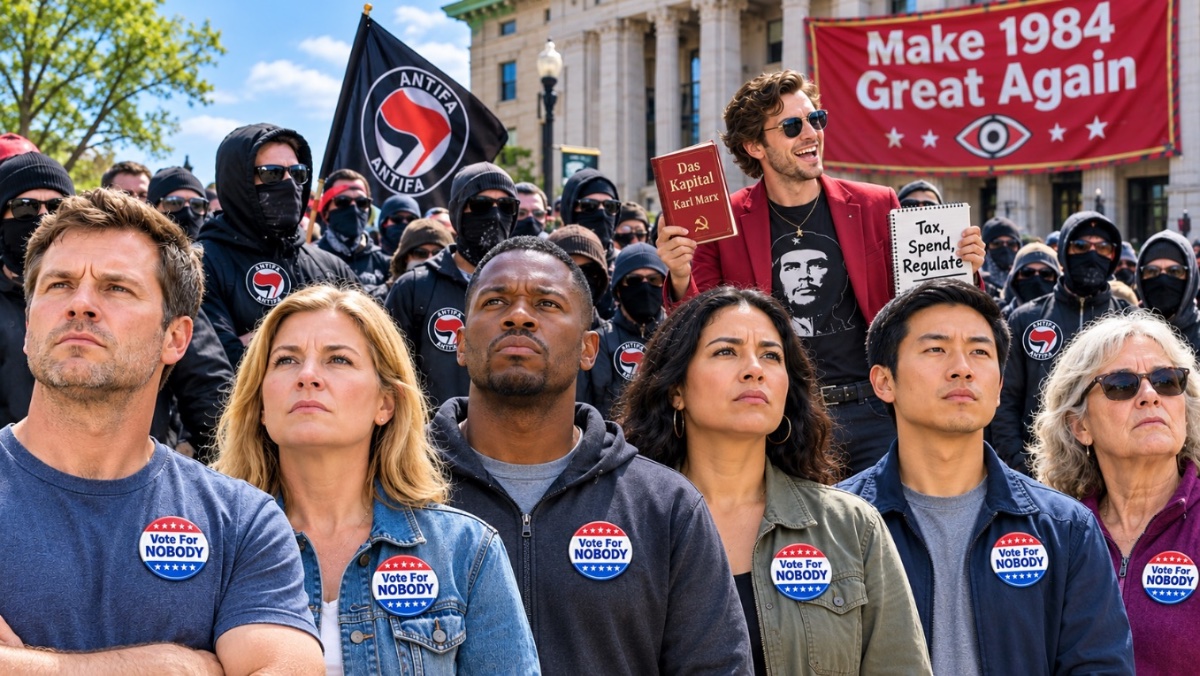
The logic is ugly but clean. Imagine a city with two voter groups. One is rich, mobile, and against you. The other is poor, stuck, and loves you.
So you raise taxes on the rich group. You spend the money on patronage jobs for your base. You call the wealthy parasites. You make them feel hated.
What happens? They leave. They take their tax dollars with them.
The city gets poorer. Less dynamic. More dependent on government.
But your share of the vote goes up. With every election, your odds improve.
Bad policy is a feature, not a bug.
Burn It Down to Rule the Ashes
There's a quote that floats around the internet. It says, "An evil man will burn his own nation to the ground to rule over the ashes." People stick Sun Tzu's name on it, but he never wrote it. The line is a modern invention that feels so real, people just accept it must be true.
But it captures Curley perfectly. He was happy to mortgage Boston's future. He just needed a smaller, more loyal voter pool. Ashes were fine, as long as he sat on top of them.
Once you see this pattern, you can't unsee it.
The Pattern Today
Look around (I see you, New York City, Los Angeles, and Chicago). You see jurisdictions where:
- Productive people and firms are bolting for the exits.
- Leaders cheer the higher taxes and the regulations driving them out.
- The ruling class shrugs at the fiscal damage.
The reflex is to call them stupid. It feels good. But it's also lazy.
Maybe they're not stupid. Maybe they're playing Curley's game.
When wealthy families flee California for Texas, the response from Sacramento isn't panic. It's a sneer. "Good riddance." When firms leave Illinois or New York, the message is the same. The leavers are traitors. The stayers are martyrs. The leader becomes a hero.
Polarized media supercharges this. In a calmer era, presiding over decline was reputational poison. Today, half the country cheers you on for it.
The Asymmetry That Makes It Work
Here's the cold truth. Voters can move. Politicians can't.
A wealthy family can leave New York for Florida. A company can move its HQ. A pro can pick Zurich over London.
But the mayor is stuck in his city. The governor is stuck in his state. Their job is to win the next election with whoever is left inside the borders.
Given that math, taxing and harassing your opponents until they leave isn't crazy. It's rational. It's how you keep your job.
We like to think "voting with your feet" disciplines bad governance. The Curley Effect flips that idea on its head. If the people leaving were going to vote against you anyway, their exit helps you. You'd rather rule a smaller, poorer, loyal town than a larger, richer, divided one.
The Catch
This game isn't free, even for the politician. The tax base shrinks. Patronage costs money you no longer have. Roads crumble. Schools rot.
But if your time horizon is the next two or three elections, who cares? You'll be retired or in a different office before the bill comes due.
You're not trying to maximize prosperity. You're maximizing control.
Wrap Up
Stop assuming incompetence. Start assuming it’s a strategy.
When you see a once-great city collapse under leaders who double down on every wrong move, ask the harder question. Not "why are they so dumb?" But "what game are they actually playing?"
Sometimes the answer is incompetence. Sometimes it's something darker.
The Curley Effect is the academic label for that darker thing. It's a real pathology in democratic systems. And until the people who can leave start naming it for what it is, they'll keep walking out the door.
One by one, it leaves the arsonists in charge of the ruins.