Silt, Anchovies, and Economic Disaster

Silt and anchovy scales.
Sometimes the greatest scientific discoveries start with the simplest things.
Today, meteorologists are worried about a severe global event. It’s part of an atmospheric pattern that wasn’t recognized until the late 1960’s. But it has had major economic impact over the decades. And it will have an impact this year if it’s as bad as predicted.
But the story starts with marine mud and frustrated fishermen.
Geologists saw something odd in sediment cores taken off the West coast of South America. The cores looked like layer cakes. One layer of mud, another of fish scales…repeated through the core.
The layers reflect massive shifts in weather patterns. But it wasn’t understood until the late 1960’s. That’s when Jacob Bjerknes, a Norwegian American meteorologist, linked the marine sediment record with atmospheric observations. He recognized that the ocean and atmosphere acted in a feedback loop that had dramatic impacts on the land.
The formal term is the El Niño, Southern Oscillation, or ENSO. It gets its name from Peruvian fisherman. They called the warm currents that sometimes occurred around Christmas “El Niño”.
What Bjerknes described was the change in surface water temperatures in the Pacific Ocean. When warm water hits Peru around Christmas, it rains. A lot. The rivers flood down from the mountains and drop an impressive amount of sediment.
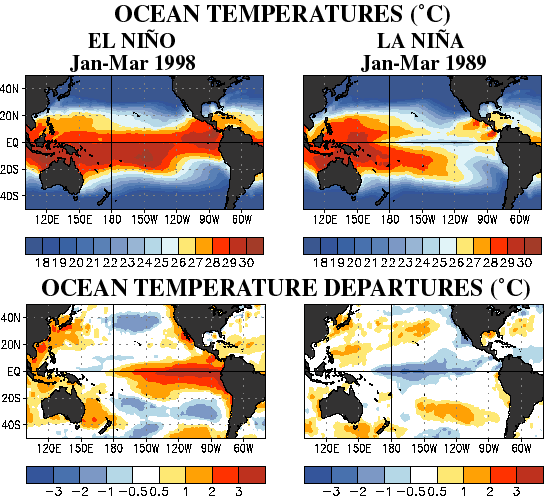
The image below shows the warm Pacific from the 1998 El Niño event, compared to the cool period (called La Niña):
The Peruvian fishermen hated these warm currents, because the fishing was terrible. The warm water and strong rains disrupted the local food chain.
Normally, the cold, nutrient rich Humboldt current wells up against the coast. The nutrients feed massive schools of anchoveta and other bait fish. During these periods, the sediments become silvery layers of fish scales and biological debris.
That’s how geologists learned to track atmospheric events. It was a huge breakthrough for scientists. But it also had economic implications.
Major Impact
In modern times, two massive El Niño’s, in 1972 and again in 1982, devastated fish populations. Before 1972, Peru was the largest fishing nation in the world. In 1970, the country caught 12 million metric tons of anchoveta. Then a massive El Niño hit and crushed the fishing industry. The combination of over-fishing (to make up the catch) and the weather devastated the fishery. In 1973, they landed 2 million metric tons. This caused a global fish-meal crisis. It drove agricultural feed up 250%.
However, the 1972 version was just a warmup. The real monster El Niño hit in 1982. This was an unprecedented weather disaster. Warm tropical waters pushed further south than ever before. The warmth stayed so long that it either killed off or forced cold water fish to migrate to other locations.
This time, the damage wasn’t limited to South America. Fishermen along the eastern side of the Pacific saw reduced catches of critical species. Tuna, smelt, mahi mahi, barracuda and other species suddenly show up in places they are never seen.
Here’s what the National Oceanographic and Atmospheric Administration says about strong El Niño and fish populations in California:
A major consequence of an El Niño is the loss of commercially important species where they traditionally occur. A notable example is the movement of the market squid to cooler waters to the north, away from established fisheries in California. This phenomenon is also true for many rockfish species that move from nearshore areas to deeper or more northerly and cooler waters. Pacific whiting likewise shift northward from their spawning and feeding areas off California, Oregon, and Washington to the more temperate latitudes centered off Vancouver Island.
And that’s only part of the economic impact of a strong El Niño. As we mentioned earlier, El Niño brings rain to the west coast of Peru. That can disrupt mining, along with fishing. But it does more than that. Here’s a general map of weather patterns associated with El Niño (from NOAA.gov):
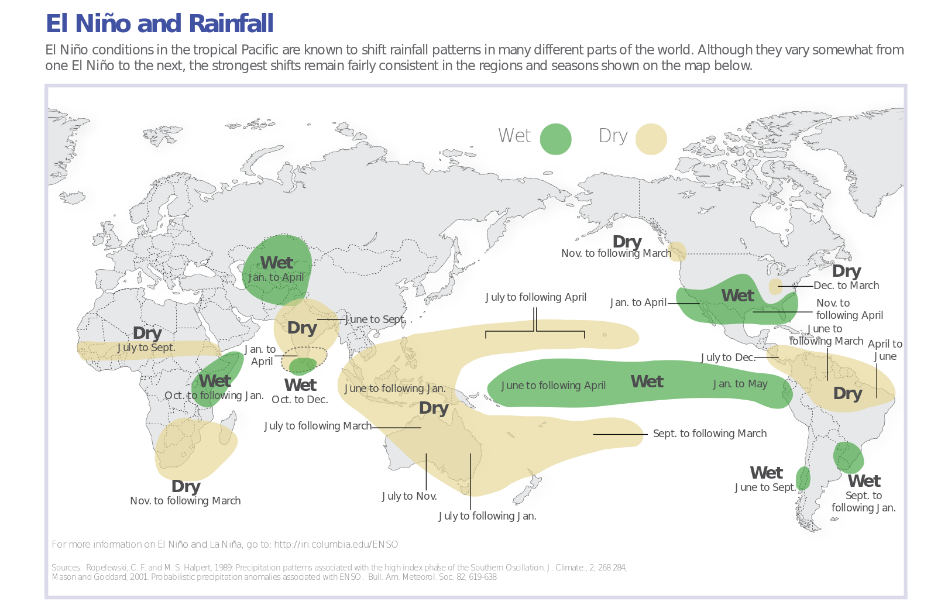
The international monetary fund (IMF) tracked the real impact of El Niño on GDP growth around the world. They found that countries like Australia, India, Indonesia, New Zealand, Peru, and South Africa face a short-lived fall in economic activity in response to an El Niño.
The study also noted that El Niño brings strong storms to Chile, which disrupts copper mining. Japan sees more typhoon strikes.
El Niño does have some benefits for North America. California usually gets more rain, which helps the farmers. The Northeast sees warmer winters, so it uses less energy. And the east coast sees fewer hurricanes. In fact, there are zero recorded major hurricane strikes on the East Coast of the U.S. during El Niño...except Florida.
Hurricane Andrew struck Miami as a massive category five storm in August 1992. It’s unusual to have the first named storm that late in hurricane season.
If the forecast severe El Niño comes to pass, we can expect food inflation on things grown internationally. If history is correct, coffee, palm oil, and wheat will go up in price. And we can expect some local problems from flooding and severe weather.
It’s not enough to speculate on just yet, but there could be some short-term trades from this oddball weather phenomenon. We’ll keep an eye out.