Missiles, Mayhem, and Metals

When the U.S. attacked Iran, the military used a huge amount of ordinance. In the first two days, the Pentagon fired about $5.6 billion’ worth of missiles and bombs.
Over the first 39 days, the U.S. struck 13,000 targets, according to the Center for Strategic & International Studies (CSIS).
Modern high-tech systems rely on a wide variety of exotic metals. And the consumption of these modern weapon systems will require supplies of metals that the U.S. doesn’t produce much of.
In the Fiscal Year 2027 budget request, there are billions of dollars allocated to building new missiles. The budget request for precision strike missiles (PrSM) alone is over 1,100. That’s nearly ten times the inventory before the war.
The table below is a rough estimate of the metal used in each of the weapon’s systems used in the attacks on Iran:
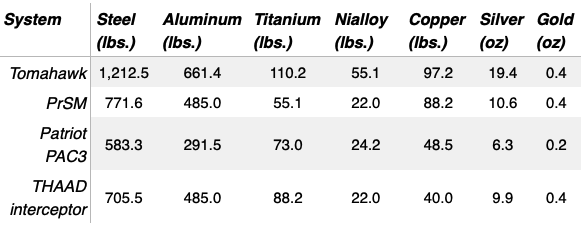
The CSIS estimates that the military budget requests ~750 new tomahawk missiles, ~1,100 PrSMs, ~3,100 Patriot missiles, ~850 THAADs, ~900 air to surface missiles, and roughly 650 additional missiles.
In addition, all these weapons require rare earth metals. Neodymium and praseodymium go in magnets used in guidance and actuation motors. Neodymium is a key component in missile guidance and propulsion systems.
Dysprosium and Terbium go into high temperature applications. Samarium-cobalt magnets are used in missiles because of their strength and thermal stability.
Germanium is important for thermal imaging and seekers in guided munitions. Praseodymium stabilizes structural components to provide stability during high-speed and high-temperature flight.
Promethium, terbium, dysprosium, and tantalum are all used in these systems as well.
The U.S. produces some of these metals in limited quantities. MP Materials (NYSE: MP) produces metals like neodymium, samarium, praseodymium, lanthanum and cerium. USA Rare Earth (Nasdaq: USAR) produces heavy rare earth metals like dysprosium, terbium, and yttrium.
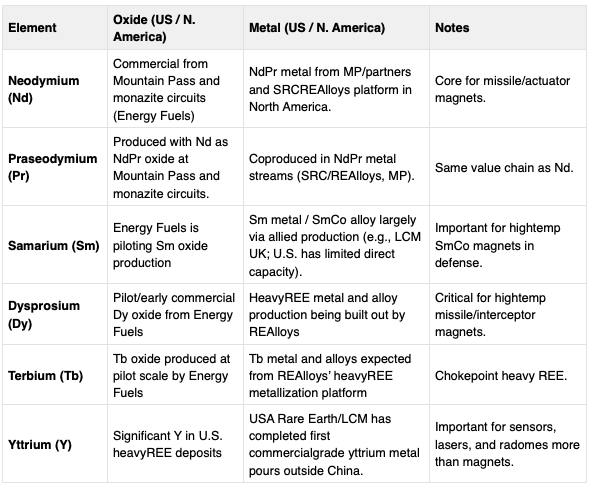
China dominates the production and refining of these metals. And in the U.S., as we can see in the table, there are only three or four sources of production in total. And none of the deposits contain all of the metals.
That’s why the Federal Government pushed out a series of plans to support and encourage development of these mines.
Technology needs these new metals. And the dislocation of the global supply chain means that buyers (like the U.S. government) need to find domestic sources. If not, they must understand that the countries that produce them (like China), can use that supply to as powerful leverage.
Building self-reliance in these “tech metals” and rare earths is critical. And it makes for a great investment opportunity. More on that soon.