
China Aims to Spoil the AI Party
China is running their favorite playbook on AI.
The same one they ran on metals, rare earths, cars, solar panels, and manufacturing in general.
It’s a simple model. Build stuff for cheaper than everyone else, and undercut the world on price.
We’ve been watching this play out in manufacturing for a long time. Now, China is coming for American AI companies’ market share.
Rising Competition
For a while, it seemed like America’s AI lead could last forever. We had the best models, the best hardware, and China was restricted from using Nvidia GPUs.
But those days are over. Chinese AI models are approaching the top U.S. offerings in terms of quality. And cost is where it gets scary.
Chinese models cost anywhere from 60-90% less than the top American ones. Here’s a table comparing a few frontier models.
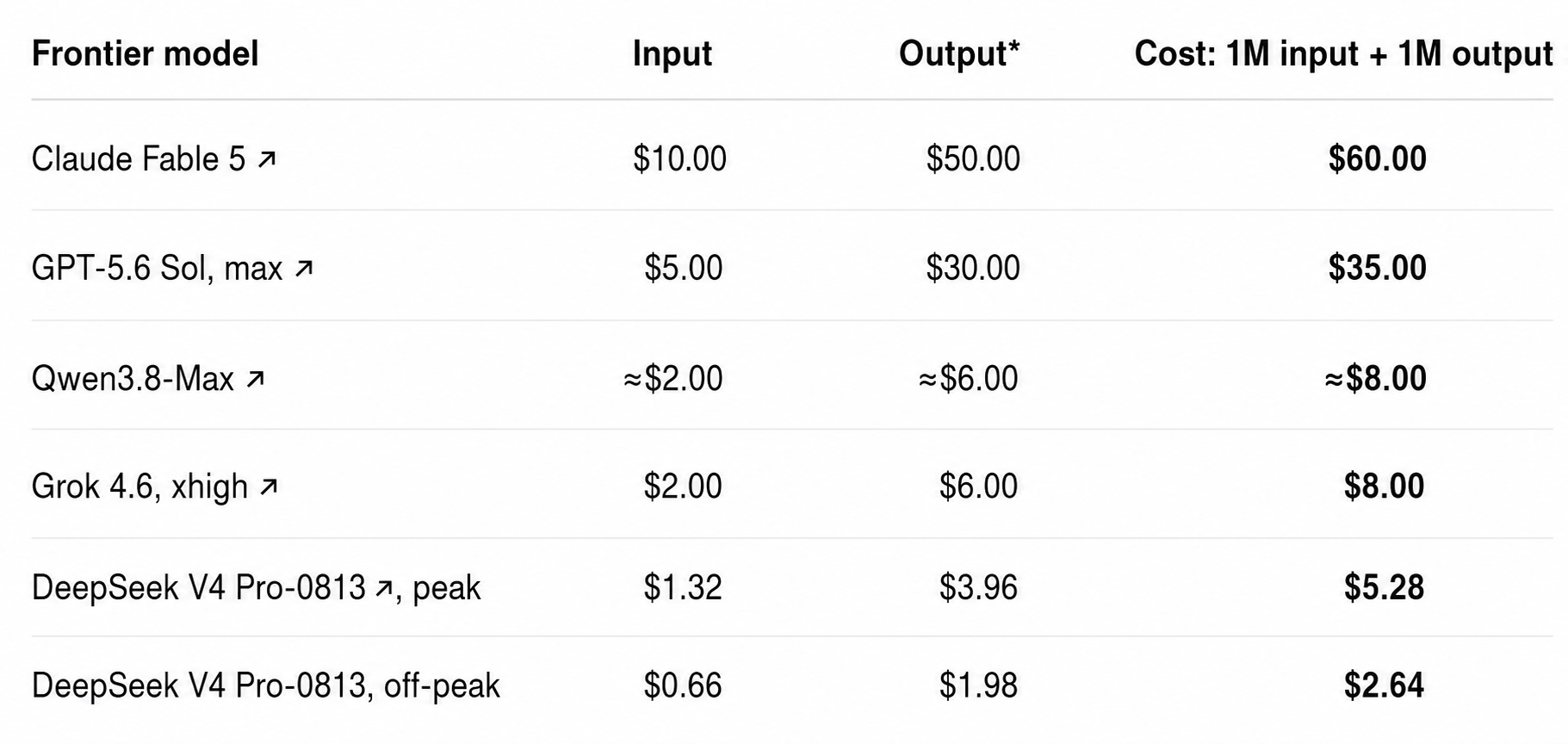
The latest Chinese AIs are 95-98% as good as ChatGPT and Claude (better in a few areas), and offered at a huge discount.
This is proving to be highly disruptive to top U.S. labs like OpenAI, Anthropic, and xAI.
After Chinese company DeepSeek released their latest open source AI model, DeepSeek v4, OpenAI cut the cost of their top model by 80%.
Rubbing salt in the wound is the fact that China’s models are almost all open-source, meaning they can be downloaded and modified by anyone. And used for any business purpose.
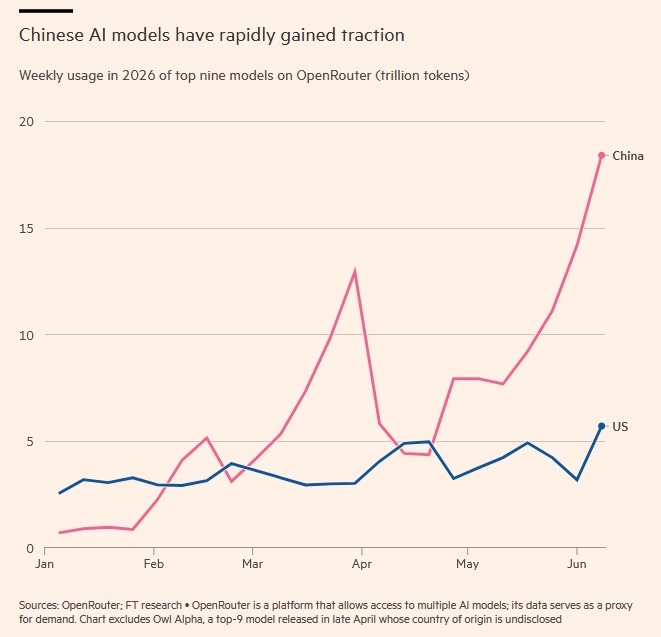
So they’re becoming extremely popular, as shown in the chart below.
Source: Financial Times
The chart shows AI model use by country, on OpenRouter, a service that developers use to access AI models. I should note here that OpenRouter doesn’t include developers who use American models directly with the provider.
So American AI is still doing well, but China is a real rising threat.
The trend is the important takeaway. Note how U.S. models (blue line) started the year with a huge lead over Chinese offerings on OpenRouter. And now China’s offerings are soaring in popularity.
Intelligence, Commoditized
The cost to run top-tier AI models is falling as competition rises. That’s good for users, at least.
I saw a post the other day where someone used DeepSeek V4 to create an entire functional video game for 7 cents. And it looked pretty good.
This is crazy. New territory. Never before has it been so effortless and cheap to create digital products. We’re going to see some crazy developments in the coming years.
And coding is just the first sector to feel the heat. Soon, AI agents will be capable of handling most white-collar tasks.
This is the commoditization of intelligence. And we’re less than 4 years into this madness.
Extreme Options
If Chinese models continue to improve at this pace, things could get ugly. I can see the U.S. completely banning Chinese AI models. After all, China banned our models very early on.
The tricky part is that most of China’s top offerings are open-source, meaning they can be downloaded and used anywhere. Effectively stopping companies from using them would be very difficult, and intrusive.
Unless we somehow ban Chinese models completely, which doesn’t seem realistic, this is going to put severe pressure on our leading firms.
The U.S. economy today depends on AI for the majority of its growth. If the pace of investment falls, or expected returns fail to materialize… That’d be bad.
With Chinese AI on the rise, American leaders are feeling the pressure. Hopefully they can buckle down and keep the breakthroughs coming.
The one positive about this competition between East and West is that it fuels innovation for both sides.
We’re going to see some miraculous, and terrifying, developments over the next few years. The cost of intelligence will continue to plummet.
For the first time in a long time, we have a real tech competitor in China. That’s good for breakthroughs, and healthy for the system as a whole, but it could be problematic for top American AI firms, many of which are valued at more than $1 trillion.
Eventually it could also be problematic for AI hardware firms like Nvidia. After all, China is banned from buying their GPUs, and is busy developing their own ecosystems.
In the long run, more competition is good. It keeps everyone frosty and on their toes. But in the short run, China’s emergence as a peer threat could have some brutal effects.

Comments: