
Silver Will Rise Again
The earliest forms of money included salt and grain. Both were universally desirable.
But there were serious flaws with these “currencies”. Salt would dissolve in water. Grain spoiled.
And they weren’t valuable enough. So these items worked for crude barter, but that’s about it.
Around 5,000 years ago, when men began to mine and process metals, copper became money. Rings, bars, and even crude early coins.
Early on, copper was highly valuable because it could be made into knives, axes, and other tools.
In ancient China, governments even issued copper alloy knives as a form of currency. Talk about hard money…
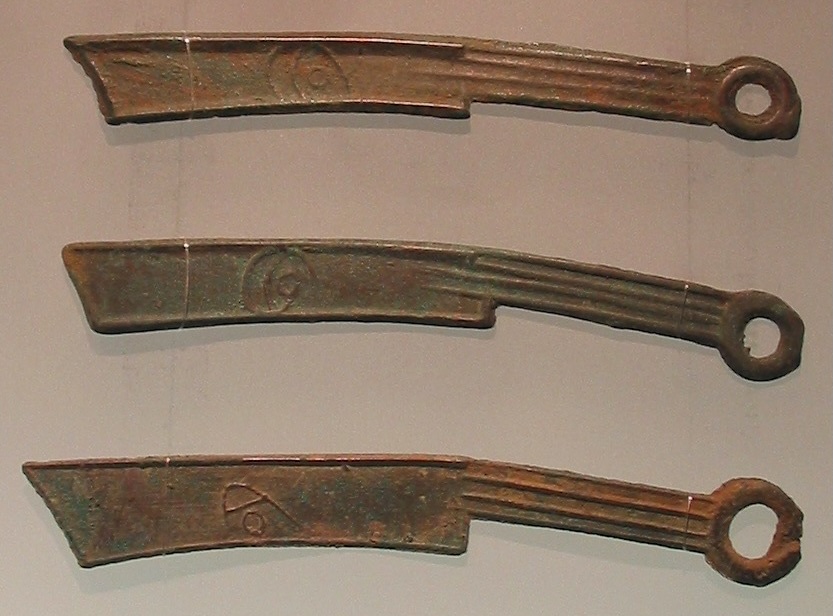
Ancient Chinese knife money. Source: Wikipedia
Bronze, an alloy of mostly copper and tin, was a major tech breakthrough. It was sturdier than plain copper, making better tools, weapons, and armor.
For hundreds of years, copper and bronze ingots, coins, and bars were a common form of money.
But as mining activity increased, these metals became too common. The value was too low to carry much wealth around. You’d need a chest full of it to buy a cow.
Silver, a more rare metal, became the favored currency. It was the Goldilocks form of money. Not too rare, not too common. Just right.
And for most of the past 3,000 years, silver has been the world’s preferred form of money. With several interruptions, all of which proved to be temporary.
The Modern Gold Era
Gold has also been a form of money for thousands of years. But before industrial-scale mining, it was rare.
Only the wealthiest citizens would own a decent chunk of gold. This is even true today. Many regular people can’t afford to buy ounces of gold at $4,400 a pop.
Silver was (and is) the people’s money. It’s about 9x more common than gold. Still rare enough to be valuable, but common enough that most people can own some.
Throughout ancient history, the gold-to-silver ratio averaged around 10. Meaning gold was 10 times more valuable than silver.
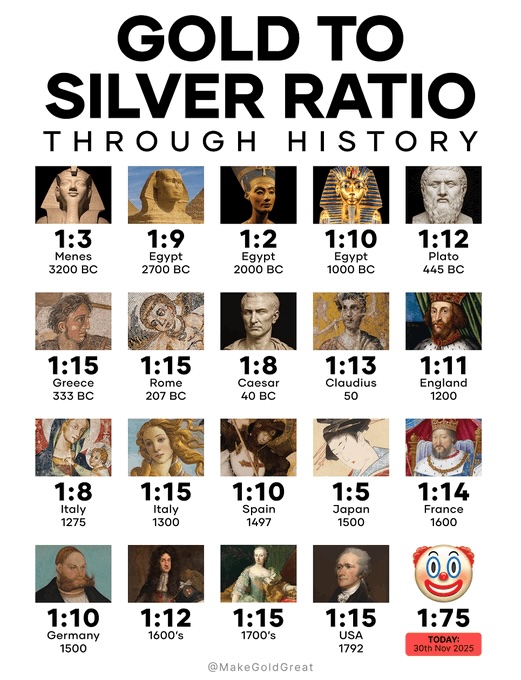
Source: Make Gold Great
Today, 1 ounce of gold is worth 67 ounces of silver. So silver is valued far lower than it was throughout history (compared with gold).
Silver has been de-monetized. Since 1965, it is no longer in our coins.
It is now a primarily industrial metal. Silver is the best electricity conductor on the planet. It also resists corrosion, making it critical for modern electronics.
The metal is particularly useful in solar panels, where it drives efficiency and long life. Solar power alone accounts for about 22% of total silver demand today. And industrial utility gives silver a lot of value by itself.
Today, gold is much more of a monetary asset than silver is. That’s primarily because central banks, like the Federal Reserve, still hold vast sums of gold as reserves.
But gold’s reign as the king of hard currency may not last forever…
Silver’s Inevitable Return
Since silver was de-monetized in 1965, it has been a rollercoaster of price action.
Throughout the 1960s, the U.S. government dumped their stockpile of silver at bargain basement prices.
The 1970s is when things got interesting. That was a period of inflation, slow growth, and financial chaos. It’s when the fiat (paper money) era began.
And periods like this are when silver shines.
Silver began 1970 trading around $1.80. By November 1971, it had fallen to $1.27. From there it went on one of the craziest bull runs in history, reaching nearly $50 in early 1980.
With high inflation throughout the 1970s, everyone looked for ways to preserve their wealth. For many people, silver fit the bill.
Yes, there was a sophisticated effort to “corner the silver market” by the Hunt Brothers, which helped drive up prices. Without them, silver wouldn’t have gotten close to $50. But the move would have been more durable. I wrote a letter on the Hunt Brothers and silver last year here.
The point is that when inflation gets nasty, ordinary people turn to silver for monetary salvation. It’s practically in our DNA.
A Silver Phoenix
Silver was the world’s favorite form of money for thousands of years. Today it’s still largely viewed as a monetary relic.
A metal that used to be money, but is now used for electronics. This will change once inflation rears its ugly head again, as we move further into the debt crisis.
People will seek out silver as an inflation hedge, store-of-value, and speculative asset. We’ve already seen hints of this, like during the silver price runup earlier this year. But that was just a hint of what’s ahead.
Because silver is primarily an industrial metal today, it is mostly priced according to that demand. Demand which is relatively predictable. Analysts model out industrial demand based on trends and surveys, and can get a pretty good idea about where the price should be headed.
But investment demand for silver is much harder to model. A full-on mania is impossible to accurately predict.
Only about 18% of silver purchased today is for investment purposes. Coins and bars. That’s why the metal is priced like an industrial input rather than a monetary asset.
But if investment demand creeps up to just 25%, that’d create fireworks. Like we saw briefly earlier this year, when silver ran from $35 to $115 in about 9 months.
And I suspect that silver will eventually make an even bigger return as the debt crisis progresses, and inflation worsens. As the world becomes more digital (and hackable), people will want a hard asset to store their wealth. And for many, gold’s out of the question. Too expensive.
Once again, silver will emerge as the metal of the people. A tool to help us preserve and grow our wealth.
Silver is currently trading at around $65 an ounce. I think that’s a fine price to buy at for long-term investors. It’s difficult to say what silver will do over the next 6 months, or even a year.
But over the next 5 years, I’m confident we’re headed much higher. And when silver inevitably goes through its next mania phase, I want plenty of exposure.
So I’m patiently holding. Waiting for the next mania phase.
The Hoover Dam Through a Garden Hose
And let’s not forget about silver miners. When the next mania phase hits, they are going to go ballistic. Check out the chart below, which shows the market cap of every silver miner ($66 billion) vs the value of big tech stocks.
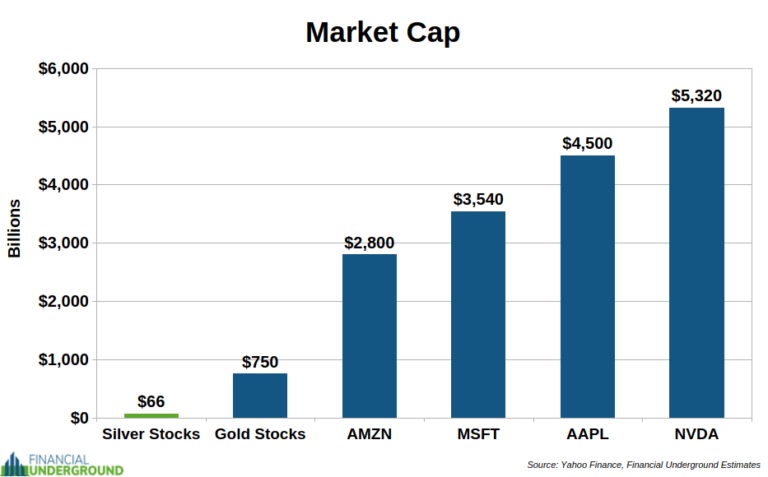
Souce: X
As you can see, every silver miner in the world combined is worth just 1/80th of Nvidia (NVDA). So during a silver mania, a flood of money pours into a very small sector.
This reminds me of a quote from Doug Casey:
“The market capitalization of silver [miner] equities is insufficient to accommodate the inflows of capital from generalist investors when the precious metals narrative takes over.
When the generalist investors come in, the result is like trying to siphon the flow of the Hoover Dam through a garden hose.”
It’s a great reminder that silver, and the companies who mine it, are tiny. So when money rushes in, the results can be absolutely explosive.

Comments: