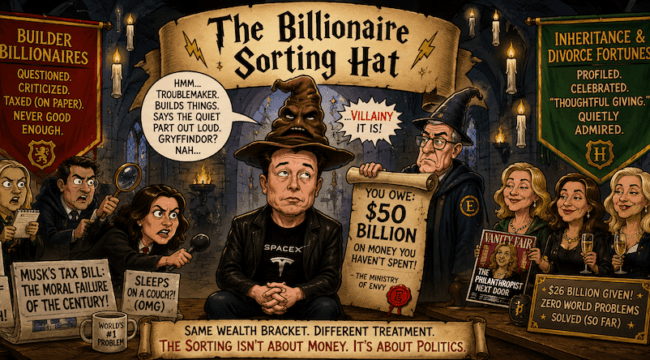

The Billionaire Sorting Hat
Elon Musk sleeps on a couch at his factory and gets told he owes $50 billion on money he hasn’t spent. A handful of women holding similar fortunes, built from inheritance or divorce, not from anything they personally shipped, and get magazine profiles about their “thoughtful giving.” Same wealth bracket. Completely different treatment.
The reporting gap isn’t random. In it, three separate failures are stacked. Let’s explore them, one at a time.
The Tax Code Punishes Builders, Not Holders
Start with the actual policy question, because it’s the one part of this argument that isn’t about vibes.
Nearly every billionaire’s net worth is mostly unrealized gains, tied up in stocks that haven’t been sold. If “you have $X billion in paper wealth, so you owe taxes on it now” were applied evenly, it would hit every fortune the same way, regardless of its source. It doesn’t. The complaint about unrealized gains seems to surface only for entrepreneurs whose wealth is visible, contested, and usually tied to a controversial public figure.
There’s a real asymmetry in what kind of wealth gets targeted, too. Let’s not feel too bad for them, but founder wealth is usually the least liquid kind there is. It’s locked in voting shares of an operating company, often legally restricted from sale, and often collateralized against loans. Yes, many founders use “buy, borrow, die” to avoid inheritance tax, and rightly so. But mostly, they want to hang onto what they spent decades building.
If you force a founder to sell shares to cover a tax bill on paper gains, you’ll likely force a change in control of the company itself. That means sometimes handing the kingdom’s keys to outside investors, like activist hedge funds, who had nothing to do with building it.
Inherited or divorce-settlement wealth is usually the opposite. It tends to be already diversified into liquid, tradable assets, precisely because the person who built the underlying business is out of the picture, and the recipient never had to run it day-to-day.
Yes, I realize MacKenzie Scott helped to set up Amazon with her then-husband, Jeff Bezos. Then she left the company to raise their children. Great. And yet, she’s given away $26 billion to left-wing causes and solved precisely zero of the world’s problems. Why does she get a pass when Elon’s trying to take us to the moon and beyond?
But more than that, it astonishes me that the general public can’t distinguish between cash in an account and paper wealth. It’s as if people think Elon has a trillion dollars sitting in his bank account right now, collecting dust.
The Press Decides Who’s a Villain Before the Facts Are In
Layer the media’s behavior on top of that, and the picture sharpens.
Search any major outlet’s archive for Musk, and you’ll find years of stories interrogating his ethics, his politics, his sleep schedule, and his tax bill. Search for billionaires who inherited fortunes or pocketed nine-figure divorce settlements, and the coverage tilts toward profiles of their philanthropy and “quiet influence.”
The sorting variable isn’t how the money was earned. If it were, inherited wealth would draw more scrutiny, not less. There’s no entrepreneurial story that explains the cost or the reason for the wealth.
The actual variables are political alignment and personal brand. If you fund causes the average newsroom likes, stay out of culture wars (or be on the “right side of history”), and keep a low public profile, then you’ll get coded as responsible. Pick fights, say the wrong things, or back the wrong political tribe, and you get labeled a problem.
Once someone’s coded as a problem, every fact about them gets filtered through that lens. The tunnel company becomes “vaporware.” The satellite company becomes “Pentagon overreach.” The largest individual tax bill ever paid, somehow, becomes a moral failing. The amount is never enough, and it’s published by people who’d never think to run the same math on anyone else. Or themselves.
Just ask Ro Khanna. I’d tell you to ask his children, who themselves have large ownership shares in three private golf clubs, a significant stake in a $65 billion wealth management firm, and investments in hedge funds that focus on distressed debt, but they’re minors. Yes, they’re minors. Enjoy going down that rabbit hole. Or should I say, “loophole?”
The Walmart Footnote Deserves Its Own Argument, Not a Drive-By
I started writing this piece thinking about the Walton heirs as people who didn’t earn their wealth but got a free pass. But it turns out, they don’t get anything like a free pass.
Of course, the salient point is that a large share of Walmart employees rely on government benefits. That’s worth examining on its own terms. It’s a question about labor structure, wage policy, and how a massive employer’s pay scale interacts with the social safety net.
But claiming Sam Walton’s heirs are personally culpable is ridiculous. Making it about their personal net worth turns a real policy question into a personality contest.
Decades’ worth of management decisions, competitive pressure in low-margin retail, and labor policy choices shaped Walmart’s wage structure. By making it about the heirs’ bank accounts rather than the company’s pay practices, you’ve traded a fact-based argument for a much weaker one. And you’ve let the actual question slide off the page unanswered.
Wrap Up
A tax framework built around the politics of envy rather than consistent principles gives the press their “perfect villain.” Of course, if the public doesn’t understand how that wealth was built, they’ll assume it was arrived at by ill-gotten means.
A press corps that sorts billionaires by political hue trains the public to treat wealth scrutiny as a referendum on personal politics rather than policy.
Once the scrutiny becomes personality-driven, nobody bothers to separate legitimate critiques, like Walmart’s wage structure, from illegitimate ones, like demanding that a founder liquidate his company to cover some imaginary tax dodge.
None of this means inherited or divorce wealth is illegitimate, or that builders are saints. Plenty of founders behave badly, and plenty of heirs do real good with money they didn’t earn.
The point is narrower: if a policy or a press narrative can’t survive being applied evenly across every billionaire regardless of how sympathetic they are, it isn’t about fairness. It’s about who’s politically easy to smear every week.
Once you notice the pattern, you’ll see it everywhere. The conversation about wealth turns into a conversation about which billionaire deserves to be this month’s villain.

Comments: