
The Missing Spirit of ‘76
I hope you had a good Memorial Day holiday. Now, it’s just six weeks to Independence Day, aka the 4th of July. This year, it’s the “America 250” celebration, a quarter millennium since the Declaration of Independence, or also called a Semiquincentennial (yes, that’s a real word).
At Paradigm Press, we have an upcoming America 250 event that I’ll discuss further along. But first: Have you noticed that, while there’s a 250th anniversary buildup, it doesn’t seem all that strong or widespread?
From what I’ve discerned, the overall level of America 250 sentiment comes across as subdued; and this 250-ennui is definitely a theme on social media. As I’ll detail below, things are not at all like what we had in 1976, during the 200thanniversary of independence.
What’s going on? Where’s that Spirit of ’76, as in… 1976? It’s missing. Let’s dig in…
Recall the Bicentennial
First, and not to be presumptuous, but were you around in 1976? By definition, you’d now be at least 50 years old. And if you’re younger than 50, maybe you heard about it as you grew up.
The point is… 1976 was a thing! The Bicentennial was Big! There was a multiyear lead-up and a nationwide sense of excitement and anticipation.
For example, corporate America poured hundreds of millions of dollars into a multiyear makeover of the then-decrepit, unsafe Statue of Liberty. And during the actual 4th of July week many foreign nations (even the Soviet Union) sent “tall ships” to New York Harbor, something that requires plenty of planning:
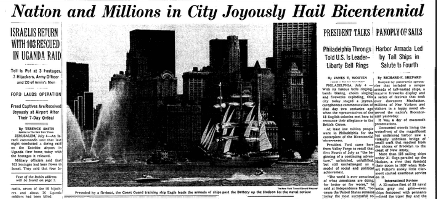
New York Times front page, July 5, 1976. Credit NYT.
Further north in the Big Apple, Broadway had a smash hit musical entitled… yes… 1776. It ran at the Gershwin, the largest stage-theater in New York. America’s Revolution was set to patriotic song, with sellout crowds all summer.
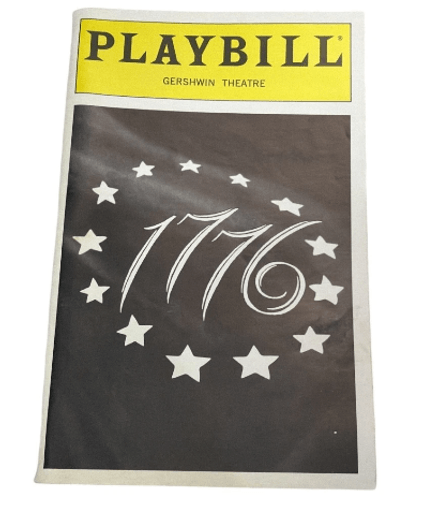
Playbill for 1776. eBay screen shot.
Bicentennial-focused marketing was ubiquitous. It touched everything from patriotic, totally red-white-&-blue Coca Cola ads to Revolution-themed highway maps – remember paper maps? – from oil companies like Conoco, now ConocoPhillips (COP):
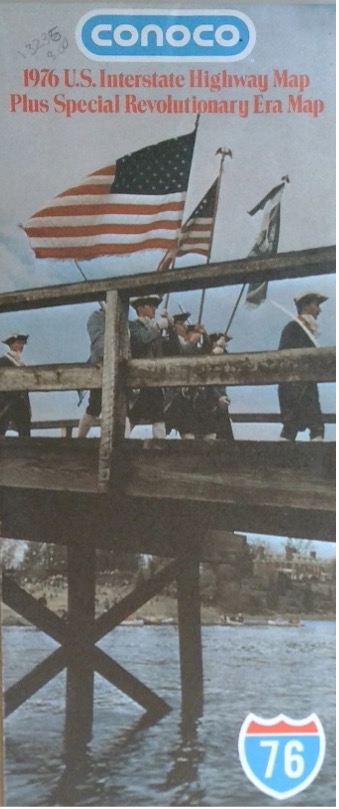
Bicentennial-themed highway map. eBay screen shot.
I could go on, but you get the idea. And the takeaway here is that, for all the problems the U.S. had back then – and yes, they were many; see below – the country seemed upbeat in ’76. But that same level of… let’s call it celebratory enthusiasm… isn’t as apparent today.
Okay, I’ll grant that President Trump is fixing fountains and the Reflecting Pool in Washington, D.C., but even that has been met with partisan and media pushback.

Trump Admin fixed historic Meridian Cascading Fountain. Credit WJLA.com.
The background story is that most Washington fountains were shut off many years ago due to neglect and poor maintenance, while the celebrated Reflecting Pool transformed into a brown swamp of algae and built-up bird poop.
In many ways the broken, dysfunctional fountains characterized the culture of recent decades, in which people in power said, in essence, “You plebes and proles out there cannot have nice things.”
A Different Take on ‘76
When you think about it, that 50-years-ago national sense of Bicentennial good feeling could definitely have gone the other way. Consider that 1976 was one year after the disastrous Saigon-evacuation that ended America’s tragic, costly effort in Vietnam.
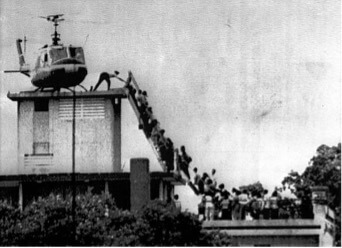
Saigon disaster, April 1975, one year pre-Bicentennial. Credit Library of Congress.
If Saigon wasn’t bad enough to wreck the nation’s party mood, the Bicentennial was a mere two years post-Watergate, when President Nixon was forced to resign.
Meanwhile in 1976, America was in the midst of roaring inflation, traceable to the 1960s and President Johnson’s blowout spending on the above-noted Vietnam War, coupled with his pipedream of a so-called “War on Poverty,” another failed conflict for the long-term “loss” column.
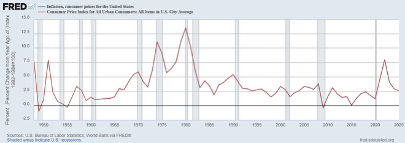
U.S. inflation, 1948 to present; note mid-1970s spike. Credit FRED, Fed of St. Louis.
That mid-decade, Bicentennial bout of inflation was also rooted in the energy shocks of 1973-74, when oil prices skyrocketed during a Middle East war, and the U.S. economy endured regional fuel and chemical shortages, and long lines at filling stations. (Sound familiar?)
Meanwhile, in 1976 the country – the entire world – was in the depths of the Cold War, in which the U.S. and Soviet Union had tens of thousands of nuclear weapons pointed at each other. Talk about things going south in a hurry? On any given day, we were 45 minutes from Armageddon.
Still, and as I recall 1976 both personally and from what history has recorded, the country felt pretty good about itself. In general, the U.S. looked like it offered a future.
Now, compare 1976 with today. And yes, hindsight is 20/20, but… little did we innocents back then anticipate what nasty stuff would hit the national fan over the next half-century, 1976 – 2026.
That is: five decades of inflation, financialization, deindustrialization, growth of government and expensive boondoggles, deficits, debt, corruption, globalism, open borders, mass migration, a widespread drug culture, H1B visas, outsourcing, crummy schools K-12, radical universities and grad programs, C0v!d lockdowns, homeowner associations, people everywhere staring like zombies into their smart phones… and you name it because I’m sure I’ve missed a few things.
America in 1976: a Foreign Country
“The past is a foreign country,” wrote L.P. Hartley in his 1953 novel The Go-Between. “They do things differently there.”
They do things differently? They sure as hell did things differently in America of 1976, a very different place to the present and now a “foreign,” long-lost land in many ways.
Among other things, in 1976 most people who worked at and ran America’s businesses, banks, educational and religious institutions, and government entities were U.S.-born citizens. They came of age during the Great Depression, World War II, the Korean and to some extent Vietnam Wars, and their shared life experiences informed their worldviews. They weren’t self-styled “citizens of the world” – i.e., they were not detached, rootless multi-nationalists – such as we see today in many C-suites.
At a deeper, cultural level in America of 1976, the intellectual poison of failed Marxism – think in terms of “Frankfurt School” – was germinating, but had not yet taken deep root. It’s a long tale, but by the mid-1980s the Hard Left was busy colonizing universities, media, religious institutions, NGOs, corporate HR departments, and definitely influencing politics.
In the five decades post-1976, what Marxists called “Critical Theory” transformed into today’s identity politics, DEI mandates, Woke-ism, and cancel culture; that is, an in-your-face means of attacking and controlling the individual in the name of group grievance.
In this sense, we now – 2026 – have a large segment of U.S. population who are not just indifferent to America 250 but are outright hostile to the very existence of the country. The usual critiques are along the lines of so-called “settlers” displacing Natives, and/or enslavement, racism, environmental destruction, exploitation of labor, “micro-aggressions,” etc.
In other words, the broad fabric American culture is now unraveling; it’s heavily influenced by dollarized globalism, plus the mind-bending, legacy toxic-sophistry of Erick Fromm, Herbert Marcuse, Howard Zinn and the like on steroids (look ‘em up; too depressing to discuss here).
Who Lives Here Anymore?
There are all of the foregoing matters (and more), and then there are just plain raw numbers. That is, according to the Census Bureau in 1976 the U.S. population was just shy 216 million. While today, the nation’s population is in the range of 350 million; perhaps 400 million by some counts. And the country’s overall demographics are quite different now-versus-then, to the point where the term “Balkanized” does not overstate the case.
In short, America is now more crowded than in 1976, evident in overburdened infrastructure: jammed roads, crowded airports, loaded rail lines, max’ed out cargo ports, busy hospitals, brimming schools, overloaded city housing, clogged courts and government offices, sprawling suburbs, rapidly-developing rural areas, busy beaches, packed parks and… yes, just about everything. (Really, have you visited a National Park lately?)
One way to view it is that the country’s vast increase in population was not met by sufficient investment in infrastructure. Looking back, we should have built more 10-lane highways in Houston, Dallas, and northern New Jersey, right? More Denver Airports. More big, ugly federal and state office buildings. More San Diego, Phoenix, Austin, Jacksonville or Charlotte sprawl. More beachfront high-rises on coastlines. More Walmart and Costco sites on former farmland.
Another way to look at it is that more-more-more has not necessarily been better-better-better, no matter what anybody built. That is, how much does quality of life improve in an overcrowded country held together by max’ed-out supply chains?
And please… don’t tell me that “America still has lots of empty land” unless you want to move to the middle of Nowhere in the Desert, High Plains, or Appalachia. Indeed, and again per the Census Bureau, over 82% of Americans live in urban areas, and quality of life in almost all areas has measurably deteriorated.
Plus, that 50-year population increase has brought a plethora of social pathologies like increased crime (petty and violent), drug usage, homelessness, and more. (On the positive side, maybe we’ve reached a point where Spencer Pratt will become Mayor of Los Angeles.)
Is There a “Spirit of ’26” Out There?
Okay, enough with the bellyaching, right? The year 1976 was then; and year 2026 is now. We have contrasts, and obviously the country had (then) and still has (now) many problems. So, we must deal with challenges as they are.
Of course, one element of dealing with things the way they are is to identify opportunities. And while we’re at it (and as Confucius noted long ago), it’s important to call things by their correct names.
One angle on current reality is that the 50-year American population explosion has led to massive increases in the use of what we at Paradigm call “hard assets,” things like energy, minerals and materials, water, waste disposal systems, and related elements of modern life. And that part of the economy is investable, so if you play it right you can stay ahead of the game.
Along these lines, as America approaches her 250th birthday, my colleague Jim Rickards and our editorial team will present a broadcast on Thursday, June 4 at 2:00 p.m. ET — LIVE from Philadelphia… the birthplace of the American experiment.
With Jim leading this livestream event — and with insights from yours truly and the rest of the gang — we’ll break down what’s driving markets in 2026, including…
The Iran war and energy shock, growing stress in private credit, deep-rooted inflation, the affordability crisis, critical minerals, gold, AI-driven power shortages and the future of Trump’s agenda.
I promise that this won’t be a dry economics lecture. Expect lively give-and-take, show-and-tell, fast-moving debate, behind-the-scenes stories and practical insights you can use immediately. Indeed, we’ll share actionable, investable ideas tied to these major trends.
Again, there is no cost to attend. Watch for more details soon. But for now, save the date: Thursday, June 4.
And at this point? Well, let’s wrap-up, get moving, and build our own, better America.
Thank you for subscribing and reading.

Comments: