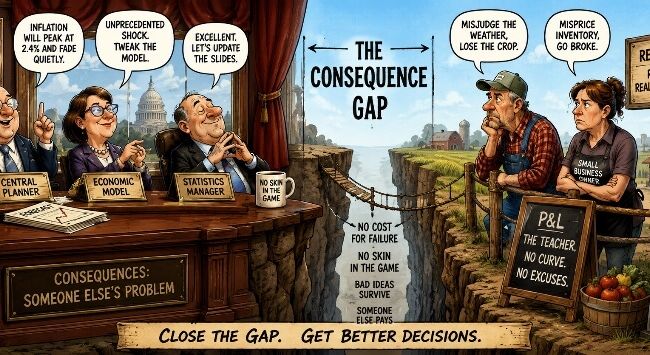

The Consequence Gap
Michel de Montaigne once said he’d rather keep company with peasants than professors.
Montaigne said the peasants had not been “educated sufficiently to reason incorrectly.”
He wasn’t in awe of ignorance. He was diagnosing something worse: a kind of education that trains sharp minds to be wrong with great confidence, at great length, and in great comfort.
You already suspect this about the experts running your country. Montaigne just gave you the receipts he wrote 450 years ago.
The Original Anti-Expert
In Montaigne’s France, “education” meant years of Latin drills, logic puzzles, and formal debate. A young man could leave that system able to argue any side of any question. He could quote Aquinas, Cicero, or Augustine at dinner and win the room.
But he often couldn’t grow a potato. (As a Gen Xer, I sympathize. I couldn’t build anything without IKEA instructions before I owned a house.)
Montaigne thought this was backward. He argued learning should build judgment, not just vocabulary. An education that produces confident talkers without sound judgment is a dangerous failure. (If only he could see today’s Federal Reserve Board!)
Plain ignorance is easy to fix. Polished error isn’t, because it comes wrapped in credentials, initials, and a job title.
The peasants around him weren’t wiser men. They were simply men whose mistakes cost them something immediately. Misjudge the weather, lose the crop. Misjudge the soil, go hungry. Their thinking received immediate, brutal, random feedback.
The scholars in their robes got applause instead.
Why Some Reasoning Gets Corrected, and Some Doesn’t
As Thomas Sowell once said, “It is hard to imagine a more stupid or more dangerous way of making decisions than by putting those decisions in the hands of people who pay no price for being wrong.” My God, that man is a national treasure.
The great British conservative statesman Edmund Burke lamented, “But the age of chivalry is gone. That of sophisters, economists, and calculators has succeeded; and the glory of Europe is extinguished forever.”
Luckily, old Edmund didn’t live long enough to see what British, French, and German politicians are doing to their countries.
Though they, and Montaigne, lived hundreds of years apart, all of them are talking about the Consequence Gap. That’s simply the difference between where someone makes a decision and the cost of being wrong. Close the gap, and bad reasoning gets punished fast. Widen it, and bad reasoning can survive indefinitely, dressed up as expertise.
The farmer has no Consequence Gap. A trader has none (unless he’s The Donald’s buddy, of course). The small-business owner, pricing inventory amid an inflationary mess, has none either. Their P&L is the teacher, and it doesn’t grade on a curve.
Now look at the people setting your monetary policy, health guidance, or economic statistics. Their Consequence Gap is enormous. When they’re wrong, they don’t go hungry. They go on television and explain that the shock was “unprecedented.”
In March 2021, the Fed said inflation would peak near 2.4% and fade quietly. By June 2022, it hit a 40-year high of 9.1%. No one at the Fed took a pay cut, let alone got tarred and feathered.
When the Ruler Becomes the Target
There’s a second trick hiding inside the first, and it’s one every reader of this newsletter has felt in their grocery bill.
Economists invented the CPI to approximate a real thing: the general debasement of money. But once CPI became the official target, officials began managing the number rather than the underlying reality. A war spikes oil prices, and suddenly that’s labeled “inflation,” even though no one printed a dollar to cause it. GDP works the same way. Government spends on a bridge to nowhere, GDP rises, and somebody calls it “growth.”
The ruler stopped measuring the terrain and became the terrain. The people managing the statistics never have to live with what the statistics hide.
A Very Old Word for the Cure
Thomas Aquinas called the solution to this problem “prudence.” He defined it as the virtue of applying right reason to actual choices, not just winning an abstract argument. Aquinas deliberately separated prudence from cleverness. A man can be clever and still choose badly. Prudence is what closes the gap between knowing and doing well.
Montaigne’s scholars had cleverness. Whatever their limits, his peasant friends had something closer to prudence, because reality forced it on them daily.
If there’s no consequence, there’s no correction. No iteration. It’s the same idea in three different centuries and three different vocabularies, and all three point at the same truth.
Watch the Hips, Not the Lips
Before you believe a forecast, ask what the forecaster will pay if he’s wrong. If the answer is “nothing,” discount it heavily. Listen to people whose own money and reputation are on the line.
Watch what insiders and institutions actually do with their capital, not what they say in a press conference. As an old trader friend of mine once told me, “Watch the hips, not the lips.”
And keep your own decisions sized so that if you’re wrong, you feel it fast enough to learn from it. That discomfort is the whole point. Master that discomfort. It’s what keeps your reasoning honest.
Wrap Up
Montaigne’s peasants never held a press conference explaining an “impossible choice.” They didn’t need to. Reality graded their homework the same week they turned it in.
Our modern experts are educated enough to reason beautifully and wrong enough to keep doing it, because the bill never lands on their desk. It lands on yours, in your grocery bill, your savings account, and your retirement statement.
You already sensed the credentials were a smokescreen. Now you’ve got 450 years of philosophy, a Catholic saint, and modern traders all agreeing with you.
That’s not cynicism. That’s just paying attention.
Comments: