

Elon: The Big Boy of Outer Space
“The scale of what is to come has no precedent,” wrote Elon Musk in a recent post on X/Twitter.
And unless you’ve been quite isolated – maybe you just returned from a trip to Antarctica – you probably know that last week, Mr. Musk launched an initial public offering (IPO) for his company, Space Exploration Tech Group, aka SpaceX (SPCX).
The company raised $85.7 billion, a record that breaks all such records. Indeed, as I noted in a prior Morning Reckoning, last week was “SpaceX Week.”
Markets loved the SpaceX debut, “a Really Big Thing” as they say in show biz. Shares priced-out to give the company a market cap north of $2 trillion by close of business last Friday, and this morning (aka “Tuesday”) SpaceX is on track to a market cap larger than that of Amazon.
Below, I’ll lay out some other Really Big Numbers that offer more perspective on SpaceX. Plus, I’ll offer a few ideas on how to hitch a ride on this shiny new rocket and tech play. Definitely, my goal is to help lower the risk of getting burned in this very hot phenomenon.
But for now, it’s fair to say that Elon is the Big Boy of Space.
The Big Boy Heritage
Right away, I admit that I have “Big Boy” on my mind, and no it’s not Elon and SpaceX. That is, I’ve been following the real Big Boy, namely engine No. 4014 of the Union Pacific Railroad Corporation (UNP), as it makes an America 250 cross-country tour.

Union Pacific’s Big Boy locomotive. Credit RailwayAge.com.
Big Boy is a working, smoke-belching steam locomotive (see above). Built in 1941, No. 4014 was one of 25 built in Schenectady, New York. He tips the scales – i.e., loco and attached tender – at nearly 1.2 million pounds. And with 16 massive drive wheels and impressive traction, this muscular machine hauled freight for UPac within the Rocky Mountains throughout World War II and beyond, until retirement in 1962.
In many ways, Big Boy represents the epitome of railway engineering and tech of its era. As with, say, ships, airplanes, electronics, munitions, and much else, the circumstances of World War II offered a moment in time that allowed people to push the envelopes of engineering and design; in this case steam-locomotive tech after 130 years of development.
And looking back… Hey, when it comes to Big Boy and his ilk, ne plus ultra.
But as fate would have it, diesel-electric drive also improved dramatically during the war, and for a long list of reasons Big Boy and his 24 brothers were the last of their mighty breed.
Now, only eight of these locomotive sets remain, and all were in museums until 2019 when UPac pulled Big Boy from a long respite in Pomona, California. Then came a complex restoration that involved tearing the iron giant down to the last nuts and bolts, and a faithful rebuild that strived for historical accuracy, excepting that Big Boy now burns oil-based fuel, not coal.
Based in Cheyenne, Wyoming, UPac rolls out Big Boy for special events but also, on occasion, tasks the old guy to pull freight as well. And now, as 2026 unfolds, UPac has the train on a national tour to celebrate America 250.

Big Boy route map. Credit Union Pacific Railroad.
As you can imagine, No. 4014 is eye candy to rail fans young and old. By the thousands – even tens of thousands, in some places – people line the tracks just to watch the old guy roll past. In many ways, it’s a primal desire to see and smell smoke and steam, and hear that glorious, deeply sonorous whistle… unlike anything else! And it’s pure Americana to watch that powerful train rumble by, with flags snapping in the breeze right up front.
And if you can’t get down trackside to witness the spectacle, of course You Tube has many well-made videos of this unique moment in rail history.
All of which brings me back to… SpaceX!
The New Big Boy
You want “Big”? Well… last week, Elon Musk delivered Big. The SpaceX IPO raised $85.7 billion. That’s massive. That’s huge. It’s the largest IPO in history. It dwarfs even Saudi Aramco’s 2019 IPO that raised just over $25 billion.
And SpaceX’s raise is real money, meaning cash in the treasury. No vaporware here.
Pre-IPO, that $85.7 billion was someone else’s cash, sitting in other people’s bank and brokerage accounts or money funds. And SpaceX sold shares to individuals and institutions. Buyers wired the money to SpaceX; well… to SpaceX’s banks.
So now, a massive wad of hard cash sits in SpaceX’s corporate accounts. Musk and his managers can hold it over time, or spend it on more rockets, more Starlink, more Starship development, other tech, and whatever other new ideas or growth they see fit to fund.
Meanwhile, investors traded cash for ownership in the company; although the overall float is less than 5% of authorized shares. Which means, to be sure, that Musk and his team still run the entire show. He’s driving the locomotive, so to speak. He’s the new Big Boy.
And has there ever been a corporate treasury with this kind of moolah just sitting there, awaiting its fate? What can you do with this kind of money? Well, compare the current company cash stash versus historical cash burn on other SpaceX business units.
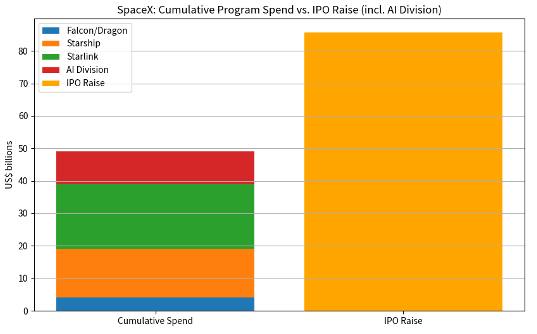
SpaceX’s current cash versus past R&D/spending. Various sources.
As the graph shows, SpaceX now has way more free cash in the bank than it ever spent on all of its past programs put together. That $85.7 billion is more than the company spent to develop the Falcon/Dragon system, Starship, Starlink, and even its AI division, which – by the way – paid for itself with its own capital raise.
In other words, with all the new cash on hand Musk and SpaceX could reproduce the company’s past efforts twice over; but that’s just a math example because SpaceX already has its successful line of launchers, a satellite constellation, advanced space vehicles in development, an AI angle, and much else up its sleeve.
So no, the new cash is for new ideas and investments, not operations. It’s enough cash to develop the company’s own brands of semiconductors, processing networks, AI systems, energy systems, launch them into orbit, and throw in a moon base and Mars efforts.
Meanwhile, it’s not as if Musk and SpaceX will have to do it all on their own dime, either (or “the shareholders’ dime,” to use a quaint old phrase).
After all, SpaceX rings its own cash register. It operates via significant revenues from its current range of businesses. Among other things, SpaceX is a key vendor to the U.S. government for space launches, communications, and even designing moon programs for NASA and the Department of War.
In other words, much of what SpaceX will do in the months and years to come will be more than paid for by what business school grads call “customers.” Maybe it’s a Paradigm Press subscriber with a Starlink terminal on the roof, or a mining company in remote Yukon or Alaska that uses Starlink to process data, or perhaps it’s Space Force working with SpaceX to place Golden Dome missile defense systems up in the sky.
SpaceX has its own money.
How Big is Big?
And of course, while we’re talking about “Big” things, SpaceX doesn’t do locomotives like old Big Boy; but it does do Big Rockets. In fact, SpaceX’s Starship system is larger than NASA’s Saturn V, which took U.S. astronauts to the moon, 1969 – 72.
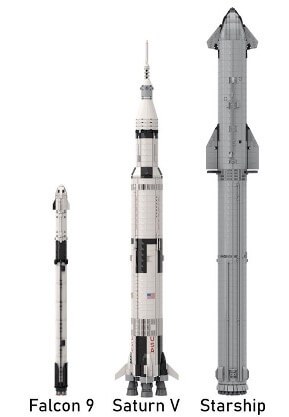
SpaceX Falcon 9 and Starship, versus 1960s era Saturn V. Credit InspiredPencil.com.
All this, and SpaceX’s rocket engines, fuel systems, guidance, structural design, return-to-land capability and much more are things that would have been Star Trek science fiction to NASA in the 1960s and 70s.
In many ways, and just as Big Boy the locomotive was pinnacle steam tech in the 1940s, SpaceX has created pinnacle levels of rocket, satellite, communications and control tech for this era; and that pinnacle still has more growth ahead. Or in other words, nobody will be putting SpaceX systems into museums any time soon.
Plus, consider SpaceX’s astonishing efficiency in developing its tech. For example, the company spent under $5 billion to develop Falcon 9, which has already reshaped the entire aerospace sector by dropping cost-to-orbit by 95%.
In comparison, NASA, the U.S. military, foreign rocket wannabes like Europe’s Arianne, and even Russia and China have poured far more money into developmental rocket systems for far fewer launches with far less effect.
Or compare how, say, California has pumped something like $20 billion into so-called “high-speed rail,” and yet there’s not a single lane of suitable track, let alone a bullet train across the Golden State. Indeed, even old Big Boy the steam locomotive offers more efficient capital spending for rolling down the rails than California and its high-speed government boondoggles.
Consider that SpaceX can launch massive rockets into the high atmosphere, place satellites into orbit, and still bring home and land stages that fall at supersonic speeds out of the sky, all for under $5 billion; but California can’t lay a single rail in the Central Valley.
Looking Ahead at SpaceX
Okay, so SpaceX went public and now has a market cap north of $2 trillion, perhaps headed to $3 trillion soon. What do you do? Well, on this point I’ll crib from my colleague Davis Wilson of our sister e-letter The Million Mission. And this graph outlines his forecast:
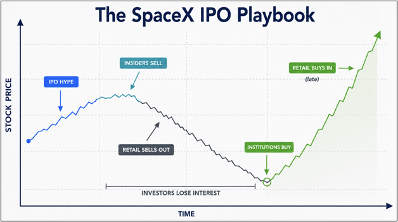
In other words, SpaceX will go through five phases:
Phase 1: IPO hype. In all the excitement, many people and institutions lined up to buy shares right out of the gate. And yes, the share price rose from the IPO price. At the outset, there’s plenty of upward pressure on the stock.
Phase 2: Insiders sell. In the not-too-distant future, watch for venture capital and SpaceX employees to unload at least some of their shares. They’ve been patient and want some cash. According to the lockup structure and timetable, we’ll see waves of selling as different groups of people reach their release dates. And when they sell, buyers will move in; but early-on, the market and share price be more synthetic than true price discovery based on fundamentals like cash flow, internal costs and expenses, and of course earnings.
Phase 3: Investors lose interest. Believe it or not, and for all the SpaceX hype, the news cycle will roll on down the tracks to the next “hot” story. Some other Huge Company will do an IPO with all the attendant bells and whistles. And SpaceX could enter into a “dead money” period where a broad segment of investors lose interest.
Phase 4: Institutions buy. Meanwhile, many large funds can’t or don’t buy meaningful positions immediately after an IPO. They avoid hype and inflated prices, and just watch the dust settle. And once the media and retail investors are focused on other shiny things… they accumulate during the doldrums.
Phase 5: Retail buys back in. Eventually, SpaceX will become a new darling. People who ignored the stock in early days will dive in. And this is where investors are at risk of chasing momentum.
What to Do Now?
Along the way, Paradigm Press editors – including me – have followed SpaceX, but also counseled patience over the IPO. Watch, wait, let the hype play out, let the up-down cycles pass along; and eventually we’ll find our opportunity.
Along the way, though, there’s much that is SpaceX-adjacent. In particular, I’ve been looking at companies that supply critical metals and materials not just to SpaceX, but to other players whose satellites SpaceX launches into orbit.
One way or another, rocketry and satellites require aerospace grades of aluminum, titanium, beryllium, and innumerable other metals and materials; certainly, rare earth elements (REs) that are critical to alloys, magnets, phosphors, electronics and more.
Along with my colleagues Matt Badialli and Dan Amoss, I’ve recently outlined several great and promising names in the “space metals” sector, published and discussed in Strategic Intelligence and related letters.
Meanwhile, we’re watching history unfold with SpaceX, just as you can see history on display with Big Boy, currently at the Steamtown National Historic Site, near Scranton, Pennsylvania.
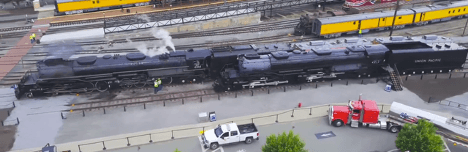
Big Boy No. 4014 alongside his brother, non-working engine No. 4012, at Steamtown National Historic Site. Credit Dept. of Interior.
And while there’s always more to say, that’s all for now. Thank you for subscribing and reading.

Comments: