
Grid Emergency = Bullish for Aluminum
In March 2026, the U.S. Department of Energy (DOE) announced it will invest $1.9 billion to accelerate improvements to the nation’s electrical grid. Of course, this program has a stupid acronym: “Speed to Power through Accelerated Reconductoring and other Key Advanced Transmission Technology Upgrades” (SPARK).
What’s important about SPARK is that it will accelerate the purchase of electrical components made in the U.S. from metals like aluminum, steel, and copper. The DOE will announce the recipients of the money at the end of May this year.
To add to the urgency, the White House announced an executive order that marks America’s electric infrastructure as critical to national defense under the Defense Production Act:
The President has issued a determination under Section 303 of the Defense Production Act finding that grid infrastructure –including transformers, transmission lines, substations, high-voltage circuit breakers, power electronics, protective relay systems, capacitor banks, electrical core steel, and related manufacturing equipment – is essential to national defense. The determination finds that domestic industry cannot timely provide these capabilities due to limited domestic production capacity, extended procurement timelines, foreign supply dependence, and insufficient capital investment.
I fully agree with this determination. The American Society of Civil Engineers (ASCE) publishes its Report Card for America’s Infrastructure every few years. In 2021, the ASCE gave the electric grid a C-. In 2025, that grade fell to a D+.
The reason for the lower score is that the demand for electricity rose to a 20-year high thanks to the growth of data centers. As of the publication of that report, a single data center required the same amount of power as about 80,000 homes. That figure is going up every month.
The cost of upgrading America’s massive electrical grid is enormous. The ASCE put a $578 billion gap between what will be spent on maintenance and what needs to be spent on upgrades. There’s only so many bandaids you can put on failing systems. At some point you need to tear it down and fix it. That’s why SPARK and the new executive order are so critical. Right now, the aging grid can’t meet demand. And the electricity costs for average Americans are soaring.
This is another tailwind to our critical metals investment thesis. The U.S. cannot make these upgrades without buying metals. Lots of them. And the focus on domestic supply means our miners will get that money.
The money spent on the grid will find its way to copper miners through higher domestic copper prices. Another metal that is already soaring is aluminum. And that is a trend we really should be in as well…
The Power Grid Metal
The best aluminum play right now, the one every investor should own, is the giant miner Alcoa (NYSE: AA). It’s already responding to the higher prices, and it’s a great idea to own it in your personal portfolio.
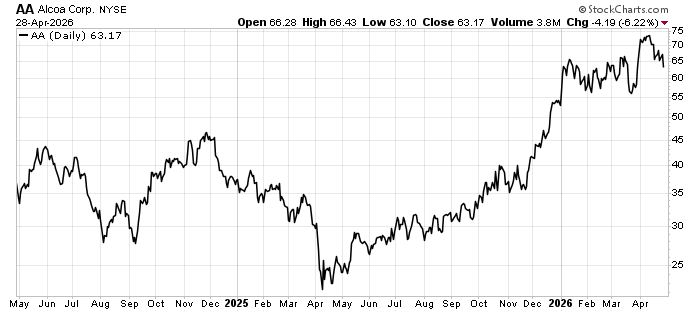
While electric motors must have copper, transmission lines are primarily made of aluminum… and they are old.
According to David Roberts’ blog Volts (one of my favorite reads), power line design dates back to the early 1900s. The “modern” design used by the U.S. today comes from the 1970s. Roberts’ argument (supported by industry experts) is that simply replacing the old lines and conductors with new technology could double the capacity of the existing grid.
We don’t have anywhere near enough aluminum supply.
According to the Aluminum Association, the U.S. needs about five new 750,000-metricton primary smelters to “fully meet current metal needs”. They estimate that the U.S. needs roughly 3.75 million metric tons per year to meet new demand for aluminum. The U.S. currently consumes about 5 million metric tons per year, across all sectors. That includes construction and packaging.
Once again, we’ll be following this trend as a critical investment area.
There are a lot of tailwinds for critical metals. But sometimes the most boring metals (like aluminum) can surprise you with outstanding returns.

Comments: