
PDAC 2026: “There’s a Heck of a Lot of Money Here”
Greetings from frigid Toronto, where I’m attending PDAC 2026, the annual convention of the Prospectors & Developers Association of Canada. Metals, minerals, mines, and me, plus about 35,000 of my nearest friends. It’s crowded (see below) and there’s much to report, so strap in.
Over the last two weeks (here and here), I wrote about PDAC from the perspective of my own rock-kicking out West. Well, now I’m kicking rocks in the Rogers Convention Center. And I don’t know if you believe in omens, but this past Sunday on the first day of the event, the very first person I met as I walked into the exhibit hall was old friend and legendary resource investor Rick Rule. Famously, Rick has advised, “Don’t waste this bull market.”
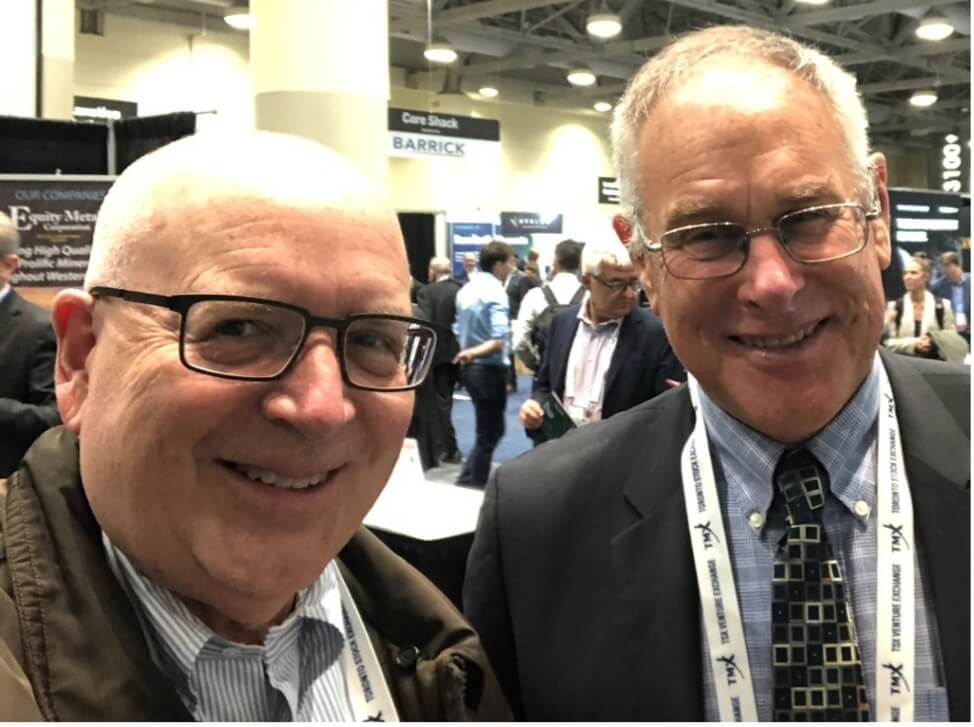
Your editor and Rick Rule on Day 1 of PDAC. BWK photo.
Waste not, want not, right? So, we chatted and I asked, “Any companies here that you think I should check out?”
Rick replied with a few names and then said, “I’m a little bit frustrated, though. There’s a heck of a lot of money here, competing with me to write checks.”
Yes indeed: a heck of a lot of money. In fact, that’s the general ambience of the place, of which I’ll detail more below.
Finally… A Cash-Rich PDAC!
First, some history… Because I’ve attended PDAC in years past – like during most of the 2010s – when the mining sector was in the dumps. Low share prices. Low prices for metals and other output. Cash-poor companies. It was a tough era in which to raise funds. I’ve seen plenty of empty booth space at previous PDACs.
In fact, it’s not wrong to say that, back in the doldrum days, much of the action within the mining sector was internal money cycling back and forth. That is, if a company wanted to raise funds, then somebody somewhere had to sell something else to free up cash. “Sell Peter,” so to speak, to raise money to “pay Paul,” if you’ll allow an ancient analogy.
For example, in a previous note I mentioned a then-small company called K92 (KNTNF), a project cast off by Barrick (B) in 2016 because it was too small and didn’t fit the balance sheet for the big gold miner. I liked what I saw, recommended KNTNF at $0.37 per share, and now it’s a $5 billion market cap copper-gold producer whose shares trade over $22 (with a modest p/e of 23).
There are other stories like K92, if you know where to look. Which is to say that, for quite some time, the mining sector has represented a finite, not-very-big bag of cash, and many players were competing for the same dollars. Indeed, for 30 years and more, capital investment across the mining space has been on the low side, and companies were not replacing output with new resources, reserves and capacity.
This, in turn, created shortages of ideas, projects, developments, working mines and mills, and especially a lack of enough human skills. And definitely, one theme here at PDAC 2026 is the shortage of trained geologists, engineers, project managers and more. (Hint: tell you children and grandchildren that there’s a good career in earth sciences. And it helps if they know how to code AND weld.)
This year, though? The money-dam has burst: “We have big cash flow coming into the sector from all over,” said a knowledgeable investment banker from one of Canada’s largest industrial finance funds.
“Every day, we take in cash out of Asia,” said the banker. “Much from Singapore, which is code for China. And Korea and Japan. Australia too. The Middle East, of course. With other large cash flows out of Europe, likely a flight to safety as the European Union falls apart.”
And what about North America? “Yep, lots of new money from the U.S. Much of it comes from tech, AI, crypto and the rest of the big markets, the New York Stock Exchange and NASDAQ. It’s sector rotation. Capital is leaving overbought plays, exiting the nosebleed sectors. Money is moving into basic industries like mining, with a particular scramble for precious metals as well, both physical and the miners.”
Gold Leads the Way
This comment from the top floor of a Toronto skyscraper jives with what we’ve seen from the trenches of Paradigm Press.
That is, since 2022, much of the world has been de-dollarizing after markets absorbed the implications of Western sanctions on Russia. We saw a historic, $350 billion money-grab of sovereign state assets that belong to the Kremlin. And the message was: if Europe and the U.S. will pickpocket nuclear-armed Russia, what chance does anyone else have?
It’s a long story, but the short version is that that big whacks of de-dollarized money moved into precious metals, and now are also moving to miners. By 2024, the last year of the Biden administration, gold prices were moving up, and then they levitated even more in 2025 during the first year of President Trump 2.0.
I recall writing, back in 2024, that “gold leads the way.” Gold prices were moving up, along with much else in the metals space at both physical levels, and in the share prices on exchanges. And the numbers speak for themselves: gold moved from the $2,000 range in early 2024 to the current price over $5,040.
And it’s not just gold. We’ve seen big price increases for other metals used in industry. Silver speaks for itself as both a monetary and industrial metal, And copper. Zinc. Even lead. And then we have exotic, critical materials like antimony, tungsten, indium, germanium, gallium, rare earths. And don’t forget uranium, a key “energy metal.” Up-up-up, if you’re on that investment pathway.
And what happened with these rising metal prices? Producing companies have seen significant increases in revenues and internal cash flows. Sure, they use the cash to pay their bills: higher prices for fuel, labor, commodities like steel and concrete, machinery and more. But at the end of the day, much of that cash flow lands on the bottom line to become earnings. And stock markets like to see earnings.
And here we are, PDAC 2026.
Crowded and Optimistic
Right now, minerals and mines are where money is flowing. So, yes, it’s crowded here at PDAC. Exhibit space is sold out. Many new investors are wandering around, visiting booths, asking questions and looking for promising ideas. And really, just moving about is a chore because of the crowds. Heck, the Rogers Convention Center even ran out of coat rack space.
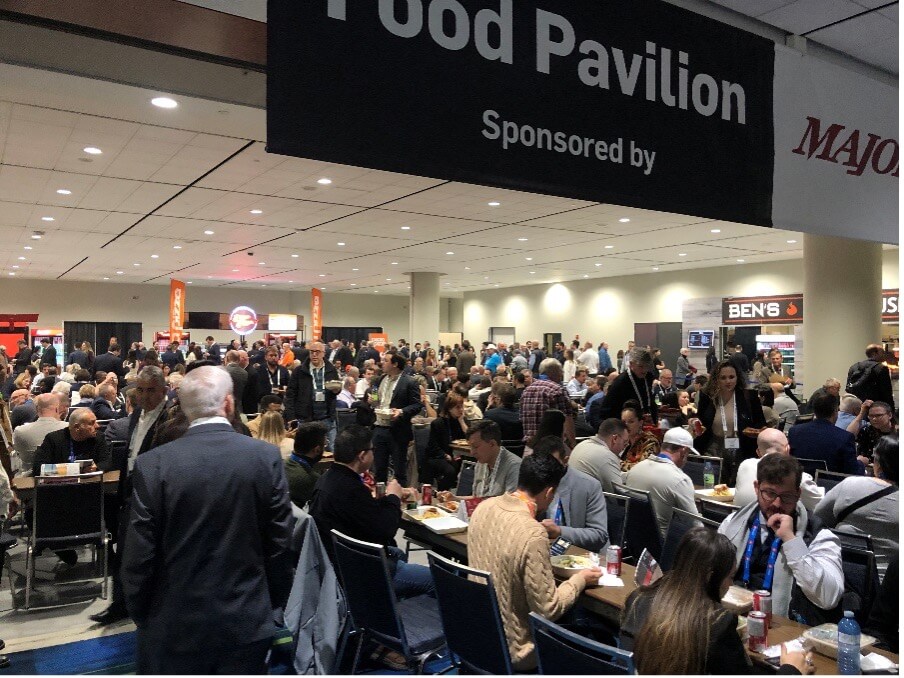
Packed PDAC. Skip lunch cuz the food court is too crowded. BWK photo.
Meanwhile, I feel optimism within each layer of the mines and minerals sector. Producers are producing, selling at high prices, and making money and profits.
Developers are developing, and many seem to have little problem raising cash to pay the bills, while in many cases merger and acquisition (M&A) angles are apparent. That is, big guys want to (and need to) buy out smaller guys to bulk up the reserve base, and it sure helps that the newly-minted cash is there to lay on the table.
And explorers are doing their thing across the world. I saw eye-watering ideas from companies out of Alaska, for example (copper, silver and zinc). And the Yukon (gold and tungsten). And British Columbia (copper-gold). And Quebec (copper, nickel and platinum group metals). Not to mention a string of ideas from Mexico to Argentina (silver, copper, gold, tin and more).
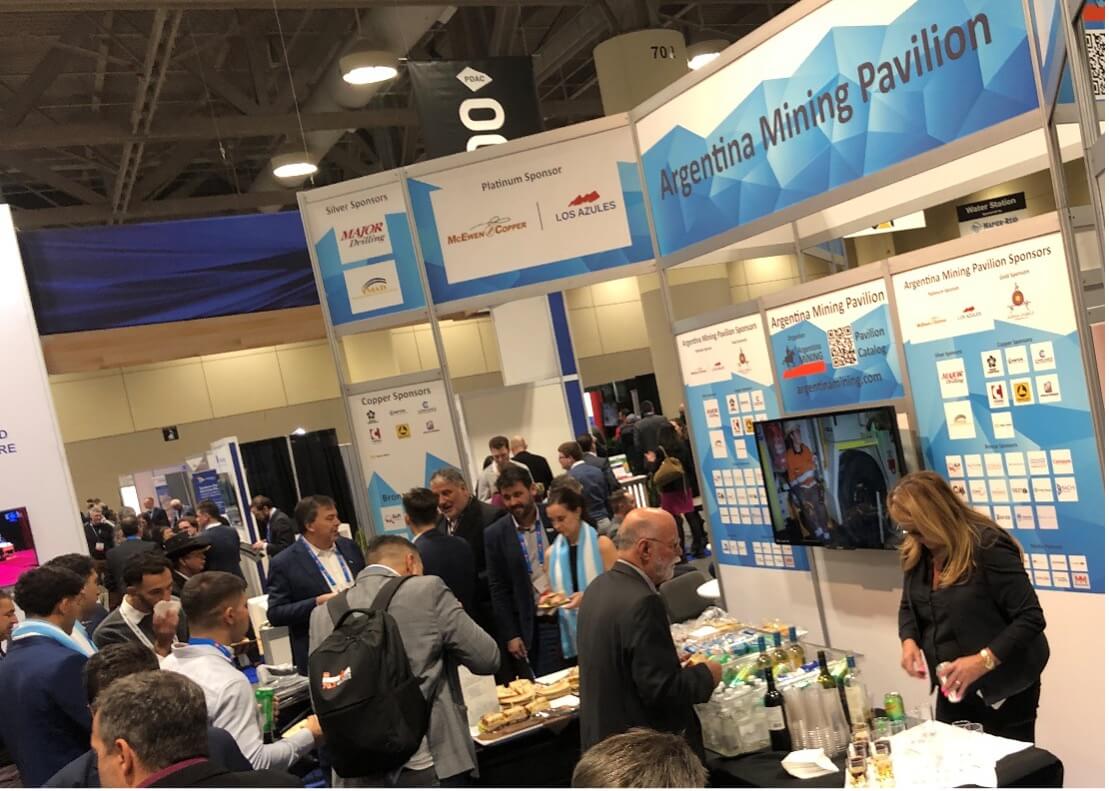
Very civilized: Argentina offered wine and ham sandwiches. BWK photo.
Along the way, I had a great discussion with an exploration geologist from Rio Tinto (RIO). He explained that Rio is spending serious cash at the corporate level for unvarnished exploration, targeting new copper deposits. And we went over several new exploration plays that Rio is investigating in Colombia, Angola, and even close to home in Utah, USA.
This is quite a development if you understand the mining industry of recent decades. Because for 30 years or so, big companies in general scaled back their own field exploration, essentially to cut costs in a long era of relatively low metal prices. If a Big Mining Guy – pick any from among the usual names – needed a new deposit, it would make a deal with an explorer with a promising discovery, or a developer with a new project under design and construction. Sort of a “just in time” approach to keeping the mills running.
“Just In Time” Is Now “Way Too Late”
But with mining, as with much else in the industrial world, “just in time” has transformed into “way too late.” Across the supply chain, if not periodic table, China controls significant swaths of basic mine and material output, from antimony to zeolites. And routinely, China puts the squeeze on buyers from the rest of the world (aka “the barbarians”) with embargos, restrictions, allocations and more.
In essence, if you don’t have a pipeline of mineral projects that range from brown stains on a mountainside to a mill cranking out product, you are behind the old 8-ball.
And so, it’s intriguing to see Rio put its own cash into real, live exploration geologists who go out in the field, kick rocks, design drilling programs, and work up a deposit. Sure, companies like Rio have an eye out for new ideas in small, independent exploration or development plays. But again, it’s healthy for the industry – and for Western economies – that big guys are also out there, working field projects and rebuilding corporate capabilities.
Meanwhile, and at a scale much smaller than Rio, I had a great chat with CEO David Wolfon of Avino Silver & Gold (ASM), a $1.4 billion market cap mining play located near Durango, in central Mexico. I’ve followed the company for over a decade and visited the site on several occasions.
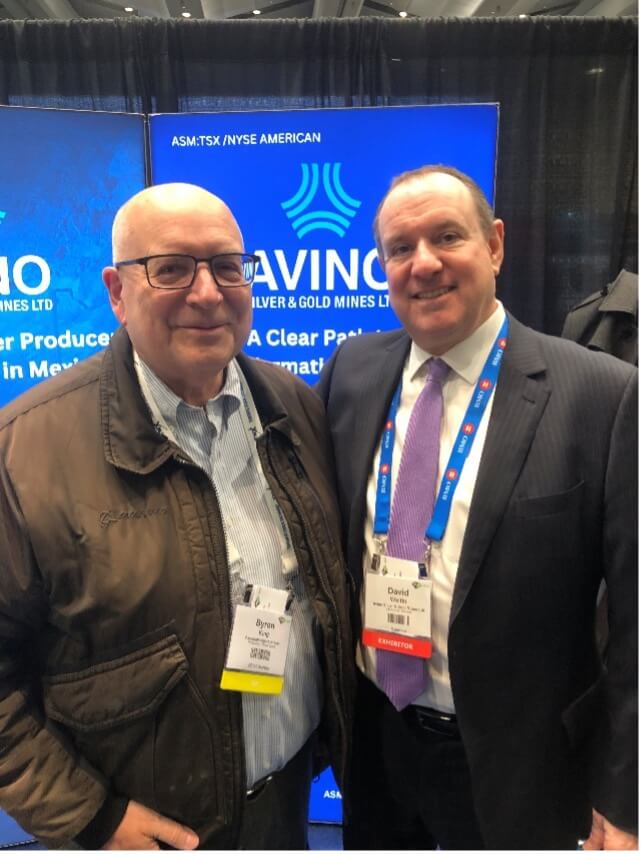
Your editor and David Wolfson, CEO of Avino Silver & Gold. BWK photo.
As recently as a year ago, in early January 2025 you could buy shares for $1.00; today, they trade over $8.00. Quite a run, right? And in terms of current metrics, the price-earnings ratio is a lofty 65 or so. But still, Avino is attractive because cash flow is growing.
Avino sells its output to one main customer, Samsung of Korea, which takes about 95% of everything at what’s fair to say is “above market” price levels, because of a sturdy relationship that has evolved over the past ten years. Samsung wants assured supplies of metal from a reliable source, and no issues with so-called ESG, or “environmental, sustainability and governance.” And Avino runs a great program, with solid relationships with the workforce and local government in its region.
Now, at current metal prices and coupled with internal controls and disciplined management, cash flow is working its way to the company profit line. Meanwhile, numerous large investors have bagged large positions in Avino shares, which indicates how the new resource market likes the company.
Meanwhile, Avino is located in a relatively safe part of Mexico: “No narcos around us,” according to David. The Durango state government wants to protect the jobs and cash flow of this significant employer. Plus, Avino has recently expanded output after a five-year capital program that it carried out even during the pandemic of 2020-21.
So, where can Avino go from here? After its big upside move in 2025, is it time to throttle back? Well, now comes the risk-reward analysis because there’s also serious takeover activity in mining, especially in the silver space. And while Avino has done well on its own, it’s also structured as a solid, accretive, cash-flowing partner in the event a larger metal producer wants to expand.
So, we’ll see, right? I’m not making any formal recommendations here. We don’t track a portfolio in the Reckoning. Do your research, watch the charts, wait for down days or weeks in the market, use limit orders, and never chase momentum.
But my Toronto takeaway is right back where we began, that “There’s a heck of a lot of money here.” Plenty of great ideas here at PDAC. Plenty of opportunities and upside.
As I write, miners and metals are selling off hard due to the broad markets crashing. In a situation like this, hedge funds and traders sell whatever they can to meet margin calls on other positions.
Precious metals remain the best safe haven investment. They will recover first and rally hard once the dust settles.
And with that, I’ll sign off and get rolling back to the conference.
Thank you for subscribing and reading.

Comments: