Why More Investors Like Gold
Gold is charging up to new highs, so it’s no surprise that the level of interest in this financial asset is charging up as well. Last week I did interviews with CNN, CNBC, USA Today and Reuters, and in most cases a specific question came up – “Should people be buying or selling gold right now?”
That’s a tough one. The monetary turmoil in Western Europe and some early signs of inflation create the right conditions for gold to continue its run, and while we see higher prices in the long term, it’s difficult to predict what might happen in the here and now.
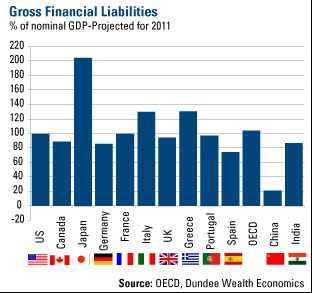
Sovereign debt is a key driver of the current economic jitters. The chart below shows next year’s sovereign debt estimates for the G-7 and other key global economies – the U.S. debt in 2011 would be about equal to GDP ($15 trillion), while the debt loads carried by Japan, Italy and Greece would exceed GDP.
With all that’s been said and written about gold lately, it’s rare to find new insights and perspectives. But this week, Martin Murenbeeld, the head economist at Dundee Wealth Economics, offered something new about the nature of the gold investment market in an interview with Mineweb.
“Investment demand for gold – and investment demand for commodities generally – is in early days. This is only just starting to develop… One of the things that I see when I travel around North America is that more and more people are starting to question “What is currency debasement? How does it work?” – that sort of thing.
“Now what’s interesting about that is that Americans and Canadians by and large never thought about currency debasement. This was something that maybe an old German would think about or Asians and Latin Americans. But not North Americans – but that has changed…
“There is a concern among investors that not all is right with the financial world and they don’t fully understand it. They think central bankers might be debasing their currencies and so there is an interest developing in gold.”
If he’s correct – the masses in the developed world are just now waking up to how their personal wealth can be affected by the future inflation spawned by the trillions of dollars and euros created to finance economic rescue plans – the potential implications for gold are profound.
Here’s one way to look at currency destruction — 10 years ago this week, $1,000 bought nearly four ounces of gold, and today $1,000 won’t even get you a single ounce. Gold is money, so when you look at the gold-dollar exchange rate, the dollar’s value has fallen by a startling 78 percent just in the past decade.
Murenbeeld goes on to make another interesting point – investment demand, rather than jewelry demand, has been the key driver for gold for most of modern history. We are returning to that scenario as gold’s safe haven appeal grows during this period of unstable government and monetary policies.
Central banks in China, India and elsewhere have snapped up hundreds of tons of gold to add to their reserves in recent years, and a growing number of other investors are following suit – the Shanghai Gold Exchange, for example reports that its volume was up 36 percent in the latest quarter. Overall investment demand is double what it was in the 1970s.
Our experience shows that whenever you have deficit spending, rapid money supply growth and negative real interest rates (inflation rate higher than nominal interest rate), gold will perform exceptionally well in that currency. Right now, we’re seeing massive deficits, negative real interest rates in the U.S., and a worldwide debt problem that is projected to get bigger.
We have long recommended, based on regressional analyses, that prudent investors consider an allocation to gold – not to get rich, but as a way diversify assets and protect wealth. Our suggestion is a maximum 10 percent allocation – half to bullion and the other half to gold equities or a good gold fund that invests in unhedged gold stocks.
Regards,
Frank Holmes,
for The Daily Reckoning
P.S. You can visit my blog, Frank Talk, for more daily insight and commentary.
[Editor’s Note: Frank Holmes will be a guest speaker at the Agora Financial Investment Symposium in July, along with Marc Faber, Bill Bonner, Barry Ritholtz, Doug Casey, and many others. You can find the registration details here.]

Comments: