
Frankenstein’s Bull-Bear Market
The S&P 500 is sitting just below a fresh all-time high.
Yet 59% of the companies in the index are down more than 20% from their highs. That means 59% of S&P 500 companies are in a bear market.
And it gets crazier. 41% of stocks in the index are down more than 30% from their highs! And 17% of the companies are down more than 50% from their peak.
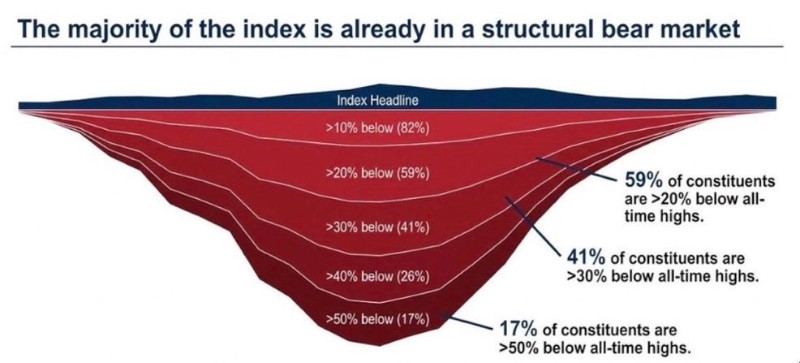 Source: Don Durrett
This situation is possible due to the market cap-weighting used by the S&P 500.
Let’s take a look at the 10 largest companies in the index. Note the weight column, which tells us what percentage of the index that company makes up.
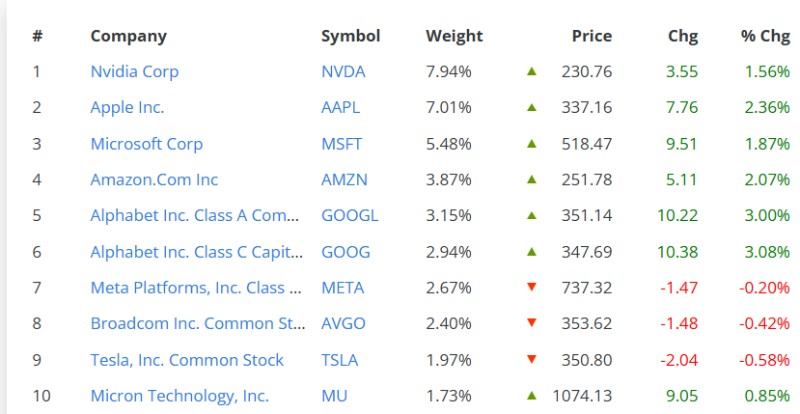
Nvidia (NVDA) alone accounts for almost 8% of the entire S&P 500. The top 3 companies (out of 500) make up about 20% of the index.
So the S&P 500 can perform extremely well in periods where most of the index is struggling or down. The big boys can drag up the market with their outsized weights and gains.
This is essentially where we are today. Over the past few years, the big AI winners are holding up the entire market.
But make no mistake. This bull-bear market is highly unusual. Yes, it has happened before. I asked ChatGPT to find previous instances, and show market returns in the following 12 and 24 months. Here are the results:
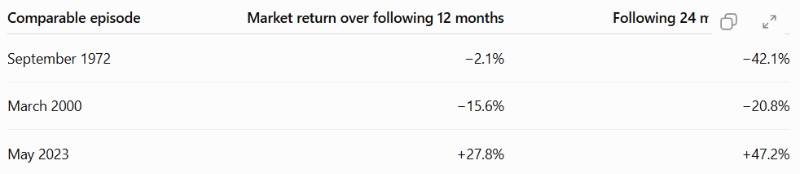
The September 1972 incident was followed by a market crash. The March 2000 one too. Only the May 2023 instance was followed by positive returns (I should note that the returns were very impressive in this case.)
Historically, when a tiny group of companies begin to dominate the market, it’s not long until a crash. The chart below, via Bank of America research, shows concentration bubbles throughout history.
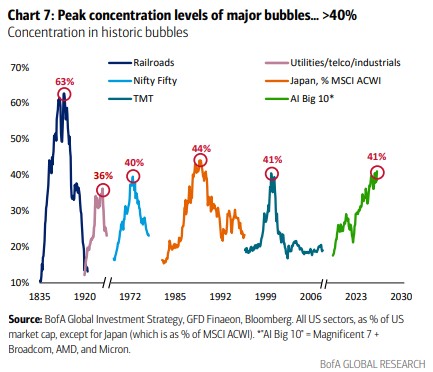
The 10 biggest AI players now make up 41% of the total U.S. market cap. This is the exact same level that top tech stocks hit in 2000.
Weak Market Breadth
Breadth measures how many stocks are participating in a stock market move.
Currently, only 44% of S&P 500 companies are trading above their 200-day moving average:
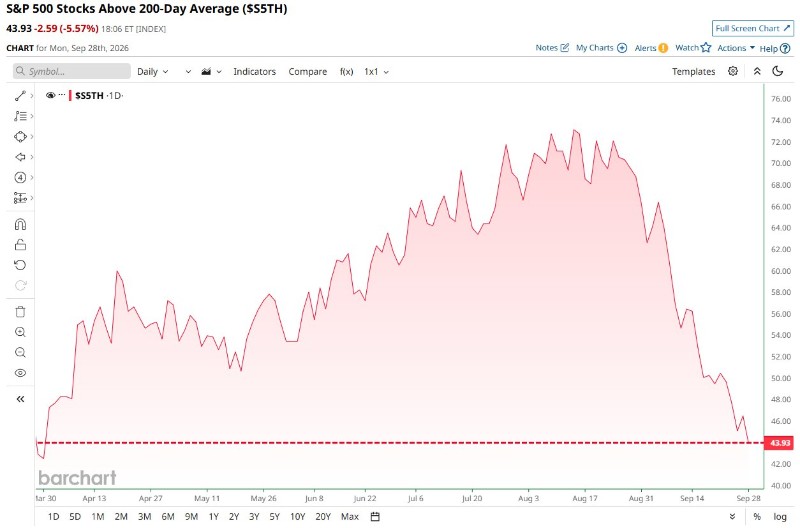 Source: Barchart
That’s the worst since March 2026, just after the war with Iran began. As you can see on the chart, back in mid-August, 72% of companies were above their 200-day moving average.
And note how sharp the drop is in the chart above. That’s just… ugly.
Opportunities Outside the S&P 500
For the past 15 years, the S&P has performed spectacularly. Largely due to the crazy-good performance from big tech and AI.
But the downside is that this index is now heavily weighted towards tech giants. If the AI train slows down, things could get ugly for the standard stock benchmark a while.
It’s funny, because the S&P 500 is supposed to provide diversification, and sometimes it does. Not today.
This trend has reinforced my belief that we should all own some companies outside the S&P 500. And since S&P 500 companies make up about 80% of the entire U.S. stock market, that really leaves only domestic small-mid caps and foreign stocks.
For example, there is only one single gold miner in the S&P 500. That’s Newmont (NEM), the world’s largest precious metal miner. Great company, I own it.
But almost all the other big gold and silver miners are headquartered outside the U.S., so they can’t be part of the S&P. If you own the S&P, you have almost zero exposure to gold miners.
Fortunately you can buy all the top gold miners by purchasing an ETF like the Vaneck Gold Miners ETF (GDX). Or you can follow the advice of experts like the ones we have here at Paradigm Press. Jim Rickards, Dan Amoss, Byron King, and Matt Badiali are all excellent at picking precious metals stocks.
Emerging Markets
Since U.S. tech has done so well over the past 15 years, many other asset classes have been forgotten. Emerging markets are one of them.
Long-time readers know I’ve been extremely bullish on Brazil for the past 18 months. It’s a commodity-heavy economy, trades at rock-bottom valuations, and everyone hated it up until about a year ago.
Buying Brazilian and other emerging market stocks is actual diversification for most investors. Buying the S&P 500 today, however, is essentially a bet on AI.
Many investors believe they are getting broad diversification by buying the S&P. But in today’s conditions, they’re not.
So if you’re all-in on U.S. stocks, consider diversifying into the emerging market world a bit. A few funds I like include the Vanguard Emerging Market ETF (VWO), the iShares Brazil ETF (EWZ), or the Cambria Emerging Shareholder Yield ETF (EYLD).
If and when the AI trend slows down, having true diversification will pay huge dividends. That’s what I’m positioning for today.

Comments: