

The Military “Tribe” Wants Containerized Warfare
“If it fits in a container, I want it.”
So said Admiral Daryl Caudle, Chief of Naval Operations (CNO) this week in front of a large gathering of military personnel and contractors at the Sea-Air-Space Conference (SAS) in National Harbor, Maryland. And hold that thought…
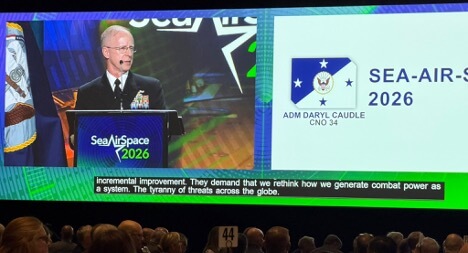
CNO Admiral Daryl Caudle at Sea-Air-Space Conference. BWK photo.
“I want it Sailor-centric,” he added. “I want your product ready to fight, and with a long sustainment tail.” And the CNO wants it soon, if not “now.” Hold that thought, too…
Because as far as the Navy is concerned, “Industry is no longer just a supplier. Industry is part of the nation’s force of arms.”
Okay, let’s look at where this is going…
America’s Military “Tribe”
Frankly, it’s refreshing to hear someone at the top – the CNO – say things like that. Because for a long time, my sense of how things work was that many people in charge of the U.S. military maintained an unhealthy distance, if not disregard, for the people and institutions that design and build the gear. No, not everybody, everywhere, all the time; but enough that the “us versus them” attitude was unhealthy and got in the way of actual deliverables that actually work.
Meanwhile, the foundational truth of military power is that it’s the first derivative of a nation’s energy and industrial power. That is, if a nation lacks energy and industry – and the kinds of smart people who bring forth energy and industry – it will never be much of a powerful state.
For example, Israel is a military power, after a fashion. But really, much of Israel’s “power” is based on U.S. equipment with a different paint job. And we can say the same thing about Saudi Arabia, Kuwait, UAE and more: they use oil money to buy U.S. and Euroland equipment, but there’s no way they could ever roll out their own high-performance ships, aircraft or munitions.
Whereas Russia has long been an energy and industrial power, complemented by large numbers of smart people, and has a military-industrial complex to show for it. More recently, see China.
But I don’t want to digress, so let’s return to the U.S. and the CNO’s comments.
First, and looking back since the days of President Eisenhower, people have commonly referred to America’s defense system as a “military-industrial complex” (MIC). And there’s a certain truth to that, although it’s not quite accurate because it leaves out the role of Congress in steering procurement decisions for raw political reasons. That is, U.S. defense is more of a military-industrial-Congressional complex, aka “MICC.”
But this week at SAS, the CNO put a different spin on the MIC/MICC. He began his talk by welcoming the serving military and military contractors as “an ecosystem of military capabilities in one room. A gathering of a tribe,” which is quite an interesting way to frame things.
Indeed, when one walks around the exhibit halls of SAS – sponsored annually by the U.S. Navy League, a private organization – the scale and scope of that military-industrial ecosystem is vast; indeed, it rivals the complexity of the most exotic tropical rainforest in variety and depth.
And calling it all a “tribe” has a certain semantic accuracy. That is, the defense-supplier community is composed of numerous companies and people – even families and clans – who recently, or over generations, have a shared business culture that involves building things for the U.S. military.
Of course, SAS highlights large, legacy – and irreplaceable – shipbuilders like Huntington Ingalls (HII) and General Dynamics (GD), whose heritage goes back into the 19th century. And then there are significant producers of aircraft and flying munitions like Raytheon-RTX (RTX), and Lockheed (LMT), again with long industrial and business heritages behind them.
Meanwhile, RTX also builds aircraft engines under the century-old Pratt & Whitney name, while just down the aisle is GE Aerospace (GE), not to be confused with power systems maker GE Vernova (GEV), both of which trace corporate roots to Thomas Edison and the 1890s.
Then there are other large system builders like 110-year-old Boeing (BA), along with Northrop Grumman (NOC), a combination of two aviation names that each reach back a century.
But it’s not just the big names on display. SAS features hundreds of other companies up and down the supply chain that make everything from drones and satellites, to wire bundles and connectors; or paints and finishes; or ropes, chains and anchors, and much more. These companies hail from literally across the country, from Hawaii, Alaska, California eastward to the banks of the Potomac River, just south of Washington.
And when you delve into the what and how? That is, what are the products and how are they made? It’s an astonishing, mind-bending journey through many decades of science, engineering and technology. Because the military specification (MilSpec) for defense goods is there for a reason, namely, to be suitable for high end combat, and only after a history of testing and field use.
Sure, 150 years ago ships signaled each other by hoisting colored flags. But today? Military-grade communications are out at the far edge of everything. Math and software, plus electrical and electronic engineering, plus power systems and computing that reflect a century-long synthesis of world-class science and applications.
You name it, and it’s a complex piece of military kit anymore. Gray paint for the hull? No, you won’t find it on the shelves at Home Depot. Glass for the bridge windows on a warship? Not what you’ll find down at the local collision repair joint. Pipes and valves? Hey, there’s very little similarity to what’s in the bins of the plumbing supply place at the edge of town.
Of course, there’s always the rejoinder about how military procurement is bespoke and expensive, and why can’t the defense people use commercial products?
Well, sure, many commercial products work well… most of the time. They function flawlessly when the temperature is controlled, and it’s not raining or freezing, and there’s no shock or vibration, and no smoke or occlusion. Commercial products can be perfectly suitable, as long as the ship isn’t rocking and nobody is shooting at you.
Then again, we don’t want to give Sailors and Marines equipment that works “most of the time,” under normal, unchallenging conditions. Because at some point, those people and their equipment might be tasked to go fight a war, and we don’t want to lengthen the odds by using iffy stuff.
And here we are now, with American troops deployed and fighting a war in the Middle East, using equipment and munitions from all the usual names… and after two months it’s fair to say that the gear works well. So, where do we go from here?
We Already Fought the Last War
Another common criticism of the military is that it prepares to “fight the last war.” And there’s plenty of history behind this comment, such as how the beginnings of many past wars – waged by the U.S. and many other nations – were replete with costly errors by generals and admirals (and their political bosses) who clearly ignored advances in both technologies, and the very science behind assembling and employing military power.
Or think of it as failures of imagination, too. And that critique may pertain to some organizations and nations… but it doesn’t hold much water if you walk around the SAS Conference this year. Because based on what’s on display in the exhibit halls, and the fascinating breakout talks by senior officers and industry reps, it’s beyond evident that people currently running the show understand that “we already fought the last war,” (I heard this from a very senior submarine admiral), and the present and future are all about reinventing everything.
This last point brings us back to the CNO and his desire to fit warfighting kit into containers. He stated that the Navy cannot afford to focus just on “platforms,” meaning big gray ships, aircraft, etc. Yes, of course, the Sea Service requires places from which to do its work, and in fact the Navy looks forward to building larger ships in years to come.
One memorable line from the CNO was, “There is confusion about the new battleship,” referring to the large vessel that President Trump proposed last fall. “So, let me make this clear… the battleship is about payload volume! You have to bring the mass.”
In other words, Trump’s battleship is not just some crackpot idea based on nostalgia for the good old days of Iowa-class ships forming a battle line. No, the new idea of warfighting is to generate what the CNO calls “combat mass.” That is, a wide variety or ordnance or electromagnetic energy that can move downrange to wreck the opponent.
“Both the present future are about speed of sensing, decision-making, and adaptation,” said the CNO. “Adapt faster than the adversary can respond,” he pointed out.
From industry, the Navy wants to see systems that “integrate, scale, and can be deployed fast.” And this gets back to how it might be packaged, meaning literally in containers like this very portable missile system called “Advanced Reactive Strike Missile” (ARES), developed by Northrop Grumman.
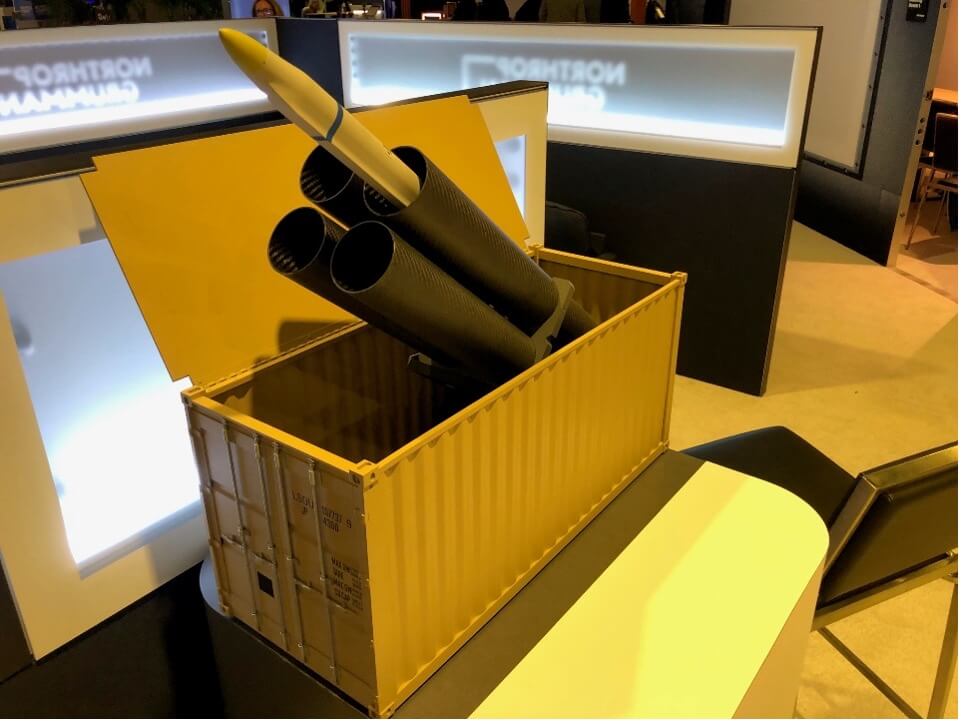
Model of Northrop Grumman ARES system. BWK photo.
As the photo shows, it’s four missiles in cannister launchers, all designed to fit into a 20-foot container. And here’s a photo of the full-size missile (a mockup, of course).
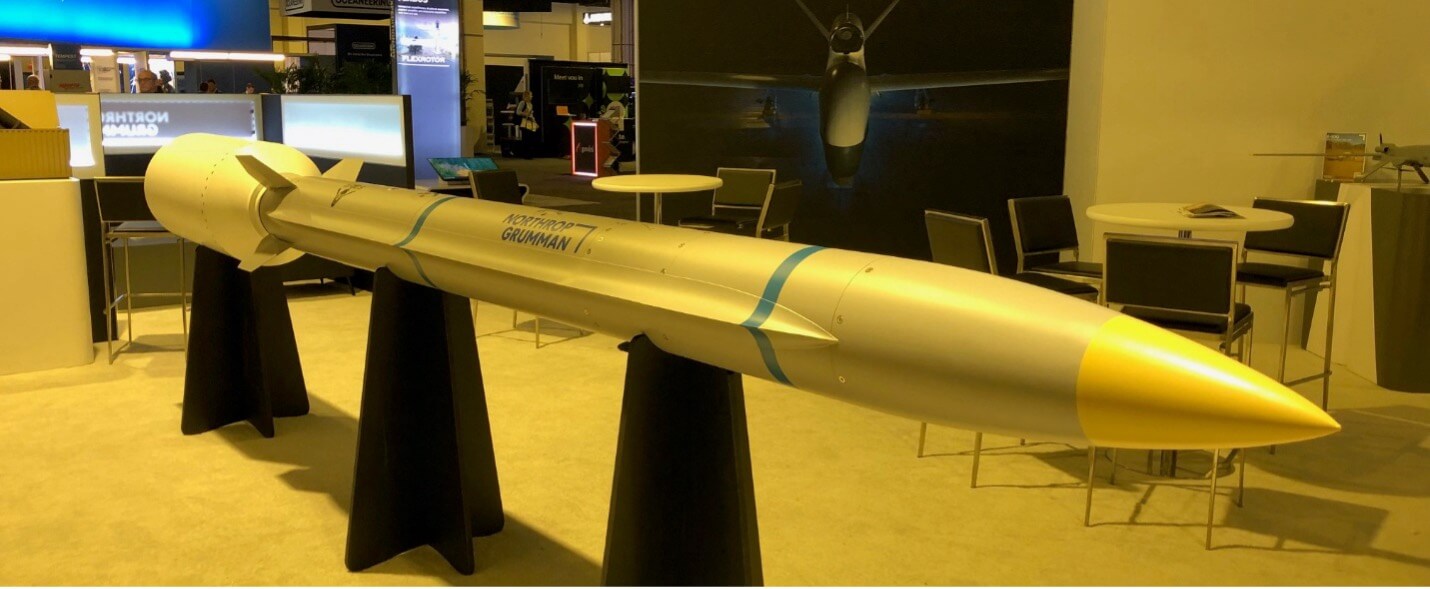
ARES Missile by Northrop Grumman. BWK photo.
And where will these containers go? Quite literally, almost anywhere. You can put them on the deck of a large ship, medium size, or even a small vessel not much different than a service boat that hauls cargo out to, say, an offshore oil rig. Here’s one example, a model of modular capability from Leidos Holdings (LDOS):
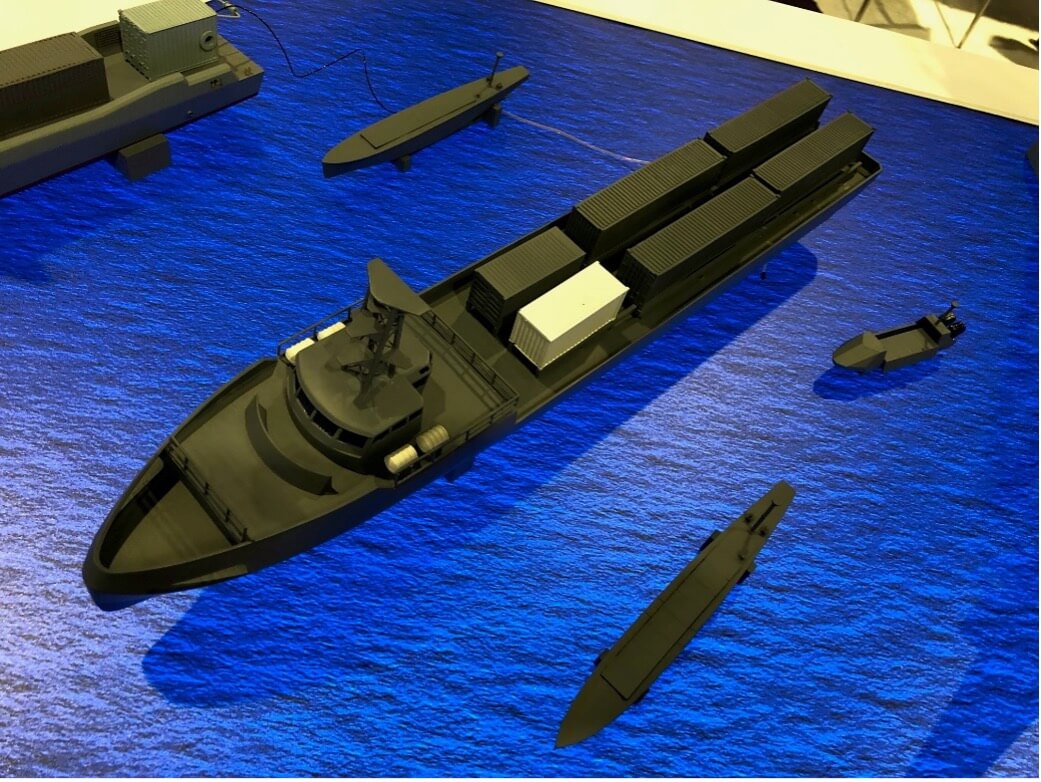
Model small ship to carry containerized ordnance. BWK photo.
And I should add that I’m showing photos of models because at a show like this, it’s impossible to bring real ships and airplanes, etc. into the exhibit hall. But the models represent either what’s already out there, our could be out there on certain timelines.
Here’s another example, a Burke-class destroyer, tied up to something that resembles a deepwater drilling rig platform, except without the drilling derrick topside.
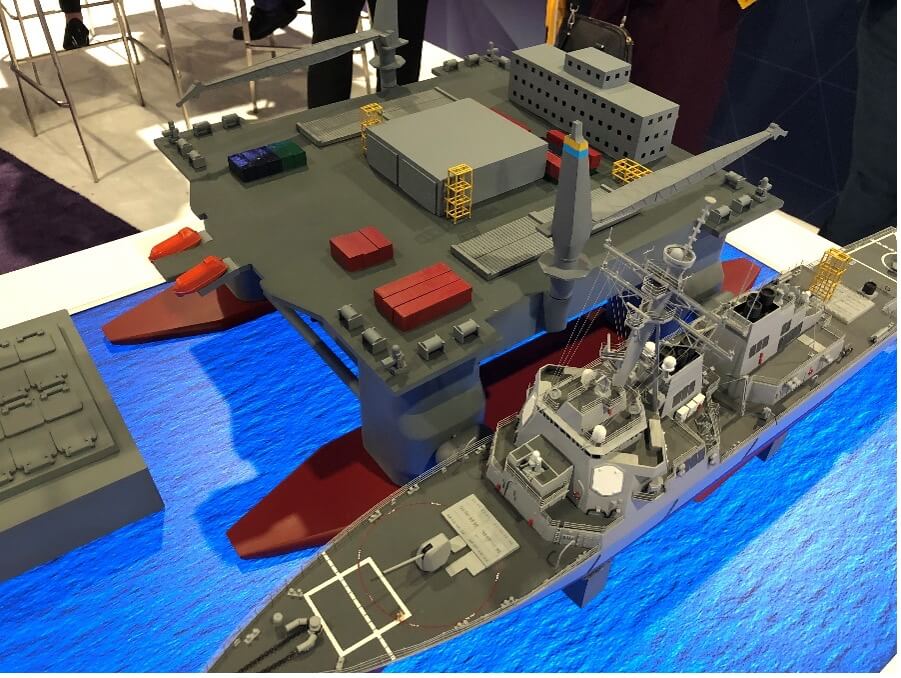
Model of offshore naval service platform. BWK photo.
What’s going on? It’s a notional idea from the venerable naval architecture firm of Gibbs & Cox — subsidiary of above-mentioned Leidos Holdings (LDOS) – which has been designing Navy ships since the mid -1930s.
The idea is to take what are (for now) relatively low-cost and available drilling rig hulls, strip them down and rebuild as naval assets. For what? Well, use your imagination: Floating fuel storage. Munitions reload. Submarine and destroyer tenders. Stable helicopter bases for oceanic domain control. Or many other ideas, but the point is to create naval and maritime assets in the short- to medium-term, using what’s already out there.
Or as a retired admiral said, who now works for Oceaneering International (OII), “There’s a deep locker of technology in industry, already invented and deployed. It works, and it’s in production. And the challenge is to adapt it for military use and stitch it all together.”
Wrap-Up
I’ll end here and just say that military procurement is changing fast, as are the requirements for what gets delivered. And there’s a new sense of cooperation between members of the “tribe.” There’s more understanding of the idea that military power is directly downstream from industry and energy. And not a moment too soon, some might say.
All in all, this is how nations win wars, and along the way it’s very investable. So, that’s all for now.
Thank you for subscribing and reading.

Comments: