

Climbing the Mt. Everest of Worry
The S&P 500 just reached a fresh all-time high.
In the middle of an energy crisis, two wars, an emerging credit crisis, and while deficits are screaming higher.
Stocks are famous for “climbing the wall of worry”. But this seems more like scaling Mount Everest in sweatpants and a hoodie.
The current optimism is based around a widespread perception that the war is over. Even if this were true, the damage already done is significant.
Yes, the ceasefire with Iran is holding. And it will hopefully be extended before its April 20th expiration.
In other positive news, President Trump announced that Israel has agreed to a 10-day ceasefire with Lebanon (home to Hezbollah).

Source: Truth Social
This is a positive signal. But achieving lasting peace between Israel and Hezbollah will be a major challenge.
Still, the ceasefire with Lebanon was one of Iran’s key sticking points. So we’ll have to see if this leads to progress toward opening the Strait of Hormuz.
A Deal Could Be 6 Months Out
The ceasefires are real progress. But they are fragile, and may only be temporary.
Importantly, the Strait of Hormuz remains closed. Even more closed than it was, with the U.S. blockade now preventing Iranian cargoes from leaving the Gulf.
The key to a lasting resolution remains a deal.
But according to reporting by Bloomberg, the negotiations could take 6 months:
“Some Gulf Arab and European leaders believe that a US-Iran peace deal will take about six months to be agreed and that the warring sides should extend their ceasefire to cover that timeframe, according to officials from the regions familiar with the matter.”
I agree, finding a lasting deal is going to take at least that long.
Naturally, we hope that the Strait will re-open before then. But this is Iran’s primary leverage point. They won’t give it up easily.
Meanwhile, the White House just highlighted a statement by Secretary of War Pete Hegseth, stating that, “This military operation is dictated by our terms”.

President Trump seems to believe that Iran can be pressured into quickly re-opening the Strait and making a deal. Let’s hope it works.
A Return to Wartime Production Mode?
In other news, the Pentagon has approached Ford and GM about converting some of their factories to produce weapons for the military. WSJ:
“The Trump administration wants automakers and other American manufacturers to play a larger role in weapons production, reminiscent of a practice used during World War II.
…The Pentagon is interested in enlisting the companies to use their personnel and factory capacity to increase production of munitions and other equipment as the wars in Ukraine and Iran deplete stocks.”
Of course, we do need to replenish weapons used in Ukraine and the Middle East. Many key systems, such as HIMARS and cruise missiles, are backlogged and allies have been waiting for years.
But the urgency of converting existing factories may indicate that these weapons will be needed soon.
Last night the Washington Post reported that another 10,000 American soldiers are on their way to the Middle East, along with the George H. W. Bush aircraft carrier strike group.
Additional U.S. missiles, bombs, and military aircraft are also being flown and shipped in from around the world.
Iran is busy repairing its underground “missile cities”, which were hit hard by U.S. and Israeli bunker-busting bombs. The country is also taking advantage of the ceasefire to repair bridges, power plants, energy infrastructure, and shift military equipment around.
Make no mistake. This war could resume at any time. And the market continues to ignore this possibility.
Portfolio Prepping
I’m still holding a few long-dated puts, but these remain a very small portion of my portfolio. The best hedge to own in this situation is still select oil stocks. Companies not affected by Middle East chaos.
Gold and silver have rebounded nicely, and miners have followed. I’m still concerned about the short-term outlook for miners, until we see the Strait of Hormuz open back up.
As long as oil prices stay elevated, it will be a weight on miners’ backs. But the bull case remains strong. And whenever this energy crisis is resolved, I expect miners to resume their extreme outperformance. So for long-term holders, staying put is the best option. That’s what I’m doing.
It makes sense to continue holding a higher than normal cash position here. While the average investor is rushing back into tech, a more cautious approach is warranted.
Ridiculously Expensive
U.S. stocks are considerably more expensive today than during the 2000 dotcom bubble peak. That’s according to a number of measures, including dividend yield, price/sales, and my favorite – the Buffett Indicator.
The Buffett Indicator compares US stock values to GDP. It is Warren Buffett’s favorite measure of how expensive stocks are. Here’s a long-term chart:
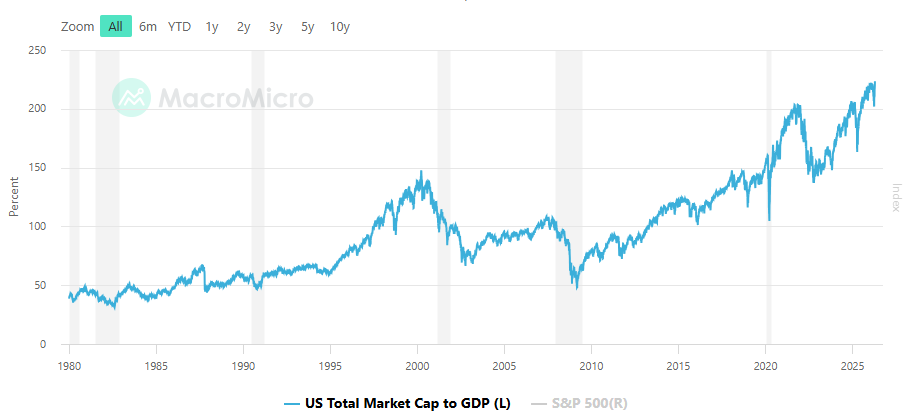
As you can see, during the dotcom bubble the Buffett Indicator peaked 137%. We didn’t surpass that level until the COVID market craziness.
Today we’re sitting at a shocking 223%!
So American stocks are worth 223% of GDP. That is… historically bubbly. This is why Warren Buffett is sitting on $373 billion worth of cash, more than a third of Berkshire Hathaway’s assets.
So the fact that people are rushing to buy U.S. stocks, in the middle of all this chaos, is a little crazy.
Our strategy of owning hard assets and emerging markets is working, and should continue to outperform the S&P 500 and Nasdaq going forward. If we get a broad selloff, it’ll go down less. And the upside remains better than expensive U.S. indexes.
My advice: don’t get caught up in the excitement and buy overpriced stocks.
More soon.

Comments: