

Uh-Oh, Silver!
One year ago, silver was trading at around $36 per ounce.
Today the price is around $66. Normally, that’d be considered a win.
But over those 12 months, we silver bugs have been on a wild ride.
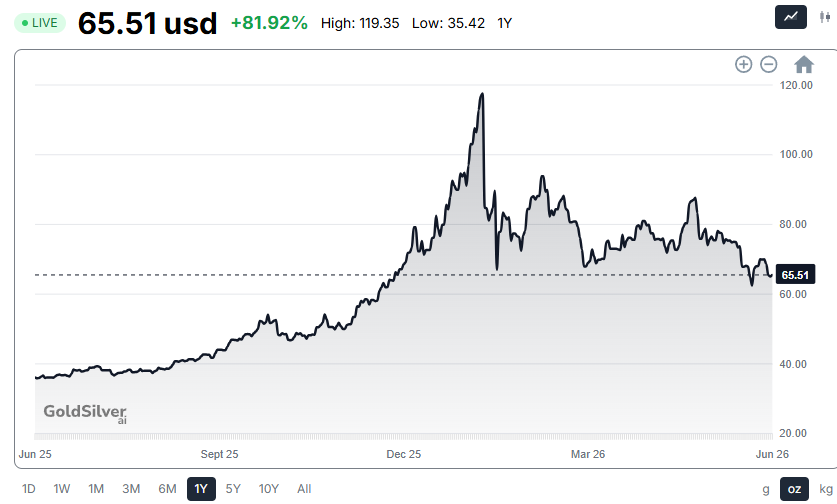
Simply incredible price action. From $36 to $119 in about 8 months. And now back down to $66.
I believe the silver bull market still has years to run. Maybe even another decade. Today, let’s explore why.
+$16 Since 1980?
Silver first reached $50 way back in 1980.
Of course, silver’s miraculous 1971-1980 run wasn’t totally natural. The famous Hunt brothers had cornered a big chunk of the silver market, controlling roughly 9% of investable silver through physical ownership and futures contracts.
But silver would have done well during the 1970s even without the Hunt Brothers. That year inflation peaked at around 14.8%.
Investors sought refuge from stagflation in precious metals. And gold and silver were the star sector of the 1970s.
It’s wild that silver is still only $16 above the 1980 peak.
This Isn’t 1980
1980 represented a peak for gold and silver that would last decades.
Some precious metal investors may be concerned that we’re seeing a similar peak today.
But what caused the 1980 peak? Two factors dominated.
In 1971, Nixon ended the last remnants of the gold standard. The U.S. dollar was no longer bound by a fixed relationship to gold.
The 1970s gold and silver bull market was primarily driven by this massive shift to purely fiat money. It was a classic devaluation of hard money into fiat.
By 1980, the Petrodollar arrangement, in which oil producers agreed to only sell oil in dollars, had restored demand for U.S. dollars on the global stage.
Additionally, Fed Chairman Paul Volcker finally resolved to kill persistent inflation by hiking interest rates to nearly 20%. These sky-high rates finally tamed inflation.
By 1980, the U.S. had eliminated the inflationary threat, and set itself up for a period of strong growth.
In 1980, stocks were dirt cheap and poised to outperform precious metals for some time to come.
A Different World
Looking back at the 1970s can be helpful at times. It was one of the greatest hard asset bull markets in history.
But it was a different kind of crisis compared to the issues we face today.
For decades the world has been on an unprecedented debt binge. Governments, corporations, and individuals have all run up huge tabs.
The U.S. debt-to-GDP ratio today is over 125%. From 1970-1980, it never surpassed 40%.
Having so much debt limits the policy options of central banks like the Federal Reserve. You can’t exactly jack rates up much higher than they are today, or soon we’ll be spending a majority of tax revenue just paying the interest on our debt. Much of the world is in a similar situation.
So I continue to believe that eventually the Fed and Treasury Department will be forced to use extreme measures. Money printing and debt monetization on a scale never seen before.
That’s a primary reason I believe the precious metals bull isn’t over. Not even close.
Finding Its New Range
Silver has fallen significantly from its 2026 highs. But the long-term trend remains up.
Silver only broke through the historic $50/oz resistance wall late last year.
Breaking the $50 level, and staying above it, was a huge milestone. And silver continues to find its new range.
Silver demand remains strong, with 2026 deficits estimated to be significantly above the 2025 shortfall.
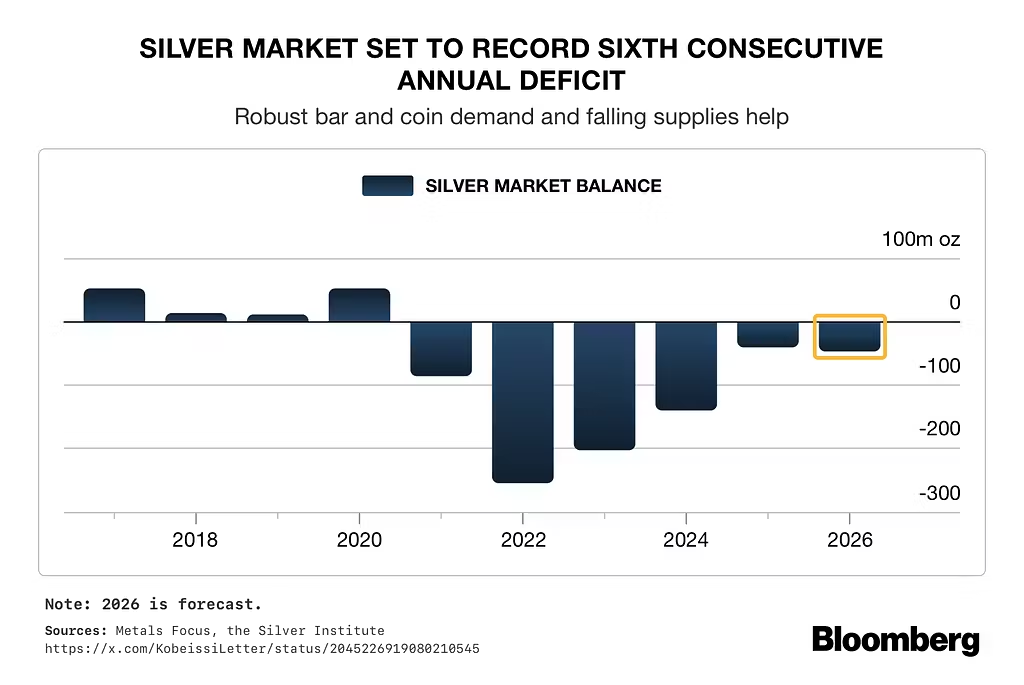
Silver being in “deficit” simply means that more is being consumed than produced. And as you can tell, we’ve been in a serious silver deficit since 2021.
Now, it’s important to note that earlier estimates had predicted a significantly smaller silver deficit in 2026. But strong demand for coins and bars, especially in Asia, made the difference.
Inventories at major exchanges like the COMEX have fallen below 100 million ounces, from a high of 300 million in 2020.
Industrial and investment demand for silver remain strong. I expect both to stay robust for years to come.
Silver production from mines remains essentially flat. Recycling is up, which is one of the reasons for this correction. Millions took advantage of the price spike to sell the family silver.
But the global debt bubble is still inflating. Massive amounts of money will need to be printed to patch holes in it.
So I’m holding. Silver is destined to hit $200 within the next few years. We’ve never had this much industrial demand, and savvy investors will buy the dip. I even expect that more global governments will begin stockpiling the metal, as both the U.S. and China have recognized silver as a critical strategic metal.
Silver remains an excellent way to hedge against inflation. It’s also a critical metal for bleeding-edge tech.
“Poor man’s gold” will remain highly volatile, but as long as you can stomach that, I say buy the dip. Cautious investors may want to consider spreading their buys out over time (dollar-cost averaging), in case we haven’t bottomed quite yet.

Comments: